

Doughnuts, cake-type, plain, chocolate-coated or frosted
Whole food · Baked Products
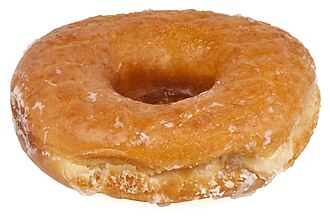
Photo: Wikipedia
A dense, moist cake-like doughnut, often ring-shaped or filled, with a tender crumb and a rich, sweet coating of chocolate or frosting. Its nutrition profile is dominated by quick-release carbohydrates and fats, providing a substantial energy boost. A 100g serving packs over 450 calories, with sugar and fat making up the majority of the energy content.
Calorie split: 4% protein · 45% carbs · 50% fat
↓ Full nutrition💚 Why it's loved
People adore the satisfying contrast between the soft, cakey interior and the smooth, sweet chocolate or frosting coating. It's a beloved staple of coffee breaks, celebrations, and nostalgic comfort food across many cultures.
⚠️ Watch-outs & how to enjoy it better
The high sugar and refined carb content can lead to rapid blood sugar spikes followed by a crash, and the calorie density requires mindful portion control. Those monitoring blood sugar or managing weight should enjoy it occasionally and consider pairing it with a source of protein (like Greek yogurt) or fiber (like a piece of fruit) to slow digestion.
Key benefits
- Provides a quick source of energy from carbohydrates.
- Can be a morale-boosting comfort food or celebratory treat.
- Often fortified with small amounts of iron and B vitamins.
- Offers dietary variety as part of an occasional indulgence.
🍽️ Popular dishes






🌍 Where it's eaten
💡 Did you know?
The 'cake' doughnut is leavened with baking powder or baking soda, not yeast, making it quicker to prepare and giving it its characteristic dense, muffin-like texture compared to airy yeast doughnuts.
Full nutrition (USDA data · scales with serving)
| Water | 16.8 g |
| Energy | 452 kcal |
| Energy | 1892 kj |
| Protein | 4.9 g |
| Total lipid (fat) | 25.3 g |
| Ash | 1.7 g |
| Carbohydrate, by difference | 51.3 g |
| Fiber, total dietary | 1.9 g |
| Total Sugars | 26.6 g |
| Calcium, Ca | 24.0 mg |
| Iron, Fe | 4.0 mg |
| Magnesium, Mg | 30.0 mg |
| Phosphorus, P | 210 mg |
| Potassium, K | 201 mg |
| Sodium, Na | 326 mg |
| Zinc, Zn | 0.98 mg |
| Copper, Cu | 0.26 mg |
| Manganese, Mn | 0.64 mg |
| Selenium, Se | 6.8 ug |
| Vitamin C, total ascorbic acid | 1.3 mg |
| Thiamin | 0.16 mg |
| Riboflavin | 0.13 mg |
| Niacin | 1.6 mg |
| Pantothenic acid | 0.13 mg |
| Vitamin B-6 | 0.02 mg |
| Folate, total | 65.0 ug |
| Folic acid | 37.0 ug |
| Folate, food | 28.0 ug |
| Folate, DFE | 90.0 ug |
| Choline, total | 29.1 mg |
| Vitamin B-12 | 0.10 ug |
| Vitamin B-12, added | 0.00 ug |
| Vitamin A, RAE | 4.0 ug |
| Retinol | 3.0 ug |
| Carotene, beta | 2.0 ug |
| Carotene, alpha | 1.0 ug |
| Cryptoxanthin, beta | 1.0 ug |
| Vitamin A, IU | 16.0 iu |
| Lycopene | 0.00 ug |
| Lutein + zeaxanthin | 24.0 ug |
| Vitamin E (alpha-tocopherol) | 2.0 mg |
| Vitamin E, added | 0.00 mg |
| Vitamin D (D2 + D3), International Units | 0.00 iu |
| Vitamin D (D2 + D3) | 0.00 ug |
| Vitamin K (phylloquinone) | 7.9 ug |
| Alcohol, ethyl | 0.00 g |
| Caffeine | 2.0 mg |
| Theobromine | 53.0 mg |
Fat & fatty acid profile (per 100g)
| Fatty acids, total saturated | 13.5 g |
| SFA 4:0 | 0.00 g |
| SFA 6:0 | 0.03 g |
| SFA 8:0 | 0.38 g |
| SFA 10:0 | 0.29 g |
| SFA 12:0 | 3.7 g |
| SFA 13:0 | 0.00 g |
| SFA 14:0 | 1.4 g |
| SFA 15:0 | 0.03 g |
| SFA 16:0 | 3.7 g |
| SFA 17:0 | 0.10 g |
| SFA 18:0 | 3.8 g |
| SFA 20:0 | 0.08 g |
| SFA 22:0 | 0.03 g |
| SFA 24:0 | 0.00 g |
| Fatty acids, total monounsaturated | 8.6 g |
| MUFA 14:1 | 0.05 g |
| MUFA 15:1 | 0.00 g |
| MUFA 16:1 | 0.16 g |
| MUFA 17:1 | 0.05 g |
| MUFA 18:1 | 8.4 g |
| MUFA 18:1 c | 8.4 g |
| MUFA 20:1 | 0.00 g |
| MUFA 22:1 | 0.00 g |
| MUFA 24:1 c | 0.00 g |
| Fatty acids, total polyunsaturated | 2.0 g |
| PUFA 18:2 | 1.8 g |
| PUFA 18:3 | 0.17 g |
| PUFA 18:3 n-3 c,c,c (ALA) | 0.17 g |
| PUFA 18:3 n-6 c,c,c | 0.00 g |
| PUFA 18:4 | 0.00 g |
| PUFA 20:2 n-6 c,c | 0.00 g |
| PUFA 20:3 | 0.00 g |
| PUFA 20:4 | 0.00 g |
| PUFA 20:5 n-3 (EPA) | 0.00 g |
| PUFA 22:5 n-3 (DPA) | 0.00 g |
| PUFA 22:6 n-3 (DHA) | 0.00 g |
| TFA 18:1 t | 0.00 g |
| Cholesterol | 19.0 mg |
Amino acid profile (per 100g)
| Tryptophan | 0.06 g |
| Threonine | 0.17 g |
| Isoleucine | 0.21 g |
| Leucine | 0.37 g |
| Lysine | 0.23 g |
| Methionine | 0.08 g |
| Cystine | 0.10 g |
| Phenylalanine | 0.22 g |
| Tyrosine | 0.13 g |
| Valine | 0.24 g |
| Arginine | 0.23 g |
| Histidine | 0.11 g |
| Alanine | 0.18 g |
| Aspartic acid | 0.34 g |
| Glutamic acid | 1.2 g |
| Glycine | 0.17 g |
| Proline | 0.43 g |
| Serine | 0.24 g |
| Hydroxyproline | 0.00 g |
FAQ
Is a cake doughnut healthier than a yeast doughnut?
Not necessarily. While cake doughnuts are denser and may be slightly smaller, both are high in calories, sugar, and fat. The primary difference is texture and leavening method, not a significant nutritional advantage.
Why does the chocolate coating make it higher in calories?
The coating is typically made from a mixture of cocoa, sugar, and fat (like palm kernel oil or butter), which adds a concentrated layer of calories and sugar on top of the already energy-dense doughnut base.
Can I make a lighter version at home?
You can try baking instead of frying, using whole wheat flour for some fiber, and making a thinner glaze with less sugar. However, it will still be a treat, not a health food.
Nutrient density (calculated · NRF9.3)
Nutrient Rich Foods index: beneficial nutrients (protein, fiber, vitamins, minerals) minus saturated fat, added sugar & sodium, per 100 kcal.
NRF9.3 index — Fulgoni, Keast & Drewnowski, 2009. Computed from USDA nutrients.
Weight-loss friendliness (composite index)
Energy density 4.52 kcal/g · 4% calories from protein · 1.9 g fiber · 26.6 g sugar per 100 g.
Composite of energy density (Rolls et al., 1999), protein & fiber satiety, minus sugar. A calculated heuristic — ranks satiety-per-calorie, not a clinical measure.
Dietary load (calculated from USDA values)
Potential renal acid load. Positive = acid-forming, negative = alkaline-forming.
Sodium-to-potassium ratio: 1.62 (lower is better — aim for ≤ 1)
Sodium:potassium per WHO potassium guidance. Computed from USDA nutrients.