

Crackers, cheese, sandwich-type with cheese filling
Whole food · Baked Products

Photo: Wikipedia
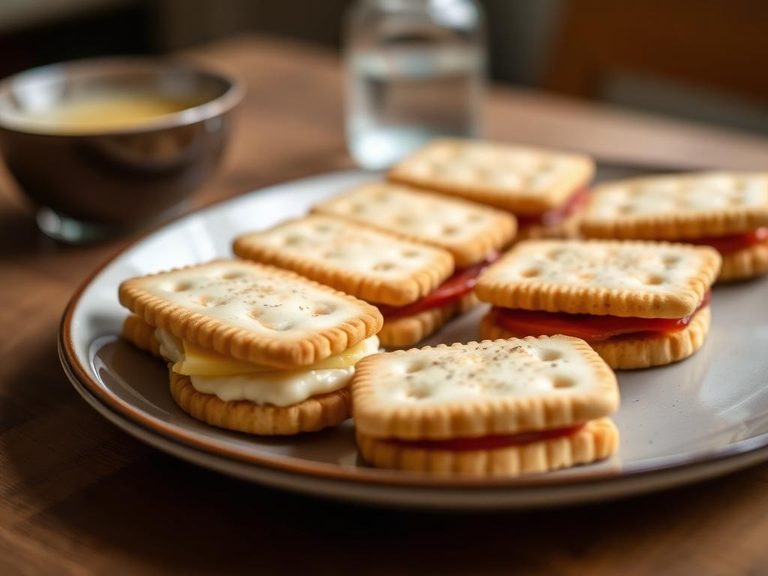
These are crisp, savory sandwich crackers where two golden, often buttery or whole-grain wafers encase a smooth, creamy cheese filling. The experience is a satisfying crunch followed by a salty, umami-rich paste. Nutritionally, they are a calorie-dense, high-carb snack with a moderate protein boost from the cheese filling.
Calorie split: 7% protein · 48% carbs · 45% fat
↓ Full nutrition💚 Why it's loved
People love them for the perfect textural contrast between the crisp cracker and the smooth, savory filling. They are a nostalgic, no-fuss snack that pairs effortlessly with a cold drink or stands alone as a quick bite.
⚠️ Watch-outs & how to enjoy it better
They can be high in sodium and refined carbohydrates, potentially causing blood-sugar spikes. To counteract this, pair with a source of fiber or protein (like an apple or a handful of nuts) and practice portion control by serving a single sleeve rather than eating from the box.
Key benefits
- Provides a quick, energy-dense calorie source.
- Offers a modest amount of protein from the cheese filling.
- Convenient, shelf-stable, and portable for on-the-go snacking.
- The savory flavor can satisfy cravings for salty, crunchy foods.
🍽️ Popular dishes

🌍 Where it's eaten
💡 Did you know?
The iconic Ritz Bits Cheese Sandwiches, a popular version of this snack, were first introduced by Nabisco in 1984.
Full nutrition (USDA data · scales with serving)
| Water | 4.8 g |
| Energy | 490 kcal |
| Energy | 2052 kj |
| Protein | 8.9 g |
| Total lipid (fat) | 24.4 g |
| Ash | 3.1 g |
| Carbohydrate, by difference | 58.8 g |
| Fiber, total dietary | 1.9 g |
| Total Sugars | 12.3 g |
| Sucrose | 3.1 g |
| Glucose | 0.00 g |
| Fructose | 0.00 g |
| Lactose | 7.7 g |
| Maltose | 1.5 g |
| Galactose | 0.00 g |
| Starch | 44.5 g |
| Calcium, Ca | 89.0 mg |
| Iron, Fe | 2.1 mg |
| Magnesium, Mg | 28.0 mg |
| Phosphorus, P | 288 mg |
| Potassium, K | 295 mg |
| Sodium, Na | 878 mg |
| Zinc, Zn | 0.57 mg |
| Copper, Cu | 0.24 mg |
| Manganese, Mn | 0.50 mg |
| Selenium, Se | 10.0 ug |
| Vitamin C, total ascorbic acid | 2.6 mg |
| Thiamin | 0.51 mg |
| Riboflavin | 0.46 mg |
| Niacin | 3.5 mg |
| Pantothenic acid | 0.85 mg |
| Vitamin B-6 | 0.11 mg |
| Folate, total | 82.0 ug |
| Folic acid | 66.0 ug |
| Folate, food | 16.0 ug |
| Folate, DFE | 128 ug |
| Choline, total | 27.5 mg |
| Vitamin B-12 | 0.80 ug |
| Vitamin A, RAE | 11.0 ug |
| Retinol | 11.0 ug |
| Carotene, beta | 2.0 ug |
| Carotene, alpha | 0.00 ug |
| Cryptoxanthin, beta | 0.00 ug |
| Vitamin A, IU | 39.0 iu |
| Lycopene | 0.00 ug |
| Lutein + zeaxanthin | 9.0 ug |
| Vitamin E (alpha-tocopherol) | 2.0 mg |
| Tocopherol, beta | 0.14 mg |
| Tocopherol, gamma | 10.0 mg |
| Tocopherol, delta | 2.6 mg |
| Tocotrienol, alpha | 0.00 mg |
| Tocotrienol, beta | 0.00 mg |
| Tocotrienol, gamma | 0.00 mg |
| Tocotrienol, delta | 0.00 mg |
| Vitamin K (phylloquinone) | 20.5 ug |
| Vitamin K (Dihydrophylloquinone) | 64.3 ug |
| Alcohol, ethyl | 0.00 g |
| Caffeine | 0.00 mg |
| Theobromine | 0.00 mg |
Fat & fatty acid profile (per 100g)
| Fatty acids, total saturated | 4.8 g |
| SFA 4:0 | 0.00 g |
| SFA 6:0 | 0.00 g |
| SFA 8:0 | 0.00 g |
| SFA 10:0 | 0.00 g |
| SFA 12:0 | 0.00 g |
| SFA 14:0 | 0.20 g |
| SFA 15:0 | 0.00 g |
| SFA 16:0 | 2.7 g |
| SFA 17:0 | 0.00 g |
| SFA 18:0 | 1.8 g |
| SFA 20:0 | 0.12 g |
| SFA 22:0 | 0.00 g |
| SFA 24:0 | 0.00 g |
| Fatty acids, total monounsaturated | 14.3 g |
| MUFA 14:1 | 0.00 g |
| MUFA 16:1 | 0.00 g |
| MUFA 18:1 | 14.2 g |
| MUFA 20:1 | 0.13 g |
| MUFA 22:1 | 0.00 g |
| Fatty acids, total polyunsaturated | 2.3 g |
| PUFA 18:2 | 2.3 g |
| PUFA 18:3 | 0.03 g |
| PUFA 18:4 | 0.00 g |
| PUFA 20:4 | 0.00 g |
| PUFA 20:5 n-3 (EPA) | 0.00 g |
| PUFA 22:5 n-3 (DPA) | 0.00 g |
| PUFA 22:6 n-3 (DHA) | 0.00 g |
| Cholesterol | 6.0 mg |
| Phytosterols | 44.0 mg |
Amino acid profile (per 100g)
| Tryptophan | 0.11 g |
| Threonine | 0.33 g |
| Isoleucine | 0.36 g |
| Leucine | 0.64 g |
| Lysine | 0.39 g |
| Methionine | 0.15 g |
| Cystine | 0.15 g |
| Phenylalanine | 0.35 g |
| Tyrosine | 0.25 g |
| Valine | 0.38 g |
| Arginine | 0.29 g |
| Histidine | 0.17 g |
| Alanine | 0.30 g |
| Aspartic acid | 0.52 g |
| Glutamic acid | 2.2 g |
| Glycine | 0.24 g |
| Proline | 0.77 g |
| Serine | 0.40 g |
FAQ
Are cheese sandwich crackers a good source of calcium?
While they contain cheese filling, the amount per serving is typically small. They are not considered a significant dietary source of calcium compared to dairy products like milk or yogurt.
Why are they so high in calories for their size?
Their calorie density comes from being low in water and high in fats (from oil and cheese) and refined carbohydrates, which pack a lot of energy into a small, dry volume.
Can I use them in cooking?
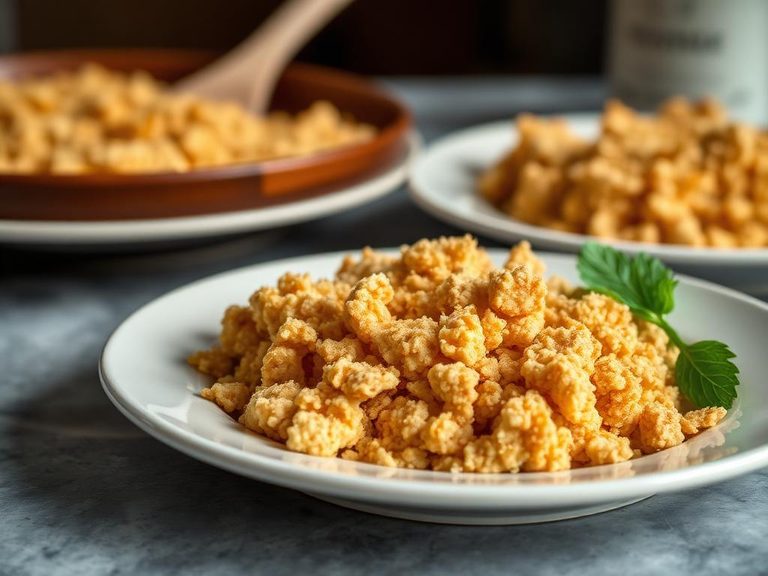
Yes! They are excellent crushed as a topping for macaroni and cheese, casseroles, or baked fish, adding a cheesy, crunchy crust.
Nutrient density (calculated · NRF9.3)
Nutrient Rich Foods index: beneficial nutrients (protein, fiber, vitamins, minerals) minus saturated fat, added sugar & sodium, per 100 kcal.
NRF9.3 index — Fulgoni, Keast & Drewnowski, 2009. Computed from USDA nutrients.
Weight-loss friendliness (composite index)
Energy density 4.90 kcal/g · 7% calories from protein · 1.9 g fiber · 12.3 g sugar per 100 g.
Composite of energy density (Rolls et al., 1999), protein & fiber satiety, minus sugar. A calculated heuristic — ranks satiety-per-calorie, not a clinical measure.
Dietary load (calculated from USDA values)
Potential renal acid load. Positive = acid-forming, negative = alkaline-forming.
Sodium-to-potassium ratio: 2.98 (lower is better — aim for ≤ 1)
Sodium:potassium per WHO potassium guidance. Computed from USDA nutrients.