

POPEYES, Mild Chicken Strips, analyzed 2006
Whole food · Fast Foods

Photo: Wikipedia
Popeyes Mild Chicken Strips are tender, juicy pieces of chicken breast, hand-battered and fried to a golden, crispy finish. The mild seasoning delivers a savory, slightly peppery flavor without the heat of their spicy counterpart, making the satisfying crunch of the batter the star. Nutritionally, they are a dense source of protein (19.2g per 100g) but also carry a significant fat and carbohydrate load from the frying process.
Calorie split: 28% protein · 28% carbs · 43% fat
↓ Full nutrition💚 Why it's loved
People adore the perfect contrast between the shatteringly crisp, well-seasoned coating and the juicy, tender chicken inside. It's a beloved comfort food that's seen as a satisfying treat, often paired with classic sides like biscuits and coleslaw.
⚠️ Watch-outs & how to enjoy it better
The frying process results in high levels of saturated fat and sodium, which can be concerning for heart health and blood pressure management. The refined carbohydrates in the batter can also cause a rapid blood-sugar spike. To counteract this, pair the strips with a fiber-rich side like green beans or a fresh salad to slow digestion, practice strict portion control (e.g., 2-3 strips), and opt for a grilled chicken alternative if available.
Key benefits
- High-quality protein source for muscle maintenance
- Provides quick, dense energy from carbohydrates and fats
- A convenient, ready-to-eat meal or snack option
- Mild flavor profile appeals to a wide range of palates
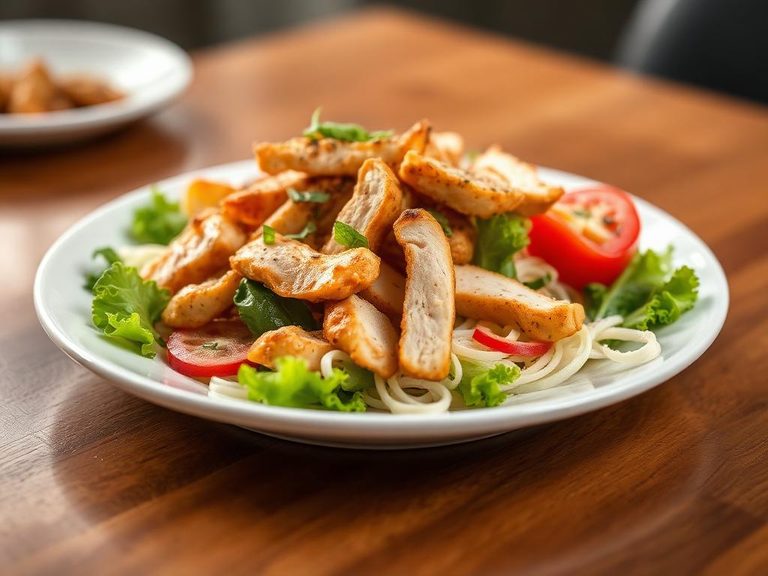
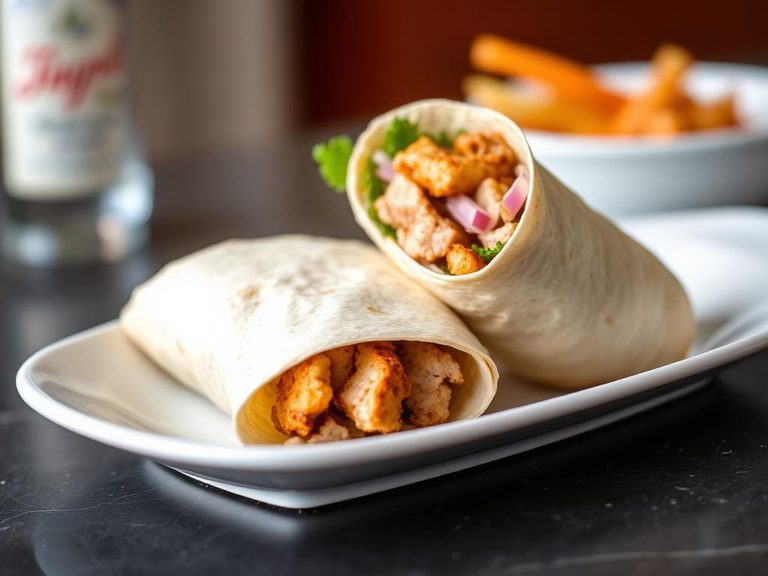
🍽️ Popular dishes



🌍 Where it's eaten
💡 Did you know?
The 'mild' in Popeyes Mild Chicken doesn't just refer to heat; the seasoning blend is a closely guarded secret, but it notably excludes the cayenne pepper that defines their 'spicy' version, focusing instead on a savory, garlicky profile.
Full nutrition (USDA data · scales with serving)
| Water | 45.2 g |
| Energy | 271 kcal |
| Energy | 1135 kj |
| Protein | 19.2 g |
| Total lipid (fat) | 13.0 g |
| Ash | 3.3 g |
| Carbohydrate, by difference | 19.3 g |
| Fiber, total dietary | 0.80 g |
| Total Sugars | 0.00 g |
| Sucrose | 0.00 g |
| Glucose | 0.00 g |
| Fructose | 0.00 g |
| Lactose | 0.00 g |
| Maltose | 0.00 g |
| Galactose | 0.00 g |
| Starch | 18.1 g |
| Calcium, Ca | 12.0 mg |
| Iron, Fe | 0.91 mg |
| Magnesium, Mg | 26.0 mg |
| Phosphorus, P | 265 mg |
| Potassium, K | 269 mg |
| Sodium, Na | 922 mg |
| Zinc, Zn | 0.59 mg |
| Copper, Cu | 0.06 mg |
| Manganese, Mn | 0.21 mg |
| Selenium, Se | 19.7 ug |
| Vitamin C, total ascorbic acid | 0.00 mg |
| Thiamin | 0.12 mg |
| Riboflavin | 0.12 mg |
| Niacin | 8.3 mg |
| Pantothenic acid | 1.1 mg |
| Vitamin B-6 | 0.49 mg |
| Vitamin B-12 | 0.11 ug |
Fat & fatty acid profile (per 100g)
| Fatty acids, total saturated | 5.4 g |
| SFA 4:0 | 0.00 g |
| SFA 6:0 | 0.01 g |
| SFA 8:0 | 0.00 g |
| SFA 10:0 | 0.02 g |
| SFA 12:0 | 0.01 g |
| SFA 14:0 | 0.31 g |
| SFA 15:0 | 0.05 g |
| SFA 16:0 | 3.1 g |
| SFA 17:0 | 0.15 g |
| SFA 18:0 | 1.8 g |
| SFA 20:0 | 0.02 g |
| SFA 22:0 | 0.01 g |
| SFA 24:0 | 0.05 g |
| Fatty acids, total monounsaturated | 6.2 g |
| MUFA 14:1 | 0.09 g |
| MUFA 15:1 | 0.00 g |
| MUFA 16:1 | 0.62 g |
| MUFA 16:1 c | 0.58 g |
| MUFA 17:1 | 0.12 g |
| MUFA 18:1 | 5.3 g |
| MUFA 18:1 c | 4.7 g |
| MUFA 20:1 | 0.09 g |
| MUFA 22:1 | 0.01 g |
| MUFA 22:1 c | 0.01 g |
| MUFA 24:1 c | 0.01 g |
| Fatty acids, total polyunsaturated | 1.3 g |
| PUFA 18:2 | 1.1 g |
| PUFA 18:2 n-6 c,c | 0.94 g |
| PUFA 18:2 CLAs | 0.06 g |
| PUFA 18:3 | 0.01 g |
| PUFA 18:3 n-3 c,c,c (ALA) | 0.01 g |
| PUFA 18:3 n-6 c,c,c | 0.01 g |
| PUFA 18:4 | 0.02 g |
| PUFA 20:2 n-6 c,c | 0.01 g |
| PUFA 20:3 | 0.02 g |
| PUFA 20:3 n-3 | 0.00 g |
| PUFA 20:3 n-6 | 0.02 g |
| PUFA 20:4 | 0.05 g |
| PUFA 20:5 n-3 (EPA) | 0.03 g |
| PUFA 22:4 | 0.01 g |
| PUFA 22:5 n-3 (DPA) | 0.01 g |
| PUFA 22:6 n-3 (DHA) | 0.02 g |
| Fatty acids, total trans | 0.68 g |
| Fatty acids, total trans-monoenoic | 0.59 g |
| TFA 16:1 t | 0.04 g |
| TFA 18:1 t | 0.55 g |
| TFA 22:1 t | 0.00 g |
| TFA 18:2 t not further defined | 0.08 g |
| Fatty acids, total trans-polyenoic | 0.08 g |
| Cholesterol | 52.0 mg |
Amino acid profile (per 100g)
| Tryptophan | 0.23 g |
| Threonine | 0.77 g |
| Isoleucine | 0.82 g |
| Leucine | 1.4 g |
| Lysine | 1.4 g |
| Methionine | 0.46 g |
| Cystine | 0.26 g |
| Phenylalanine | 0.78 g |
| Tyrosine | 0.50 g |
| Valine | 0.87 g |
| Arginine | 1.1 g |
| Histidine | 0.62 g |
| Alanine | 1.0 g |
| Aspartic acid | 1.6 g |
| Glutamic acid | 4.0 g |
| Glycine | 0.79 g |
| Proline | 1.0 g |
| Serine | 0.76 g |
FAQ
How does the mild strip differ nutritionally from the spicy strip?
The core nutritional values (calories, protein, fat, carbs) are nearly identical. The difference is in the seasoning blend; the spicy version contains more sodium and capsaicin from peppers, but this does not significantly alter the macronutrient profile.
Are these strips a good post-workout food?
They provide ample protein for muscle repair, but the high fat and refined carbs from frying make them suboptimal. The fat can slow protein absorption, and the carbs can cause an energy crash. A leaner protein source with complex carbs is generally better for recovery.
What is the main allergen concern?
The primary allergens are wheat (from the flour in the batter) and soy (often present in the frying oil and seasoning). They are also prepared in facilities that handle milk, eggs, and shellfish, posing a cross-contamination risk.
Nutrient density (calculated · NRF9.3)
Nutrient Rich Foods index: beneficial nutrients (protein, fiber, vitamins, minerals) minus saturated fat, added sugar & sodium, per 100 kcal.
NRF9.3 index — Fulgoni, Keast & Drewnowski, 2009. Computed from USDA nutrients.
Weight-loss friendliness (composite index)
Energy density 2.71 kcal/g · 28% calories from protein · 0.8 g fiber · 0.0 g sugar per 100 g.
Composite of energy density (Rolls et al., 1999), protein & fiber satiety, minus sugar. A calculated heuristic — ranks satiety-per-calorie, not a clinical measure.
Dietary load (calculated from USDA values)
Potential renal acid load. Positive = acid-forming, negative = alkaline-forming.
Sodium-to-potassium ratio: 3.43 (lower is better — aim for ≤ 1)
Sodium:potassium per WHO potassium guidance. Computed from USDA nutrients.