

Beef Pot Pie, frozen entree, prepared
Whole food · Meals, Entrees, and Side Dishes

Photo: Wikipedia
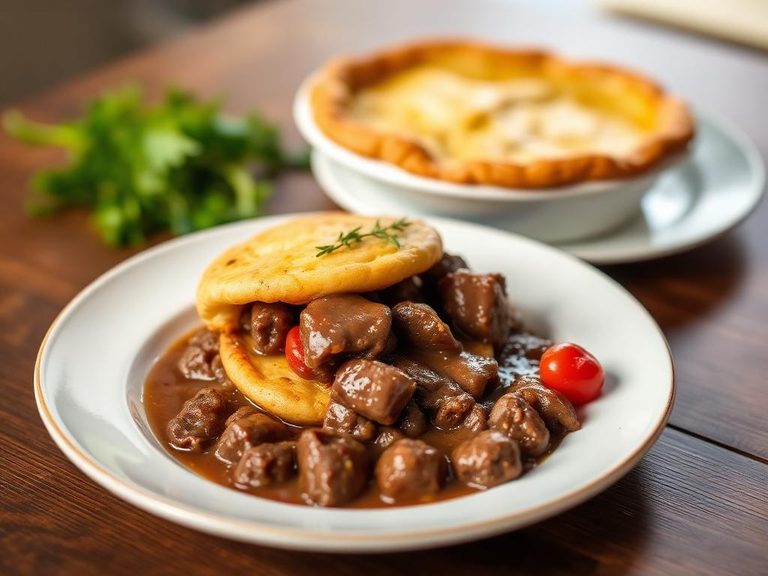
A classic frozen entree featuring a golden, flaky pastry crust encasing a savory filling of tender beef chunks, carrots, and peas in a rich, creamy gravy. The texture is a comforting contrast between the crisp, buttery top and the soft, hearty interior. Nutritionally, it provides a substantial source of protein and fat for satiety, though it is calorie-dense.
Calorie split: 13% protein · 40% carbs · 47% fat
↓ Full nutrition💚 Why it's loved
People love it for its deep, savory umami flavor and the ultimate comfort-food experience of a warm, filling pastry. It's a nostalgic, all-in-one meal that feels like a hug in a bowl.
⚠️ Watch-outs & how to enjoy it better
The high fat, calorie, and often sodium content can be a concern for heart health or weight management. To counteract, pair it with a large, leafy green salad to add volume and fiber, and practice portion control by enjoying a modest serving alongside other vegetables.
Key benefits
- Good source of protein for muscle maintenance
- Provides quick energy from carbohydrates
- Convenient, complete meal with protein, carbs, and fat
- Contains vegetables like carrots and peas for some micronutrients
🍽️ Popular dishes


🌍 Where it's eaten
💡 Did you know?
The 'pot' in pot pie originally referred to the earthenware pot the pie was baked and served in, not the ingredients inside.
Full nutrition (USDA data · scales with serving)
| Water | 58.0 g |
| Energy | 220 kcal |
| Energy | 919 kj |
| Protein | 7.3 g |
| Total lipid (fat) | 11.4 g |
| Ash | 1.3 g |
| Carbohydrate, by difference | 22.1 g |
| Fiber, total dietary | 0.80 g |
| Sucrose | 0.32 g |
| Glucose | 0.77 g |
| Fructose | 0.08 g |
| Lactose | 0.00 g |
| Maltose | 1.7 g |
| Starch | 14.1 g |
| Calcium, Ca | 14.0 mg |
| Iron, Fe | 1.3 mg |
| Magnesium, Mg | 13.0 mg |
| Phosphorus, P | 67.0 mg |
| Potassium, K | 115 mg |
| Sodium, Na | 365 mg |
| Zinc, Zn | 1.1 mg |
| Copper, Cu | 0.03 mg |
| Manganese, Mn | 0.21 mg |
| Selenium, Se | 5.3 ug |
| Vitamin C, total ascorbic acid | 0.30 mg |
| Thiamin | 0.20 mg |
| Riboflavin | 0.09 mg |
| Niacin | 1.6 mg |
| Pantothenic acid | 0.14 mg |
| Vitamin B-6 | 0.13 mg |
| Folate, total | 18.0 ug |
| Folic acid | 15.0 ug |
| Folate, food | 3.0 ug |
| Folate, DFE | 28.0 ug |
| Choline, total | 19.6 mg |
| Betaine | 14.1 mg |
| Vitamin B-12 | 0.32 ug |
| Vitamin E (alpha-tocopherol) | 0.26 mg |
| Tocopherol, beta | 0.03 mg |
| Tocopherol, gamma | 0.71 mg |
| Tocopherol, delta | 0.13 mg |
| Tocotrienol, alpha | 0.02 mg |
| Tocotrienol, beta | 0.00 mg |
| Tocotrienol, gamma | 0.00 mg |
| Tocotrienol, delta | 0.00 mg |
| Vitamin K (phylloquinone) | 2.7 ug |
| Vitamin K (Dihydrophylloquinone) | 3.3 ug |
| Vitamin K (Menaquinone-4) | 2.2 ug |
Fat & fatty acid profile (per 100g)
| Fatty acids, total saturated | 4.1 g |
| SFA 4:0 | 0.00 g |
| SFA 6:0 | 0.00 g |
| SFA 8:0 | 0.00 g |
| SFA 10:0 | 0.01 g |
| SFA 12:0 | 0.00 g |
| SFA 14:0 | 0.18 g |
| SFA 15:0 | 0.01 g |
| SFA 16:0 | 2.4 g |
| SFA 17:0 | 0.06 g |
| SFA 18:0 | 1.5 g |
| SFA 20:0 | 0.03 g |
| SFA 22:0 | 0.01 g |
| SFA 24:0 | 0.00 g |
| Fatty acids, total monounsaturated | 5.3 g |
| MUFA 14:1 | 0.03 g |
| MUFA 15:1 | 0.00 g |
| MUFA 16:1 | 0.24 g |
| MUFA 17:1 | 0.04 g |
| MUFA 18:1 | 4.9 g |
| MUFA 20:1 | 0.06 g |
| MUFA 22:1 | 0.00 g |
| MUFA 24:1 c | 0.00 g |
| Fatty acids, total polyunsaturated | 1.5 g |
| PUFA 18:2 | 1.3 g |
| PUFA 18:3 | 0.07 g |
| PUFA 18:4 | 0.02 g |
| PUFA 20:2 n-6 c,c | 0.03 g |
| PUFA 20:3 | 0.00 g |
| PUFA 20:4 | 0.01 g |
| PUFA 20:5 n-3 (EPA) | 0.00 g |
| PUFA 21:5 | 0.00 g |
| PUFA 22:4 | 0.00 g |
| PUFA 22:5 n-3 (DPA) | 0.00 g |
| PUFA 22:6 n-3 (DHA) | 0.00 g |
| Cholesterol | 21.0 mg |
Amino acid profile (per 100g)
| Tryptophan | 0.08 g |
| Threonine | 0.27 g |
| Isoleucine | 0.27 g |
| Leucine | 0.52 g |
| Lysine | 0.42 g |
| Methionine | 0.13 g |
| Cystine | 0.11 g |
| Phenylalanine | 0.30 g |
| Tyrosine | 0.20 g |
| Valine | 0.32 g |
| Arginine | 0.40 g |
| Histidine | 0.19 g |
| Alanine | 0.37 g |
| Aspartic acid | 0.54 g |
| Glutamic acid | 1.5 g |
| Glycine | 0.37 g |
| Proline | 0.55 g |
| Serine | 0.29 g |
FAQ
Is beef pot pie a complete meal?
Yes, it is considered a complete meal as it contains protein (beef), carbohydrates (pastry), and fats (gravy/butter), along with some vegetables. However, it may benefit from added fresh vegetables for a more balanced plate.
Why is the pastry crust so important?
The crust is crucial for texture and flavor contrast. It provides a flaky, buttery barrier that keeps the filling moist and adds a satisfying crunch to each bite.
Can I make a healthier version at home?
Absolutely. You can use a whole-wheat pastry crust, leaner cuts of beef, load the filling with extra vegetables like mushrooms and celery, and use a broth-based gravy instead of a cream-based one to reduce calories and fat.
Nutrient density (calculated · NRF9.3)
Nutrient Rich Foods index: beneficial nutrients (protein, fiber, vitamins, minerals) minus saturated fat, added sugar & sodium, per 100 kcal.
NRF9.3 index — Fulgoni, Keast & Drewnowski, 2009. Computed from USDA nutrients.
Weight-loss friendliness (composite index)
Energy density 2.20 kcal/g · 13% calories from protein · 0.8 g fiber · 0.0 g sugar per 100 g.
Composite of energy density (Rolls et al., 1999), protein & fiber satiety, minus sugar. A calculated heuristic — ranks satiety-per-calorie, not a clinical measure.
Dietary load (calculated from USDA values)
Potential renal acid load. Positive = acid-forming, negative = alkaline-forming.
Sodium-to-potassium ratio: 3.17 (lower is better — aim for ≤ 1)
Sodium:potassium per WHO potassium guidance. Computed from USDA nutrients.