

Bacon, turkey, low sodium
Whole food · Sausages and Luncheon Meats

Photo: Wikipedia
Low-sodium turkey bacon is a lean, smoky alternative to traditional pork bacon, made from cured turkey breast. It offers a satisfyingly crisp texture when cooked, though it is generally less fatty and less salty than its pork counterpart. With 253 calories and 13.33g of protein per 100g, it provides a protein-rich option with significantly less sodium than regular bacon.
Calorie split: 21% protein · 8% carbs · 71% fat
↓ Full nutrition💚 Why it's loved
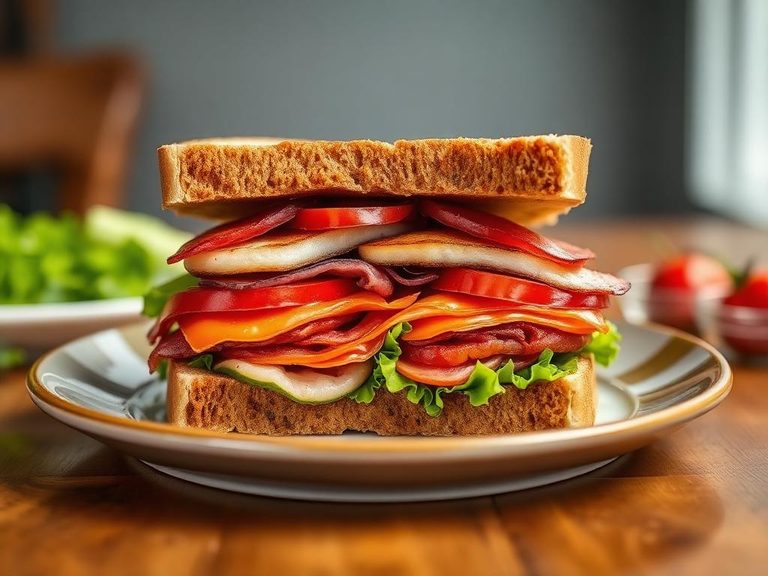
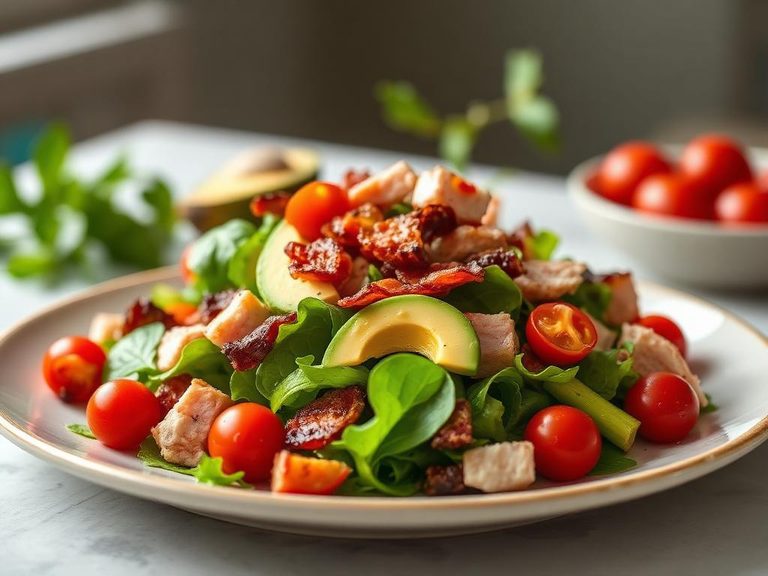
People love it for the familiar smoky, savory bacon flavor with a fraction of the sodium, making it a go-to for health-conscious breakfasts. Its versatility allows it to be crumbled over salads, used in sandwiches, or eaten as a crispy snack, fitting into various cuisines from American breakfasts to modern fusion dishes.
⚠️ Watch-outs & how to enjoy it better
Some find it less flavorful and less crispy than pork bacon due to lower fat content, which can lead to a drier texture if overcooked. To counteract this, cook it slowly over medium heat to render moisture and achieve crispness, and pair it with flavorful sides like avocado or eggs to enhance the overall taste profile.
Key benefits
- Lower in sodium than traditional pork bacon
- Good source of lean protein (13.33g per 100g)
- Lower in fat (20g per 100g) compared to pork bacon
- Versatile for breakfast, salads, and snacks
- Suitable for low-sodium dietary plans
🍽️ Popular dishes

🌍 Where it's eaten
💡 Did you know?
Turkey bacon was popularized in the 1990s as a healthier alternative to pork bacon, but it's technically a processed meat product made from turkey breast that is seasoned and smoked to mimic the taste of traditional bacon.
Full nutrition (USDA data · scales with serving)
| Water | 58.9 g |
| Energy | 253 kcal |
| Energy | 1057 kj |
| Protein | 13.3 g |
| Total lipid (fat) | 20.0 g |
| Ash | 2.9 g |
| Carbohydrate, by difference | 4.8 g |
| Fiber, total dietary | 0.00 g |
| Total Sugars | 0.00 g |
| Calcium, Ca | 10.0 mg |
| Iron, Fe | 0.72 mg |
| Magnesium, Mg | 19.0 mg |
| Phosphorus, P | 145 mg |
| Potassium, K | 156 mg |
| Sodium, Na | 900 mg |
| Zinc, Zn | 1.6 mg |
| Copper, Cu | 0.06 mg |
| Manganese, Mn | 0.01 mg |
| Selenium, Se | 19.4 ug |
| Vitamin C, total ascorbic acid | 24.0 mg |
| Thiamin | 0.03 mg |
| Riboflavin | 0.18 mg |
| Niacin | 6.2 mg |
| Pantothenic acid | 0.62 mg |
| Vitamin B-6 | 0.40 mg |
| Folate, total | 6.0 ug |
| Folic acid | 0.00 ug |
| Folate, food | 6.0 ug |
| Folate, DFE | 6.0 ug |
| Choline, total | 56.9 mg |
| Vitamin B-12 | 0.66 ug |
| Vitamin B-12, added | 0.00 ug |
| Vitamin A, RAE | 8.0 ug |
| Retinol | 8.0 ug |
| Carotene, beta | 0.00 ug |
| Carotene, alpha | 0.00 ug |
| Cryptoxanthin, beta | 0.00 ug |
| Vitamin A, IU | 25.0 iu |
| Lycopene | 0.00 ug |
| Lutein + zeaxanthin | 0.00 ug |
| Vitamin E (alpha-tocopherol) | 2.7 mg |
| Vitamin E, added | 0.00 mg |
| Vitamin D (D2 + D3), International Units | 10.0 iu |
| Vitamin D (D2 + D3) | 0.20 ug |
| Vitamin D3 (cholecalciferol) | 0.20 ug |
| Vitamin K (phylloquinone) | 10.8 ug |
| Alcohol, ethyl | 0.00 g |
| Caffeine | 0.00 mg |
| Theobromine | 0.00 mg |
Fat & fatty acid profile (per 100g)
| Fatty acids, total saturated | 6.7 g |
| SFA 4:0 | 0.00 g |
| SFA 6:0 | 0.00 g |
| SFA 8:0 | 0.00 g |
| SFA 10:0 | 0.01 g |
| SFA 12:0 | 0.04 g |
| SFA 14:0 | 0.13 g |
| SFA 15:0 | 0.02 g |
| SFA 16:0 | 4.2 g |
| SFA 17:0 | 0.04 g |
| SFA 18:0 | 1.8 g |
| SFA 20:0 | 0.27 g |
| SFA 22:0 | 0.14 g |
| SFA 24:0 | 0.00 g |
| Fatty acids, total monounsaturated | 8.6 g |
| MUFA 14:1 | 0.01 g |
| MUFA 15:1 | 0.00 g |
| MUFA 16:1 | 0.15 g |
| MUFA 17:1 | 0.01 g |
| MUFA 18:1 | 8.2 g |
| MUFA 20:1 | 0.17 g |
| MUFA 22:1 | 0.00 g |
| MUFA 24:1 c | 0.00 g |
| Fatty acids, total polyunsaturated | 4.3 g |
| PUFA 18:2 | 3.1 g |
| PUFA 18:3 | 1.1 g |
| PUFA 18:4 | 0.00 g |
| PUFA 20:2 n-6 c,c | 0.01 g |
| PUFA 20:3 | 0.01 g |
| PUFA 20:4 | 0.04 g |
| PUFA 20:5 n-3 (EPA) | 0.00 g |
| PUFA 22:4 | 0.01 g |
| PUFA 22:5 n-3 (DPA) | 0.00 g |
| PUFA 22:6 n-3 (DHA) | 0.00 g |
| Fatty acids, total trans | 0.00 g |
| Cholesterol | 100 mg |
Amino acid profile (per 100g)
| Tryptophan | 0.19 g |
| Threonine | 0.65 g |
| Isoleucine | 0.52 g |
| Leucine | 1.3 g |
| Lysine | 1.5 g |
| Methionine | 0.47 g |
| Cystine | 0.17 g |
| Phenylalanine | 0.59 g |
| Tyrosine | 0.53 g |
| Valine | 0.59 g |
| Arginine | 1.1 g |
| Histidine | 0.49 g |
| Alanine | 1.0 g |
| Aspartic acid | 1.5 g |
| Glutamic acid | 2.5 g |
| Glycine | 0.93 g |
| Proline | 1.1 g |
| Serine | 0.72 g |
FAQ
Is low-sodium turkey bacon healthier than regular bacon?
Yes, it typically contains less sodium and fat than pork bacon, but it is still a processed meat. It's a better option for those monitoring sodium intake, but moderation is key.
How can I make turkey bacon crispy?
Cook it slowly over medium heat in a skillet or bake it in the oven at 400°F (200°C) for 10-15 minutes, flipping occasionally, to achieve a crispy texture without burning.
Can I use turkey bacon in recipes that call for pork bacon?
Yes, it can substitute in most recipes, but note that it may release less fat and have a milder flavor. Adjust cooking times and seasonings as needed.
Nutrient density (calculated · NRF9.3)
Nutrient Rich Foods index: beneficial nutrients (protein, fiber, vitamins, minerals) minus saturated fat, added sugar & sodium, per 100 kcal.
NRF9.3 index — Fulgoni, Keast & Drewnowski, 2009. Computed from USDA nutrients.
Weight-loss friendliness (composite index)
Energy density 2.53 kcal/g · 21% calories from protein · 0.0 g fiber · 0.0 g sugar per 100 g.
Composite of energy density (Rolls et al., 1999), protein & fiber satiety, minus sugar. A calculated heuristic — ranks satiety-per-calorie, not a clinical measure.
Dietary load (calculated from USDA values)
Potential renal acid load. Positive = acid-forming, negative = alkaline-forming.
Sodium-to-potassium ratio: 5.77 (lower is better — aim for ≤ 1)
Sodium:potassium per WHO potassium guidance. Computed from USDA nutrients.