Fish, tuna, yellowfin, fresh, cooked, dry heat
Whole food · Finfish and Shellfish Products
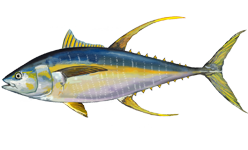
Photo: Wikipedia
Yellowfin tuna, cooked by dry heat, is a lean, meaty fish with a firm, steak-like texture and a clean, mildly sweet ocean flavor. Its most striking feature is its exceptional protein density—nearly 30 grams per 100 calories—making it a powerhouse for muscle repair and satiety.
💚 Why it's loved
People love it for its satisfying, substantial bite and versatile, clean taste that pairs well with bold sauces or stands alone. It's a staple in global cuisines, from Japanese sashimi to Mediterranean grilled steaks, symbolizing both health and culinary sophistication.
⚠️ Watch-outs & how to enjoy it better
As a large predatory fish, it can contain mercury, so pregnant women and young children should limit intake. Its very lean, low-fat nature means it can dry out easily if overcooked. To counteract dryness, marinate briefly or cook quickly at high heat, and pair with a flavorful sauce or healthy fat like avocado or olive oil.
Key benefits
- Excellent source of high-quality, complete protein
- Very low in fat and calories
- Naturally carb-free, suitable for low-carb diets
- Rich in selenium, an important antioxidant mineral
- Good source of B vitamins, especially niacin (B3)
🍽️ Popular dishes
🌍 Where it's eaten
💡 Did you know?
Yellowfin tuna are among the fastest fish in the ocean, capable of swimming at speeds up to 50 mph (80 km/h), which contributes to their firm, muscular flesh.
Full nutrition (scales with serving)
| Water | 69.0 g |
| Energy | 130 kcal |
| Energy | 543 kj |
| Protein | 29.1 g |
| Total lipid (fat) | 0.59 g |
| Ash | 2.0 g |
| Carbohydrate, by difference | 0.00 g |
| Fiber, total dietary | 0.00 g |
| Total Sugars | 0.00 g |
| Calcium, Ca | 4.0 mg |
| Iron, Fe | 0.92 mg |
| Magnesium, Mg | 42.0 mg |
| Phosphorus, P | 333 mg |
| Potassium, K | 527 mg |
| Sodium, Na | 54.0 mg |
| Zinc, Zn | 0.45 mg |
| Copper, Cu | 0.04 mg |
| Manganese, Mn | 0.01 mg |
| Selenium, Se | 108 ug |
| Vitamin C, total ascorbic acid | 0.00 mg |
| Thiamin | 0.13 mg |
| Riboflavin | 0.14 mg |
| Niacin | 22.1 mg |
| Pantothenic acid | 0.33 mg |
| Vitamin B-6 | 1.0 mg |
| Folate, total | 2.0 ug |
| Folic acid | 0.00 ug |
| Folate, food | 2.0 ug |
| Folate, DFE | 2.0 ug |
| Choline, total | 77.6 mg |
| Vitamin B-12 | 2.4 ug |
| Vitamin B-12, added | 0.00 ug |
| Vitamin A, RAE | 22.0 ug |
| Retinol | 22.0 ug |
| Carotene, beta | 0.00 ug |
| Carotene, alpha | 0.00 ug |
| Cryptoxanthin, beta | 0.00 ug |
| Vitamin A, IU | 65.0 iu |
| Lycopene | 0.00 ug |
| Lutein + zeaxanthin | 0.00 ug |
| Vitamin E (alpha-tocopherol) | 0.29 mg |
| Vitamin E, added | 0.00 mg |
| Tocopherol, beta | 0.00 mg |
| Tocopherol, gamma | 0.00 mg |
| Tocopherol, delta | 0.00 mg |
| Tocotrienol, alpha | 0.00 mg |
| Tocotrienol, beta | 0.00 mg |
| Tocotrienol, gamma | 0.00 mg |
| Tocotrienol, delta | 0.00 mg |
| Vitamin D (D2 + D3), International Units | 82.0 iu |
| Vitamin D (D2 + D3) | 2.0 ug |
| Vitamin D3 (cholecalciferol) | 2.0 ug |
| Vitamin K (phylloquinone) | 0.10 ug |
| Alcohol, ethyl | 0.00 g |
| Caffeine | 0.00 mg |
| Theobromine | 0.00 mg |
Fat & fatty acid profile (per 100g)
| Fatty acids, total saturated | 0.20 g |
| SFA 4:0 | 0.00 g |
| SFA 6:0 | 0.00 g |
| SFA 8:0 | 0.00 g |
| SFA 10:0 | 0.00 g |
| SFA 12:0 | 0.00 g |
| SFA 14:0 | 0.01 g |
| SFA 15:0 | 0.00 g |
| SFA 16:0 | 0.13 g |
| SFA 17:0 | 0.01 g |
| SFA 18:0 | 0.05 g |
| SFA 20:0 | 0.00 g |
| SFA 22:0 | 0.00 g |
| SFA 24:0 | 0.00 g |
| Fatty acids, total monounsaturated | 0.14 g |
| MUFA 14:1 | 0.00 g |
| MUFA 15:1 | 0.00 g |
| MUFA 16:1 | 0.01 g |
| MUFA 17:1 | 0.00 g |
| MUFA 18:1 | 0.10 g |
| MUFA 20:1 | 0.01 g |
| MUFA 22:1 | 0.00 g |
| MUFA 24:1 c | 0.01 g |
| Fatty acids, total polyunsaturated | 0.17 g |
| PUFA 18:2 | 0.02 g |
| PUFA 18:3 | 0.00 g |
| PUFA 18:4 | 0.00 g |
| PUFA 20:2 n-6 c,c | 0.00 g |
| PUFA 20:3 | 0.00 g |
| PUFA 20:4 | 0.02 g |
| PUFA 20:5 n-3 (EPA) | 0.01 g |
| PUFA 22:4 | 0.00 g |
| PUFA 22:5 n-3 (DPA) | 0.01 g |
| PUFA 22:6 n-3 (DHA) | 0.10 g |
| Fatty acids, total trans | 0.02 g |
| Cholesterol | 47.0 mg |
Amino acid profile (per 100g)
| Tryptophan | 0.31 g |
| Threonine | 1.2 g |
| Isoleucine | 1.3 g |
| Leucine | 2.3 g |
| Lysine | 2.6 g |
| Methionine | 0.83 g |
| Cystine | 0.30 g |
| Phenylalanine | 1.1 g |
| Tyrosine | 0.94 g |
| Valine | 1.4 g |
| Arginine | 1.7 g |
| Histidine | 0.82 g |
| Alanine | 1.7 g |
| Aspartic acid | 2.9 g |
| Glutamic acid | 4.2 g |
| Glycine | 1.3 g |
| Proline | 0.99 g |
| Serine | 1.1 g |
FAQ
What's the difference between yellowfin and albacore tuna?
Yellowfin (ahi) has a darker, reddish-pink color and a firmer, meatier texture, while albacore is lighter in color and has a milder, softer flavor. Nutritionally, yellowfin is typically leaner.
Is it safe to eat yellowfin tuna every day?
Due to potential mercury content, health authorities recommend varying your seafood choices. For most adults, 2-3 servings per week of lower-mercury fish is a safe guideline. Check local advisories for specific fish.
How do I prevent it from becoming dry and tough?
The key is to not overcook it. For steaks, sear quickly over high heat for just a couple of minutes per side, leaving the center rare to medium-rare. It will continue to cook from residual heat.