

Orange juice, chilled, includes from concentrate, with added calcium
Whole food · Fruits and Fruit Juices
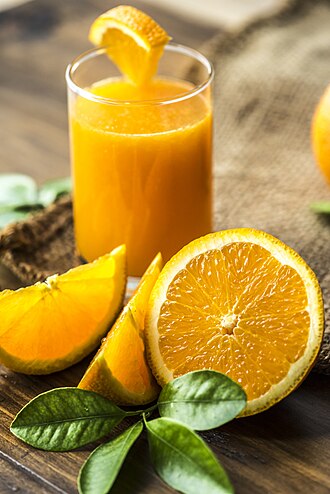
Photo: Wikipedia
A chilled, calcium-fortified beverage made from concentrated orange juice, delivering a bright, sweet-tart flavor with a smooth, refreshing texture. It's a convenient way to get a quick energy boost from its natural sugars, with the added benefit of calcium for bone health. The vibrant orange color and familiar citrus aroma make it a classic breakfast staple.
Calorie split: 6% protein · 92% carbs · 2% fat
↓ Full nutrition💚 Why it's loved
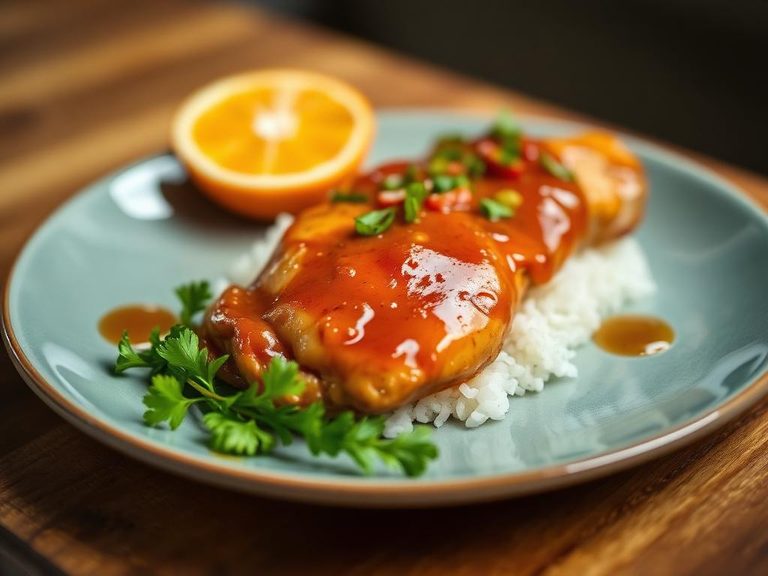
People love it for its perfectly balanced sweet and tangy flavor that instantly wakes up the palate. It's incredibly versatile, serving as a quick breakfast drink, a mixer for cocktails like mimosas, or a base for marinades and dressings.
⚠️ Watch-outs & how to enjoy it better
The high natural sugar content can cause rapid blood-sugar spikes, making it a concern for those managing diabetes or watching calorie intake. To counteract this, pair a small portion (e.g., 120ml) with a source of protein or healthy fat like eggs, nuts, or yogurt to slow sugar absorption. Also, be mindful of added sugars if choosing versions with 'extra pulp' or 'enhanced flavor.'
Key benefits
- Excellent source of Vitamin C for immune support
- Fortified with Calcium for bone and teeth health
- Provides quick, natural energy from fruit sugars
- Hydrating and refreshing, especially chilled
- Contains potassium for fluid balance
🍽️ Popular dishes


🌍 Where it's eaten
💡 Did you know?
The process of making 'from concentrate' juice involves evaporating the water from freshly squeezed juice for easier transport, then adding it back later—a method pioneered by the US military during World War II to supply troops with Vitamin C.
Full nutrition (USDA data · scales with serving)
| Water | 87.2 g |
| Energy | 47.0 kcal |
| Energy | 199 kj |
| Protein | 0.68 g |
| Total lipid (fat) | 0.12 g |
| Ash | 0.71 g |
| Carbohydrate, by difference | 11.3 g |
| Fiber, total dietary | 0.30 g |
| Total Sugars | 8.3 g |
| Sucrose | 4.0 g |
| Glucose | 2.1 g |
| Fructose | 2.2 g |
| Lactose | 0.00 g |
| Maltose | 0.00 g |
| Galactose | 0.00 g |
| Calcium, Ca | 140 mg |
| Iron, Fe | 0.13 mg |
| Magnesium, Mg | 11.0 mg |
| Phosphorus, P | 47.0 mg |
| Potassium, K | 178 mg |
| Sodium, Na | 2.0 mg |
| Zinc, Zn | 0.07 mg |
| Copper, Cu | 0.04 mg |
| Manganese, Mn | 0.02 mg |
| Selenium, Se | 0.10 ug |
| Vitamin C, total ascorbic acid | 33.6 mg |
| Thiamin | 0.05 mg |
| Riboflavin | 0.04 mg |
| Niacin | 0.28 mg |
| Pantothenic acid | 0.20 mg |
| Vitamin B-6 | 0.08 mg |
| Folate, total | 19.0 ug |
| Folic acid | 0.00 ug |
| Folate, food | 19.0 ug |
| Folate, DFE | 19.0 ug |
| Choline, total | 6.2 mg |
| Betaine | 0.20 mg |
| Vitamin B-12 | 0.00 ug |
| Vitamin B-12, added | 0.00 ug |
| Vitamin A, RAE | 2.0 ug |
| Retinol | 0.00 ug |
| Carotene, beta | 8.0 ug |
| Carotene, alpha | 8.0 ug |
| Cryptoxanthin, beta | 27.0 ug |
| Vitamin A, IU | 42.0 iu |
| Lycopene | 0.00 ug |
| Lutein + zeaxanthin | 27.0 ug |
| Vitamin E (alpha-tocopherol) | 0.20 mg |
| Vitamin E, added | 0.00 mg |
| Vitamin D (D2 + D3), International Units | 0.00 iu |
| Vitamin D (D2 + D3) | 0.00 ug |
| Vitamin K (phylloquinone) | 0.00 ug |
| Vitamin K (Dihydrophylloquinone) | 0.00 ug |
| Alcohol, ethyl | 0.00 g |
| Caffeine | 0.00 mg |
| Theobromine | 0.00 mg |
Fat & fatty acid profile (per 100g)
| Fatty acids, total saturated | 0.01 g |
| SFA 4:0 | 0.00 g |
| SFA 6:0 | 0.00 g |
| SFA 8:0 | 0.00 g |
| SFA 10:0 | 0.00 g |
| SFA 12:0 | 0.00 g |
| SFA 14:0 | 0.00 g |
| SFA 16:0 | 0.01 g |
| SFA 18:0 | 0.00 g |
| Fatty acids, total monounsaturated | 0.02 g |
| MUFA 16:1 | 0.00 g |
| MUFA 18:1 | 0.02 g |
| MUFA 20:1 | 0.00 g |
| MUFA 22:1 | 0.00 g |
| Fatty acids, total polyunsaturated | 0.03 g |
| PUFA 18:2 | 0.02 g |
| PUFA 18:3 | 0.01 g |
| PUFA 18:4 | 0.00 g |
| PUFA 20:4 | 0.00 g |
| PUFA 20:5 n-3 (EPA) | 0.00 g |
| PUFA 22:5 n-3 (DPA) | 0.00 g |
| PUFA 22:6 n-3 (DHA) | 0.00 g |
| Fatty acids, total trans | 0.00 g |
| Cholesterol | 0.00 mg |
Amino acid profile (per 100g)
| Tryptophan | 0.00 g |
| Threonine | 0.01 g |
| Isoleucine | 0.00 g |
| Leucine | 0.01 g |
| Lysine | 0.02 g |
| Methionine | 0.00 g |
| Cystine | 0.00 g |
| Phenylalanine | 0.01 g |
| Tyrosine | 0.00 g |
| Valine | 0.01 g |
| Arginine | 0.08 g |
| Histidine | 0.00 g |
| Alanine | 0.02 g |
| Aspartic acid | 0.11 g |
| Glutamic acid | 0.04 g |
| Glycine | 0.01 g |
| Proline | 0.08 g |
| Serine | 0.02 g |
FAQ
How is 'from concentrate' different from 'not from concentrate'?
'From concentrate' juice has water removed at the source for efficient shipping, then reconstituted. 'Not from concentrate' is pasteurized and bottled without this step, often perceived as fresher but with a shorter shelf life before opening.
Why is calcium added to orange juice?
Calcium is added to fortify the juice, making it a significant source of this essential mineral for people who may not consume enough dairy. It's often added as calcium citrate or calcium phosphate, which dissolve well without altering the taste.
Is the sugar in orange juice the same as in soda?
While both are simple sugars, the sugar in 100% orange juice is naturally occurring fructose from the fruit. It comes packaged with vitamins, minerals, and some fiber (if not filtered), unlike the added sugars in soda which provide 'empty calories.' However, the body metabolizes the sugar similarly.
Nutrient density (calculated · NRF9.3)
Nutrient Rich Foods index: beneficial nutrients (protein, fiber, vitamins, minerals) minus saturated fat, added sugar & sodium, per 100 kcal.
NRF9.3 index — Fulgoni, Keast & Drewnowski, 2009. Computed from USDA nutrients.
Weight-loss friendliness (composite index)
Energy density 0.47 kcal/g · 6% calories from protein · 0.3 g fiber · 8.3 g sugar per 100 g.
Composite of energy density (Rolls et al., 1999), protein & fiber satiety, minus sugar. A calculated heuristic — ranks satiety-per-calorie, not a clinical measure.
Dietary load (calculated from USDA values)
Potential renal acid load. Positive = acid-forming, negative = alkaline-forming.
Sodium-to-potassium ratio: 0.01 (lower is better — aim for ≤ 1)
Sodium:potassium per WHO potassium guidance. Computed from USDA nutrients.