

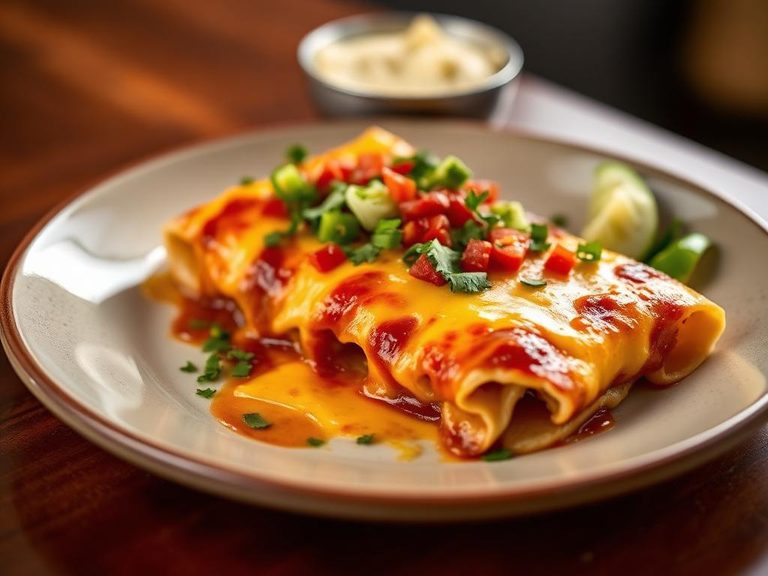
ON THE BORDER, cheese enchilada
Whole food · Restaurant Foods

Photo: Wikipedia
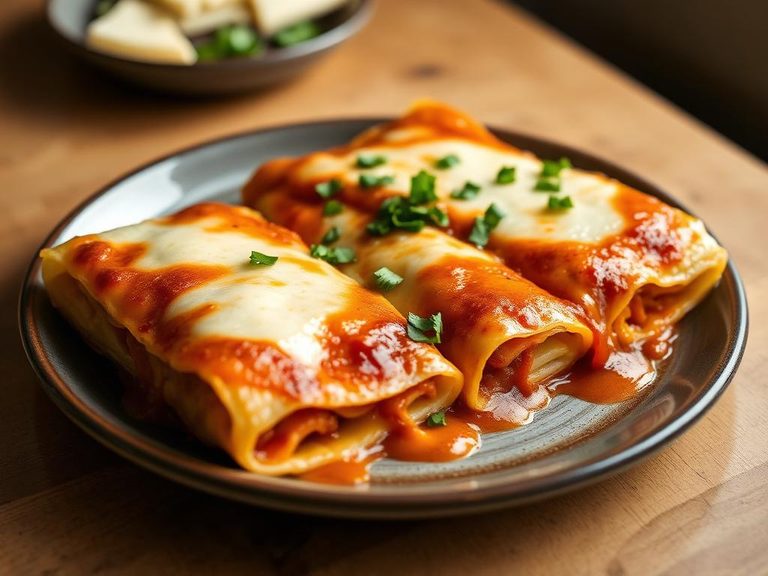
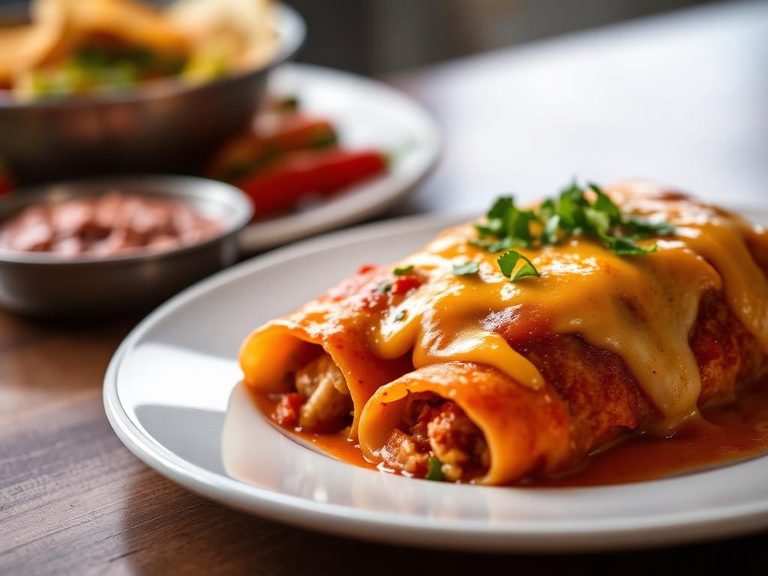
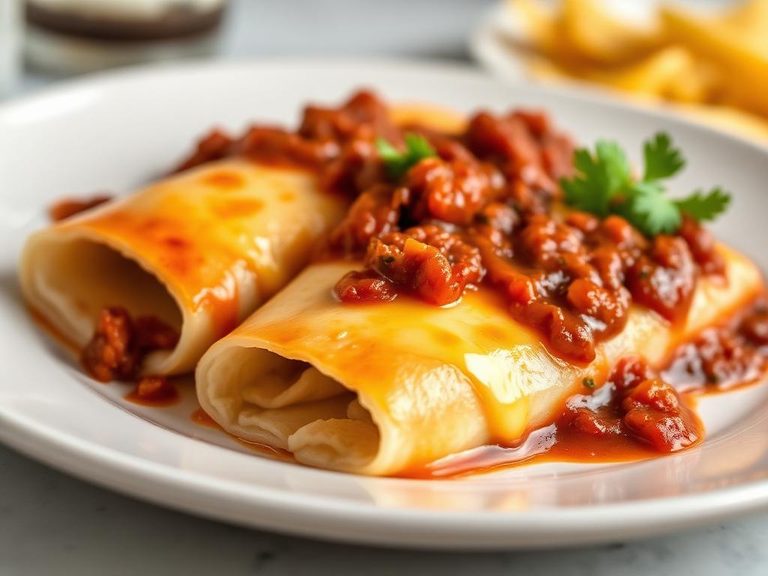
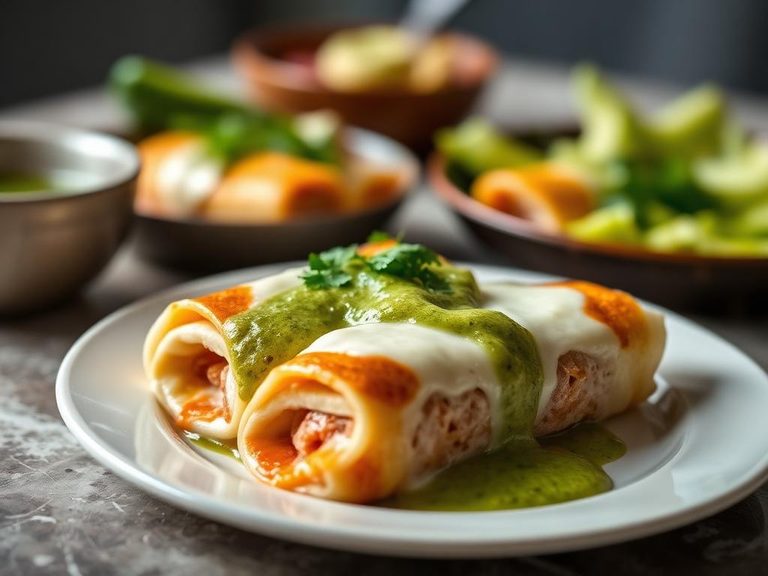
A warm corn tortilla rolled around a generous filling of melted cheese, bathed in a rich, savory chili-spiced sauce. The texture is a comforting contrast between the soft, yielding tortilla and the gooey, stretchy cheese interior. Nutritionally, it's a calorie-dense item, with over half its energy coming from fats, primarily from the cheese and sauce.
Calorie split: 17% protein · 24% carbs · 59% fat
↓ Full nutrition💚 Why it's loved
People love it for the ultimate comfort food experience—the satisfying combination of warm, melty cheese and savory, slightly spicy sauce is deeply flavorful. It's a beloved staple of Tex-Mex cuisine, often enjoyed as a hearty main dish or part of a festive meal.
⚠️ Watch-outs & how to enjoy it better
The high fat and calorie content can be a concern for those monitoring intake, and the sodium level in the sauce and cheese may be high. To counteract, pair with a large, fresh salad or steamed vegetables to add volume and fiber, and practice portion control by having one as part of a balanced plate rather than multiple.
Key benefits
- Good source of protein from cheese
- Provides calcium for bone health
- Contains dietary fiber from corn tortilla
- Quick source of energy from fats and carbs
🍽️ Popular dishes
🌍 Where it's eaten
💡 Did you know?
The word 'enchilada' literally means 'in chili' in Spanish, referring to the practice of rolling a tortilla around a filling and then covering it in a chili pepper sauce.
Full nutrition (USDA data · scales with serving)
| Water | 51.8 g |
| Energy | 271 kcal |
| Energy | 1134 kj |
| Protein | 11.7 g |
| Total lipid (fat) | 17.7 g |
| Ash | 2.6 g |
| Carbohydrate, by difference | 16.2 g |
| Fiber, total dietary | 1.8 g |
| Total Sugars | 2.9 g |
| Sucrose | 0.25 g |
| Glucose | 0.97 g |
| Fructose | 0.83 g |
| Lactose | 0.66 g |
| Maltose | 0.18 g |
| Galactose | 0.00 g |
| Starch | 12.5 g |
| Calcium, Ca | 293 mg |
| Iron, Fe | 0.71 mg |
| Magnesium, Mg | 30.0 mg |
| Phosphorus, P | 288 mg |
| Potassium, K | 176 mg |
| Sodium, Na | 561 mg |
| Zinc, Zn | 1.9 mg |
| Copper, Cu | 0.07 mg |
| Manganese, Mn | 0.13 mg |
| Selenium, Se | 16.0 ug |
| Thiamin | 0.07 mg |
| Riboflavin | 0.22 mg |
| Niacin | 0.78 mg |
| Pantothenic acid | 0.37 mg |
| Vitamin B-6 | 0.13 mg |
| Folate, total | 14.0 ug |
| Vitamin B-12 | 0.72 ug |
| Vitamin A, RAE | 10.0 ug |
| Carotene, beta | 112 ug |
| Carotene, alpha | 0.00 ug |
| Cryptoxanthin, beta | 11.0 ug |
| Vitamin A, IU | 195 iu |
| Lycopene | 1562 ug |
| Lutein + zeaxanthin | 58.0 ug |
| Vitamin E (alpha-tocopherol) | 0.89 mg |
| Tocopherol, beta | 0.02 mg |
| Tocopherol, gamma | 1.7 mg |
| Tocopherol, delta | 0.35 mg |
| Tocotrienol, alpha | 0.14 mg |
| Tocotrienol, beta | 0.00 mg |
| Tocotrienol, gamma | 0.00 mg |
| Tocotrienol, delta | 0.00 mg |
Fat & fatty acid profile (per 100g)
| Fatty acids, total saturated | 7.5 g |
| SFA 4:0 | 0.23 g |
| SFA 6:0 | 0.19 g |
| SFA 8:0 | 0.12 g |
| SFA 10:0 | 0.29 g |
| SFA 12:0 | 0.33 g |
| SFA 14:0 | 1.1 g |
| SFA 15:0 | 0.12 g |
| SFA 16:0 | 3.5 g |
| SFA 17:0 | 0.08 g |
| SFA 18:0 | 1.5 g |
| SFA 20:0 | 0.03 g |
| SFA 22:0 | 0.01 g |
| SFA 24:0 | 0.01 g |
| Fatty acids, total monounsaturated | 4.1 g |
| MUFA 14:1 | 0.10 g |
| MUFA 15:1 | 0.00 g |
| MUFA 16:1 | 0.21 g |
| MUFA 16:1 c | 0.17 g |
| MUFA 17:1 | 0.03 g |
| MUFA 18:1 | 3.7 g |
| MUFA 18:1 c | 3.4 g |
| MUFA 20:1 | 0.04 g |
| MUFA 22:1 | 0.00 g |
| MUFA 22:1 c | 0.00 g |
| MUFA 24:1 c | 0.00 g |
| Fatty acids, total polyunsaturated | 2.1 g |
| PUFA 18:2 | 1.8 g |
| PUFA 18:2 n-6 c,c | 1.7 g |
| PUFA 18:2 CLAs | 0.06 g |
| PUFA 18:3 | 0.20 g |
| PUFA 18:3 n-3 c,c,c (ALA) | 0.19 g |
| PUFA 18:3 n-6 c,c,c | 0.01 g |
| PUFA 18:3i | 0.00 g |
| PUFA 18:4 | 0.00 g |
| PUFA 20:2 n-6 c,c | 0.00 g |
| PUFA 20:3 | 0.01 g |
| PUFA 20:3 n-3 | 0.00 g |
| PUFA 20:3 n-6 | 0.01 g |
| PUFA 20:4 | 0.02 g |
| PUFA 20:5 n-3 (EPA) | 0.00 g |
| PUFA 22:4 | 0.00 g |
| PUFA 22:5 n-3 (DPA) | 0.01 g |
| PUFA 22:6 n-3 (DHA) | 0.00 g |
| Fatty acids, total trans | 0.42 g |
| Fatty acids, total trans-monoenoic | 0.33 g |
| TFA 16:1 t | 0.04 g |
| TFA 18:1 t | 0.30 g |
| TFA 22:1 t | 0.00 g |
| TFA 18:2 t not further defined | 0.09 g |
| Fatty acids, total trans-polyenoic | 0.09 g |
| Cholesterol | 41.0 mg |
FAQ
What kind of cheese is typically used?
Traditionally, a good melting cheese like Cheddar, Monterey Jack, or a Mexican blend like Oaxaca or Asadero is used for its creamy texture and mild flavor.
Is it gluten-free?
The core components (corn tortilla, cheese, sauce) are naturally gluten-free, but always check sauce ingredients for thickeners and ensure no cross-contamination if prepared commercially.
Can I make a lighter version at home?
Yes. Use low-fat cheese, whole-wheat or corn tortillas, and a sauce made from scratch with less oil. You can also add vegetables like spinach or zucchini to the filling to boost fiber and nutrients.
Nutrient density (calculated · NRF9.3)
Nutrient Rich Foods index: beneficial nutrients (protein, fiber, vitamins, minerals) minus saturated fat, added sugar & sodium, per 100 kcal.
NRF9.3 index — Fulgoni, Keast & Drewnowski, 2009. Computed from USDA nutrients.
Weight-loss friendliness (composite index)
Energy density 2.71 kcal/g · 17% calories from protein · 1.8 g fiber · 2.9 g sugar per 100 g.
Composite of energy density (Rolls et al., 1999), protein & fiber satiety, minus sugar. A calculated heuristic — ranks satiety-per-calorie, not a clinical measure.
Dietary load (calculated from USDA values)
Potential renal acid load. Positive = acid-forming, negative = alkaline-forming.
Sodium-to-potassium ratio: 3.19 (lower is better — aim for ≤ 1)
Sodium:potassium per WHO potassium guidance. Computed from USDA nutrients.