

Nuts, pecans, oil roasted, with salt added
Whole food · Nut and Seed Products

Photo: Wikipedia
Oil-roasted pecans with salt are a rich, buttery nut with a satisfying crunch and a savory-sweet finish. Their high fat content (75g per 100g) delivers a deeply satisfying mouthfeel, while the added salt amplifies their natural, subtly sweet, and woody flavor. Nutritionally, they are a calorie-dense powerhouse of monounsaturated fats and a good source of fiber.
Calorie split: 5% protein · 7% carbs · 88% fat
↓ Full nutrition💚 Why it's loved
People adore them for their uniquely buttery, rich flavor and crisp texture that elevates both sweet and savory dishes. They are a beloved staple in Southern U.S. cuisine, especially in holiday pies and pralines, symbolizing comfort and indulgence.
⚠️ Watch-outs & how to enjoy it better
Their very high calorie and fat density means portions can add up quickly, and the added sodium may be a concern for those monitoring salt intake. As a tree nut, they are a common allergen. To manage, practice strict portion control (stick to a small handful) and pair with lower-calorie foods like fresh fruit or yogurt to increase satiety.
Key benefits
- Excellent source of heart-healthy monounsaturated fats
- Provides over 9g of dietary fiber per 100g
- Contains antioxidants like ellagic acid
- Good plant-based source of manganese
- High in energy, ideal for sustained fuel
🍽️ Popular dishes


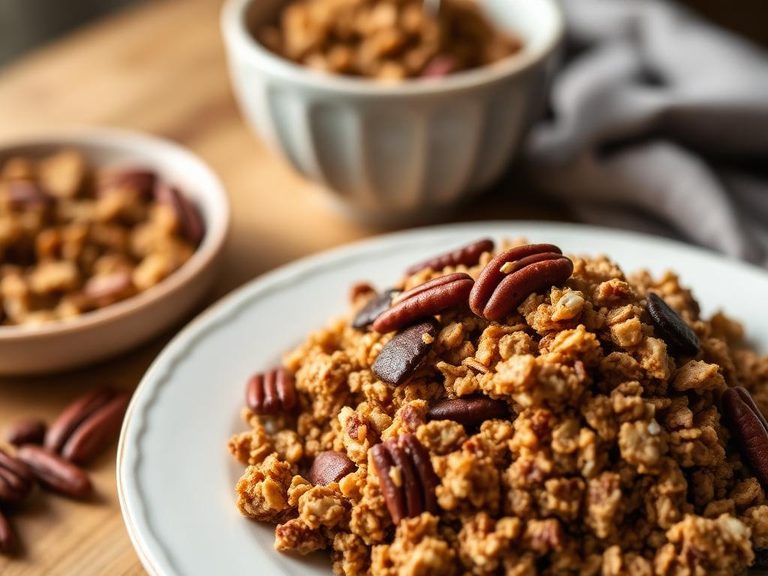
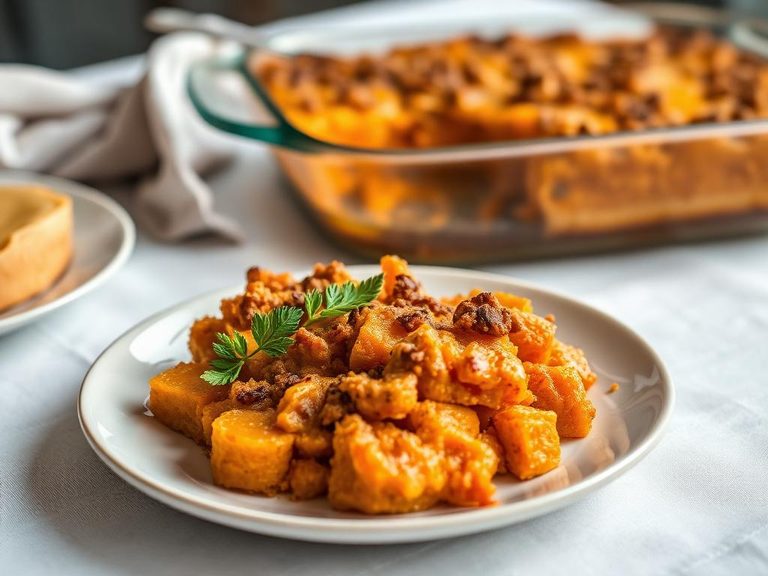
🌍 Where it's eaten
💡 Did you know?
Pecans are the only major tree nut native to North America, and the word 'pecan' is an Algonquian word meaning 'a nut too hard to crack by hand.'
Full nutrition (USDA data · scales with serving)
| Water | 1.1 g |
| Energy | 715 kcal |
| Energy | 2990 kj |
| Protein | 9.2 g |
| Total lipid (fat) | 75.2 g |
| Ash | 1.4 g |
| Carbohydrate, by difference | 13.0 g |
| Fiber, total dietary | 9.5 g |
| Total Sugars | 4.0 g |
| Sucrose | 3.9 g |
| Glucose | 0.04 g |
| Fructose | 0.04 g |
| Lactose | 0.00 g |
| Maltose | 0.00 g |
| Starch | 0.28 g |
| Calcium, Ca | 67.0 mg |
| Iron, Fe | 2.5 mg |
| Magnesium, Mg | 121 mg |
| Phosphorus, P | 263 mg |
| Potassium, K | 392 mg |
| Sodium, Na | 393 mg |
| Zinc, Zn | 4.5 mg |
| Copper, Cu | 1.2 mg |
| Manganese, Mn | 3.7 mg |
| Selenium, Se | 6.0 ug |
| Vitamin C, total ascorbic acid | 0.70 mg |
| Thiamin | 0.47 mg |
| Riboflavin | 0.11 mg |
| Niacin | 1.2 mg |
| Pantothenic acid | 0.74 mg |
| Vitamin B-6 | 0.19 mg |
| Folate, total | 15.0 ug |
| Folic acid | 0.00 ug |
| Folate, food | 15.0 ug |
| Folate, DFE | 15.0 ug |
| Vitamin B-12 | 0.00 ug |
| Vitamin A, RAE | 5.0 ug |
| Retinol | 0.00 ug |
| Carotene, beta | 62.0 ug |
| Carotene, alpha | 0.00 ug |
| Vitamin A, IU | 104 iu |
| Vitamin E (alpha-tocopherol) | 2.5 mg |
| Tocopherol, beta | 0.35 mg |
| Tocopherol, gamma | 24.2 mg |
| Tocopherol, delta | 1.1 mg |
| Vitamin D (D2 + D3), International Units | 0.00 iu |
| Vitamin D (D2 + D3) | 0.00 ug |
Fat & fatty acid profile (per 100g)
| Fatty acids, total saturated | 7.2 g |
| SFA 8:0 | 0.00 g |
| SFA 10:0 | 0.00 g |
| SFA 12:0 | 0.00 g |
| SFA 13:0 | 0.00 g |
| SFA 14:0 | 0.00 g |
| SFA 15:0 | 0.00 g |
| SFA 16:0 | 5.0 g |
| SFA 17:0 | 0.00 g |
| SFA 18:0 | 1.8 g |
| SFA 20:0 | 0.14 g |
| SFA 22:0 | 0.16 g |
| SFA 24:0 | 0.11 g |
| Fatty acids, total monounsaturated | 41.0 g |
| MUFA 14:1 | 0.00 g |
| MUFA 16:1 | 0.02 g |
| MUFA 18:1 | 40.7 g |
| MUFA 20:1 | 0.27 g |
| MUFA 22:1 | 0.00 g |
| MUFA 24:1 c | 0.00 g |
| Fatty acids, total polyunsaturated | 23.6 g |
| PUFA 18:2 | 22.6 g |
| PUFA 18:3 | 1.0 g |
| PUFA 20:2 n-6 c,c | 0.00 g |
| PUFA 20:3 | 0.00 g |
| PUFA 20:4 | 0.00 g |
| PUFA 20:5 n-3 (EPA) | 0.00 g |
| PUFA 22:5 n-3 (DPA) | 0.00 g |
| PUFA 22:6 n-3 (DHA) | 0.00 g |
| Cholesterol | 0.00 mg |
| Phytosterols | 108 mg |
| Stigmasterol | 5.0 mg |
| Campesterol | 7.0 mg |
| Beta-sitosterol | 96.0 mg |
Amino acid profile (per 100g)
| Tryptophan | 0.09 g |
| Threonine | 0.31 g |
| Isoleucine | 0.34 g |
| Leucine | 0.60 g |
| Lysine | 0.29 g |
| Methionine | 0.18 g |
| Cystine | 0.15 g |
| Phenylalanine | 0.43 g |
| Tyrosine | 0.22 g |
| Valine | 0.41 g |
| Arginine | 1.2 g |
| Histidine | 0.26 g |
| Alanine | 0.40 g |
| Aspartic acid | 0.93 g |
| Glutamic acid | 1.8 g |
| Glycine | 0.45 g |
| Proline | 0.36 g |
| Serine | 0.48 g |
FAQ
How do oil-roasted pecans differ from dry-roasted?
Oil-roasting involves tossing the nuts in a small amount of oil before roasting, which gives them a richer mouthfeel and helps seasonings like salt adhere better. Dry-roasting uses no added oil, resulting in a slightly less glossy finish and a purer, toasty nut flavor.
Are the added oils and salt unhealthy?
The added oil (often a neutral vegetable oil) increases the total fat and calorie count but doesn't significantly change the nut's beneficial fat profile. The sodium from the salt is the primary nutritional trade-off. For a lower-sodium option, look for 'lightly salted' versions or choose unsalted nuts and season yourself.
What's the best way to store them?
Due to their high fat content, pecans can go rancid. Store them in an airtight container in a cool, dark place for up to 3 months, or in the refrigerator for up to 6 months, or freeze for up to a year to preserve freshness.
Nutrient density (calculated · NRF9.3)
Nutrient Rich Foods index: beneficial nutrients (protein, fiber, vitamins, minerals) minus saturated fat, added sugar & sodium, per 100 kcal.
NRF9.3 index — Fulgoni, Keast & Drewnowski, 2009. Computed from USDA nutrients.
Weight-loss friendliness (composite index)
Energy density 7.15 kcal/g · 5% calories from protein · 9.5 g fiber · 4.0 g sugar per 100 g.
Composite of energy density (Rolls et al., 1999), protein & fiber satiety, minus sugar. A calculated heuristic — ranks satiety-per-calorie, not a clinical measure.
Dietary load (calculated from USDA values)
Potential renal acid load. Positive = acid-forming, negative = alkaline-forming.
Sodium-to-potassium ratio: 1.00 (lower is better — aim for ≤ 1)
Sodium:potassium per WHO potassium guidance. Computed from USDA nutrients.