

Cabbage, red, raw
Whole food · Vegetables and Vegetable Products

Photo: Wikipedia
Red cabbage is a vibrant, crunchy cruciferous vegetable with a deep purple hue and a mildly peppery, earthy flavor. Its crisp texture and striking color make it a standout in raw salads and slaws, while its low-calorie profile (31 kcal/100g) is packed with fiber and vitamin C. The anthocyanins that give it its purple color also act as powerful antioxidants, making it a nutrient-dense addition to any meal.
Calorie split: 16% protein · 80% carbs · 4% fat
↓ Full nutrition💚 Why it's loved
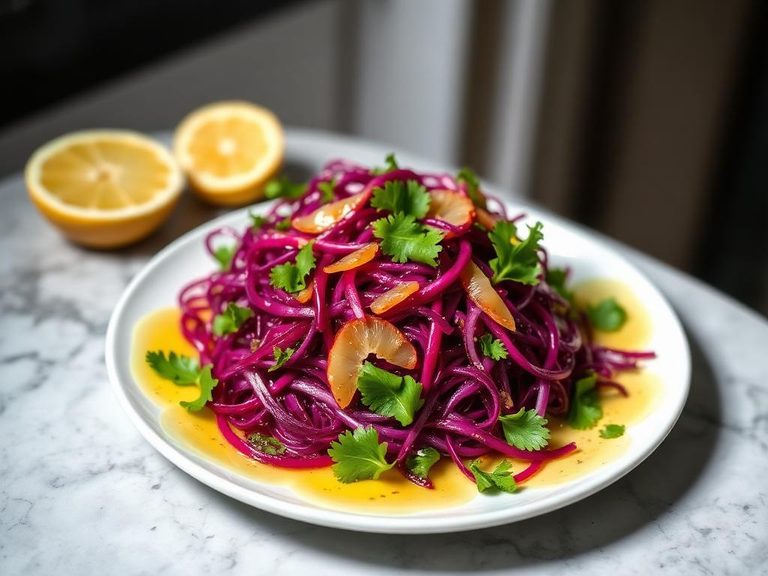
People love red cabbage for its vibrant color that adds visual appeal to dishes, and its satisfying crunch that holds up well in slaws and salads. Its mild, slightly sweet and peppery flavor pairs beautifully with tangy dressings, apples, and vinegar-based preparations, making it a versatile staple in many cuisines.
⚠️ Watch-outs & how to enjoy it better
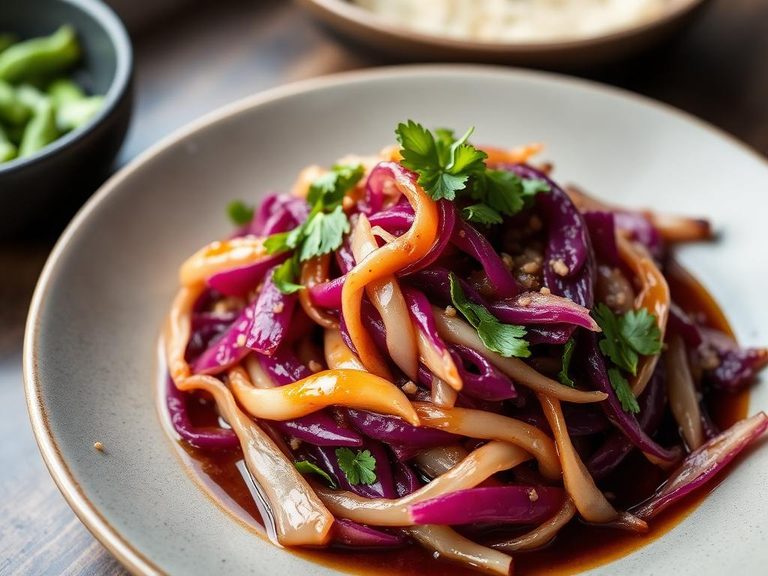
Raw red cabbage can cause bloating or gas in some individuals due to its high fiber and raffinose content, especially for those with sensitive digestive systems. To counteract this, try lightly cooking or fermenting it (as in sauerkraut), or pair it with digestive herbs like ginger or fennel to ease digestion.
Key benefits
- Rich in anthocyanins, powerful antioxidants that may support heart health
- High in vitamin C, essential for immune function and collagen production
- Good source of dietary fiber, aiding digestion and promoting satiety
- Low in calories and fat, making it ideal for weight management
- Contains vitamin K, important for bone health and blood clotting
🍽️ Popular dishes
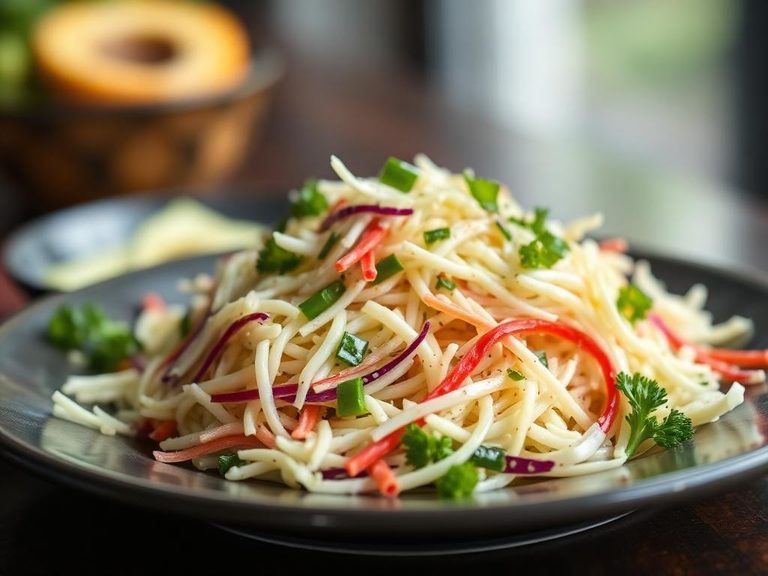
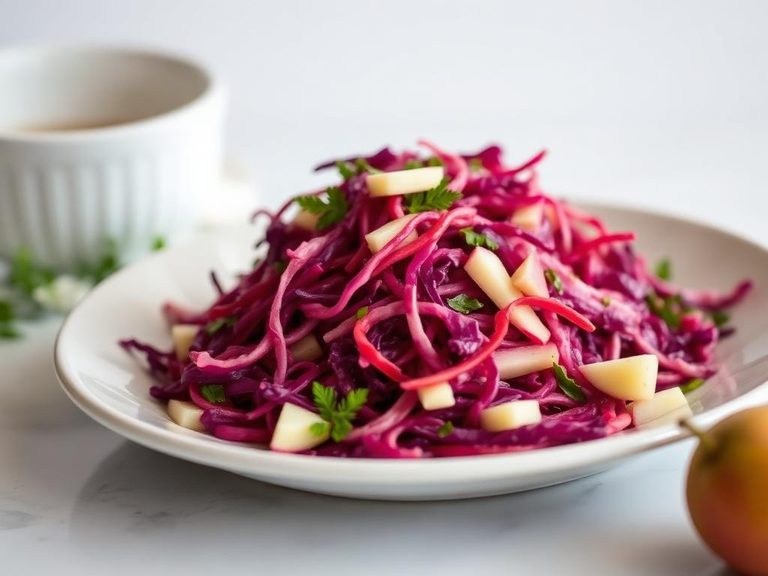
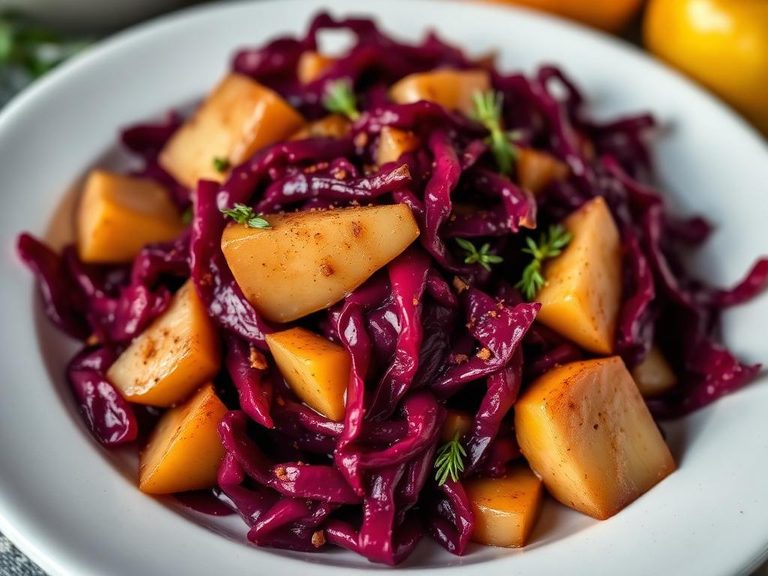
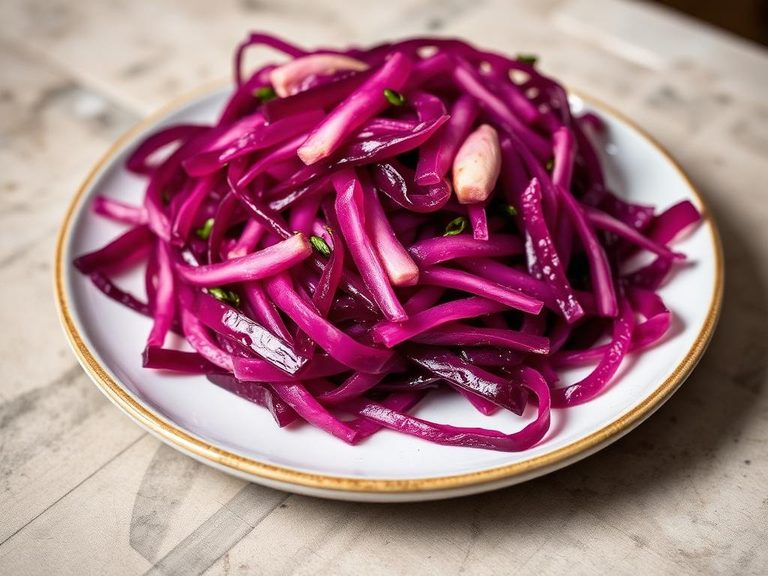
🌍 Where it's eaten
💡 Did you know?
Red cabbage contains a natural pH indicator: its anthocyanins turn blue in alkaline conditions and pink in acidic ones, which is why adding vinegar or lemon juice to cooked red cabbage helps preserve its vibrant purple color.
Full nutrition (USDA data · scales with serving)
| Water | 90.4 g |
| Energy | 31.0 kcal |
| Energy | 130 kj |
| Protein | 1.4 g |
| Total lipid (fat) | 0.16 g |
| Ash | 0.64 g |
| Carbohydrate, by difference | 7.4 g |
| Fiber, total dietary | 2.1 g |
| Total Sugars | 3.8 g |
| Sucrose | 0.60 g |
| Glucose | 1.7 g |
| Fructose | 1.5 g |
| Lactose | 0.00 g |
| Maltose | 0.00 g |
| Galactose | 0.00 g |
| Starch | 0.00 g |
| Calcium, Ca | 45.0 mg |
| Iron, Fe | 0.80 mg |
| Magnesium, Mg | 16.0 mg |
| Phosphorus, P | 30.0 mg |
| Potassium, K | 243 mg |
| Sodium, Na | 27.0 mg |
| Zinc, Zn | 0.22 mg |
| Copper, Cu | 0.02 mg |
| Manganese, Mn | 0.24 mg |
| Selenium, Se | 0.60 ug |
| Vitamin C, total ascorbic acid | 57.0 mg |
| Thiamin | 0.06 mg |
| Riboflavin | 0.07 mg |
| Niacin | 0.42 mg |
| Pantothenic acid | 0.15 mg |
| Vitamin B-6 | 0.21 mg |
| Folate, total | 18.0 ug |
| Folic acid | 0.00 ug |
| Folate, food | 18.0 ug |
| Folate, DFE | 18.0 ug |
| Choline, total | 17.1 mg |
| Betaine | 0.10 mg |
| Vitamin B-12 | 0.00 ug |
| Vitamin B-12, added | 0.00 ug |
| Vitamin A, RAE | 56.0 ug |
| Retinol | 0.00 ug |
| Carotene, beta | 670 ug |
| Carotene, alpha | 0.00 ug |
| Cryptoxanthin, beta | 0.00 ug |
| Vitamin A, IU | 1116 iu |
| Lycopene | 20.0 ug |
| Lutein + zeaxanthin | 329 ug |
| Vitamin E (alpha-tocopherol) | 0.11 mg |
| Vitamin E, added | 0.00 mg |
| Vitamin D (D2 + D3), International Units | 0.00 iu |
| Vitamin D (D2 + D3) | 0.00 ug |
| Vitamin K (phylloquinone) | 38.2 ug |
| Vitamin K (Dihydrophylloquinone) | 0.00 ug |
| Alcohol, ethyl | 0.00 g |
| Caffeine | 0.00 mg |
| Theobromine | 0.00 mg |
Fat & fatty acid profile (per 100g)
| Fatty acids, total saturated | 0.02 g |
| SFA 4:0 | 0.00 g |
| SFA 6:0 | 0.00 g |
| SFA 8:0 | 0.00 g |
| SFA 10:0 | 0.00 g |
| SFA 12:0 | 0.00 g |
| SFA 14:0 | 0.00 g |
| SFA 16:0 | 0.02 g |
| SFA 18:0 | 0.00 g |
| Fatty acids, total monounsaturated | 0.01 g |
| MUFA 16:1 | 0.00 g |
| MUFA 18:1 | 0.01 g |
| MUFA 20:1 | 0.00 g |
| MUFA 22:1 | 0.00 g |
| Fatty acids, total polyunsaturated | 0.08 g |
| PUFA 18:2 | 0.03 g |
| PUFA 18:3 | 0.04 g |
| PUFA 18:4 | 0.00 g |
| PUFA 20:4 | 0.00 g |
| PUFA 20:5 n-3 (EPA) | 0.00 g |
| PUFA 22:5 n-3 (DPA) | 0.00 g |
| PUFA 22:6 n-3 (DHA) | 0.00 g |
| Fatty acids, total trans | 0.00 g |
| Cholesterol | 0.00 mg |
Amino acid profile (per 100g)
| Tryptophan | 0.01 g |
| Threonine | 0.04 g |
| Isoleucine | 0.03 g |
| Leucine | 0.05 g |
| Lysine | 0.05 g |
| Methionine | 0.01 g |
| Cystine | 0.01 g |
| Phenylalanine | 0.04 g |
| Tyrosine | 0.02 g |
| Valine | 0.05 g |
| Arginine | 0.08 g |
| Histidine | 0.02 g |
| Alanine | 0.05 g |
| Aspartic acid | 0.14 g |
| Glutamic acid | 0.33 g |
| Glycine | 0.03 g |
| Proline | 0.05 g |
| Serine | 0.06 g |
FAQ
Is red cabbage the same as purple cabbage?
Yes, red cabbage and purple cabbage are the same vegetable. The name 'red cabbage' is traditional, but its deep purple color is due to anthocyanin pigments.
Can I eat red cabbage raw?
Absolutely. Raw red cabbage is crisp and peppery, perfect for slaws and salads. However, if you have digestive sensitivities, lightly cooking or fermenting it may be easier on your stomach.
How do I keep red cabbage from turning blue when cooking?
Add an acidic ingredient like vinegar, lemon juice, or apple cider vinegar to the cooking liquid. The acid helps maintain the vibrant purple color by keeping the pH low.
Nutrient density (calculated · NRF9.3)
Nutrient Rich Foods index: beneficial nutrients (protein, fiber, vitamins, minerals) minus saturated fat, added sugar & sodium, per 100 kcal.
NRF9.3 index — Fulgoni, Keast & Drewnowski, 2009. Computed from USDA nutrients.
Weight-loss friendliness (composite index)
Energy density 0.31 kcal/g · 18% calories from protein · 2.1 g fiber · 3.8 g sugar per 100 g.
Composite of energy density (Rolls et al., 1999), protein & fiber satiety, minus sugar. A calculated heuristic — ranks satiety-per-calorie, not a clinical measure.
Dietary load (calculated from USDA values)
Potential renal acid load. Positive = acid-forming, negative = alkaline-forming.
Sodium-to-potassium ratio: 0.11 (lower is better — aim for ≤ 1)
Sodium:potassium per WHO potassium guidance. Computed from USDA nutrients.