

Beef, loin, top loin, separable lean and fat, trimmed to 1/8" fat, all grades, cooked, grilled
Whole food · Beef Products

Photo: Wikipedia
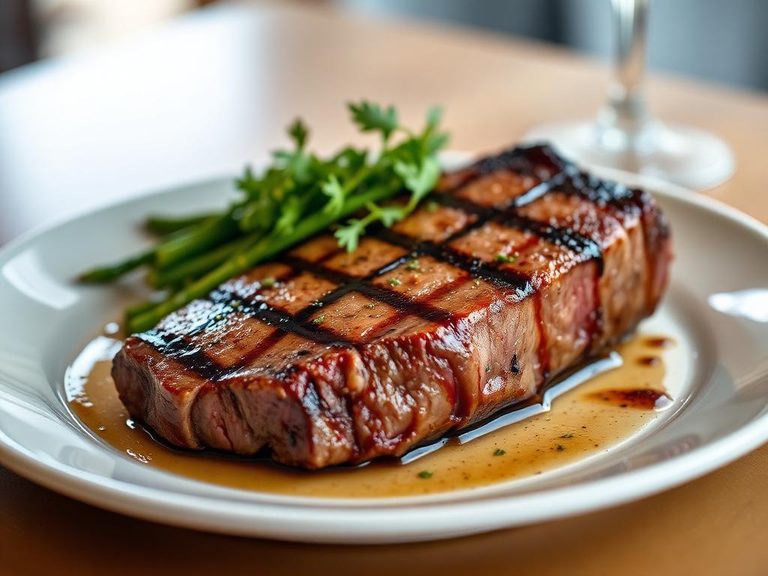
This is a premium cut of beef from the loin, specifically the top loin (New York strip), cooked to a perfect sear. It offers a robust, beefy flavor with a firm yet tender texture and a satisfying, juicy bite. Nutritionally, it's a powerhouse of high-quality protein and healthy fats, with virtually no carbohydrates.
Calorie split: 41% protein · 0% carbs · 59% fat
↓ Full nutrition💚 Why it's loved
People love it for its classic, deep umami beef flavor and the luxurious, satisfying chew of a well-cooked steak. It's a versatile centerpiece, equally at home in a simple grilled steak dinner or sliced for a hearty salad.
⚠️ Watch-outs & how to enjoy it better
As a fatty cut, it is high in calories and saturated fat, which should be considered in moderation. For those watching sodium intake, be mindful of pre-marinated or heavily seasoned versions. Tip: Pair it with a large portion of non-starchy vegetables like grilled asparagus or a fresh salad to balance the meal and add fiber.
Key benefits
- Excellent source of complete, high-quality protein for muscle maintenance.
- Rich in essential nutrients like iron, zinc, and B vitamins (especially B12).
- Provides conjugated linoleic acid (CLA), a fatty acid studied for potential health benefits.
- Zero carbohydrates, making it suitable for ketogenic and low-carb diets.
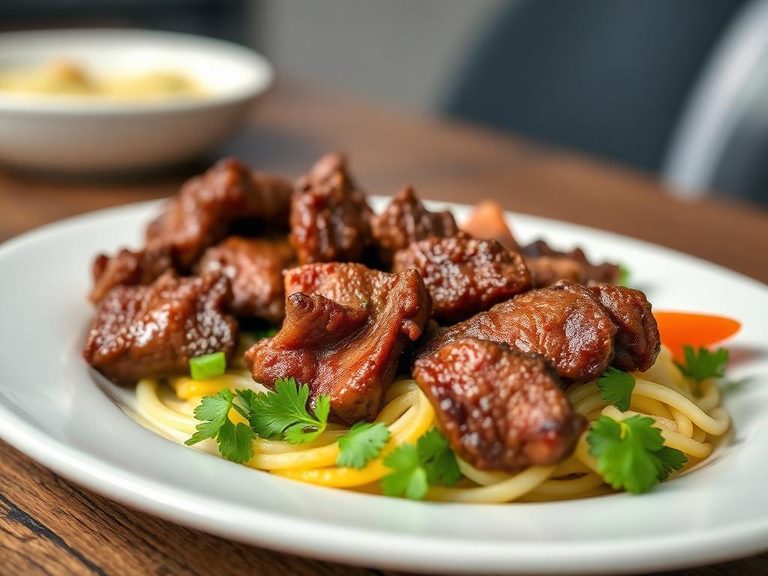
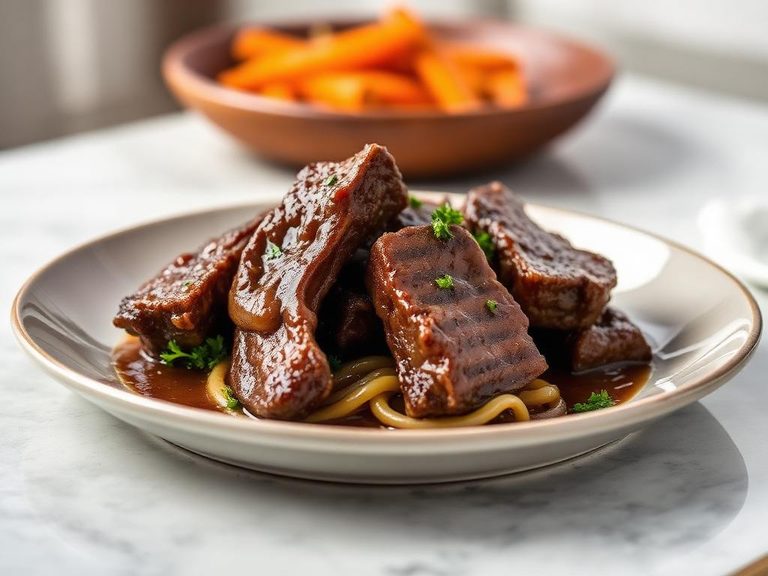
🍽️ Popular dishes
🌍 Where it's eaten
💡 Did you know?
The 'top loin' muscle is the same cut that, when left with a long bone attached, becomes the famous T-bone or Porterhouse steak.
Full nutrition (USDA data · scales with serving)
| Water | 56.5 g |
| Energy | 264 kcal |
| Energy | 1106 kj |
| Protein | 26.4 g |
| Total lipid (fat) | 16.8 g |
| Ash | 1.0 g |
| Carbohydrate, by difference | 0.00 g |
| Fiber, total dietary | 0.00 g |
| Total Sugars | 0.00 g |
| Calcium, Ca | 19.0 mg |
| Iron, Fe | 1.7 mg |
| Magnesium, Mg | 22.0 mg |
| Phosphorus, P | 204 mg |
| Potassium, K | 328 mg |
| Sodium, Na | 54.0 mg |
| Zinc, Zn | 4.8 mg |
| Copper, Cu | 0.08 mg |
| Manganese, Mn | 0.01 mg |
| Selenium, Se | 28.5 ug |
| Fluoride, F | 22.4 ug |
| Vitamin C, total ascorbic acid | 0.00 mg |
| Thiamin | 0.07 mg |
| Riboflavin | 0.13 mg |
| Niacin | 7.0 mg |
| Pantothenic acid | 0.52 mg |
| Vitamin B-6 | 0.55 mg |
| Folate, total | 8.0 ug |
| Folic acid | 0.00 ug |
| Folate, food | 8.0 ug |
| Folate, DFE | 8.0 ug |
| Choline, total | 101 mg |
| Betaine | 13.2 mg |
| Vitamin B-12 | 1.6 ug |
| Vitamin B-12, added | 0.00 ug |
| Vitamin A, RAE | 0.00 ug |
| Retinol | 0.00 ug |
| Carotene, beta | 0.00 ug |
| Carotene, alpha | 0.00 ug |
| Cryptoxanthin, beta | 0.00 ug |
| Vitamin A, IU | 0.00 iu |
| Lycopene | 0.00 ug |
| Lutein + zeaxanthin | 0.00 ug |
| Vitamin E (alpha-tocopherol) | 0.46 mg |
| Vitamin E, added | 0.00 mg |
| Tocopherol, beta | 0.00 mg |
| Tocopherol, gamma | 0.00 mg |
| Tocopherol, delta | 0.00 mg |
| Vitamin D (D2 + D3), International Units | 11.0 iu |
| Vitamin D (D2 + D3) | 0.30 ug |
| Vitamin D3 (cholecalciferol) | 0.30 ug |
| Vitamin K (phylloquinone) | 1.6 ug |
| Alcohol, ethyl | 0.00 g |
| Caffeine | 0.00 mg |
| Theobromine | 0.00 mg |
Fat & fatty acid profile (per 100g)
| Fatty acids, total saturated | 6.6 g |
| SFA 4:0 | 0.00 g |
| SFA 6:0 | 0.00 g |
| SFA 8:0 | 0.00 g |
| SFA 10:0 | 0.04 g |
| SFA 12:0 | 0.04 g |
| SFA 14:0 | 0.51 g |
| SFA 16:0 | 4.0 g |
| SFA 18:0 | 2.0 g |
| Fatty acids, total monounsaturated | 7.0 g |
| MUFA 16:1 | 0.63 g |
| MUFA 18:1 | 6.3 g |
| MUFA 20:1 | 0.02 g |
| MUFA 22:1 | 0.00 g |
| Fatty acids, total polyunsaturated | 0.62 g |
| PUFA 18:2 | 0.43 g |
| PUFA 18:3 | 0.15 g |
| PUFA 18:4 | 0.00 g |
| PUFA 20:4 | 0.04 g |
| PUFA 20:5 n-3 (EPA) | 0.00 g |
| PUFA 22:5 n-3 (DPA) | 0.00 g |
| PUFA 22:6 n-3 (DHA) | 0.00 g |
| Cholesterol | 88.0 mg |
Amino acid profile (per 100g)
| Tryptophan | 0.17 g |
| Threonine | 1.1 g |
| Isoleucine | 1.2 g |
| Leucine | 2.1 g |
| Lysine | 2.2 g |
| Methionine | 0.69 g |
| Cystine | 0.34 g |
| Phenylalanine | 1.0 g |
| Tyrosine | 0.84 g |
| Valine | 1.3 g |
| Arginine | 1.7 g |
| Histidine | 0.84 g |
| Alanine | 1.6 g |
| Aspartic acid | 2.4 g |
| Glutamic acid | 4.0 g |
| Glycine | 1.6 g |
| Proline | 1.3 g |
| Serine | 1.0 g |
| Hydroxyproline | 0.28 g |
FAQ
What's the difference between top loin and sirloin?
Top loin (New York strip) comes from the short loin primal, is more tender, and has a more uniform fat cap. Sirloin comes from the rear, is leaner, slightly tougher, and often has a more pronounced beefy flavor.
Is the fat on this cut good to eat?
Yes, when cooked, the fat renders and adds immense flavor and juiciness. You can choose to eat it or trim it off after cooking based on your preference.
How do I prevent it from being tough?
Avoid overcooking. Use a meat thermometer for accuracy (130-135°F for medium-rare). Let it rest for 5-10 minutes after cooking to allow the juices to redistribute throughout the meat.
Nutrient density (calculated · NRF9.3)
Nutrient Rich Foods index: beneficial nutrients (protein, fiber, vitamins, minerals) minus saturated fat, added sugar & sodium, per 100 kcal.
NRF9.3 index — Fulgoni, Keast & Drewnowski, 2009. Computed from USDA nutrients.
Weight-loss friendliness (composite index)
Energy density 2.64 kcal/g · 40% calories from protein · 0.0 g fiber · 0.0 g sugar per 100 g.
Composite of energy density (Rolls et al., 1999), protein & fiber satiety, minus sugar. A calculated heuristic — ranks satiety-per-calorie, not a clinical measure.
Dietary load (calculated from USDA values)
Potential renal acid load. Positive = acid-forming, negative = alkaline-forming.
Sodium-to-potassium ratio: 0.16 (lower is better — aim for ≤ 1)
Sodium:potassium per WHO potassium guidance. Computed from USDA nutrients.