Nuts, almonds, oil roasted, lightly salted
Whole food · Nut and Seed Products

Photo: Wikipedia
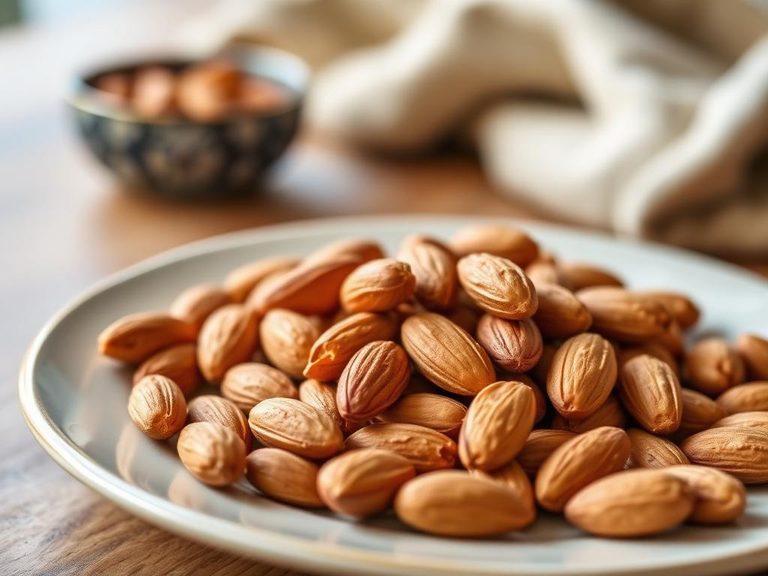
These are whole almonds roasted in their own oil until golden and then lightly dusted with salt. They offer a satisfying, deep crunch with a rich, nutty flavor that's enhanced by a savory finish. Nutritionally, they are a powerhouse of healthy monounsaturated fats and plant-based protein.
💚 Why it's loved
People adore the perfect balance of savory salt and deep, roasted nuttiness, making them an incredibly addictive and satisfying snack. Their versatility shines in everything from trail mixes and salads to baked goods and as a standalone treat.
⚠️ Watch-outs & how to enjoy it better
The roasting and salting process increases calorie density and sodium content, which requires mindful portion control. As a common tree nut, they are a major allergen, and the high fat content, while healthy, can cause digestive discomfort for some if eaten in large quantities. To counteract, stick to a single serving (about 23 almonds), pair them with a piece of fruit to balance the snack, and always check labels for added oils or excessive salt.
Key benefits
- Excellent source of heart-healthy monounsaturated fats.
- Provides a substantial 21g of plant protein per 100g.
- High in dietary fiber (10.5g) for digestive health.
- Rich in vitamin E, a potent antioxidant.
- Contains essential minerals like magnesium and manganese.
🍽️ Popular dishes



🌍 Where it's eaten
💡 Did you know?
The almond is not a true nut botanically; it's the seed of a drupe, a fruit with a fleshy outer part that surrounds a hard shell with the seed inside.
Full nutrition (scales with serving)
| Water | 2.8 g |
| Energy | 607 kcal |
| Energy | 2540 kj |
| Protein | 21.2 g |
| Total lipid (fat) | 55.2 g |
| Ash | 3.1 g |
| Carbohydrate, by difference | 17.7 g |
| Fiber, total dietary | 10.5 g |
| Total Sugars | 4.5 g |
| Sucrose | 4.4 g |
| Glucose | 0.04 g |
| Fructose | 0.00 g |
| Lactose | 0.00 g |
| Maltose | 0.14 g |
| Starch | 0.56 g |
| Calcium, Ca | 291 mg |
| Iron, Fe | 3.7 mg |
| Magnesium, Mg | 274 mg |
| Phosphorus, P | 466 mg |
| Potassium, K | 699 mg |
| Sodium, Na | 143 mg |
| Zinc, Zn | 3.1 mg |
| Copper, Cu | 0.95 mg |
| Manganese, Mn | 2.5 mg |
| Selenium, Se | 4.1 ug |
| Vitamin C, total ascorbic acid | 0.00 mg |
| Thiamin | 0.09 mg |
| Riboflavin | 0.78 mg |
| Niacin | 3.7 mg |
| Pantothenic acid | 0.23 mg |
| Vitamin B-6 | 0.12 mg |
| Folate, total | 27.0 ug |
| Folate, food | 27.0 ug |
| Choline, total | 52.1 mg |
| Betaine | 0.50 mg |
| Vitamin B-12 | 0.00 ug |
| Carotene, beta | 1.0 ug |
| Carotene, alpha | 0.00 ug |
| Cryptoxanthin, beta | 0.00 ug |
| Vitamin A, IU | 1.0 iu |
| Lycopene | 0.00 ug |
| Lutein + zeaxanthin | 1.0 ug |
| Vitamin E (alpha-tocopherol) | 26.0 mg |
| Tocopherol, beta | 0.42 mg |
| Tocopherol, gamma | 0.88 mg |
| Tocopherol, delta | 0.14 mg |
| Vitamin K (phylloquinone) | 0.00 ug |
| Alcohol, ethyl | 0.00 g |
| Caffeine | 0.00 mg |
| Theobromine | 0.00 mg |
Fat & fatty acid profile (per 100g)
| Fatty acids, total saturated | 4.2 g |
| SFA 4:0 | 0.00 g |
| SFA 6:0 | 0.00 g |
| SFA 8:0 | 0.00 g |
| SFA 10:0 | 0.00 g |
| SFA 12:0 | 0.00 g |
| SFA 13:0 | 0.00 g |
| SFA 14:0 | 0.00 g |
| SFA 15:0 | 0.00 g |
| SFA 16:0 | 3.3 g |
| SFA 17:0 | 0.00 g |
| SFA 18:0 | 0.91 g |
| SFA 20:0 | 0.00 g |
| SFA 22:0 | 0.00 g |
| SFA 24:0 | 0.00 g |
| Fatty acids, total monounsaturated | 34.8 g |
| MUFA 14:1 | 0.00 g |
| MUFA 16:1 | 0.21 g |
| MUFA 18:1 | 34.6 g |
| MUFA 20:1 | 0.00 g |
| MUFA 22:1 | 0.00 g |
| MUFA 24:1 c | 0.00 g |
| Fatty acids, total polyunsaturated | 13.5 g |
| PUFA 18:2 | 13.5 g |
| PUFA 18:3 | 0.00 g |
| PUFA 18:4 | 0.00 g |
| PUFA 20:2 n-6 c,c | 0.00 g |
| PUFA 20:3 | 0.00 g |
| PUFA 20:4 | 0.00 g |
| PUFA 20:5 n-3 (EPA) | 0.00 g |
| PUFA 22:5 n-3 (DPA) | 0.00 g |
| PUFA 22:6 n-3 (DHA) | 0.00 g |
| Cholesterol | 0.00 mg |
| Phytosterols | 130 mg |
| Stigmasterol | 3.0 mg |
| Campesterol | 9.0 mg |
| Beta-sitosterol | 118 mg |
Amino acid profile (per 100g)
| Tryptophan | 0.19 g |
| Threonine | 0.68 g |
| Isoleucine | 0.69 g |
| Leucine | 1.5 g |
| Lysine | 0.60 g |
| Methionine | 0.19 g |
| Cystine | 0.28 g |
| Phenylalanine | 1.1 g |
| Tyrosine | 0.53 g |
| Valine | 0.80 g |
| Arginine | 2.5 g |
| Histidine | 0.59 g |
| Alanine | 1.00 g |
| Aspartic acid | 2.7 g |
| Glutamic acid | 5.2 g |
| Glycine | 1.5 g |
| Proline | 0.97 g |
| Serine | 1.0 g |
FAQ
How do oil-roasted and dry-roasted almonds differ?
Oil-roasted almonds are cooked with a small amount of oil (often almond oil), resulting in a richer flavor and slightly smoother texture. Dry-roasted almonds are cooked without added oil, which can give them a more pronounced, toasty flavor but a drier mouthfeel.
Are lightly salted almonds a healthy snack?
Yes, in moderation. They provide beneficial fats, protein, and fiber. The key is portion control due to their calorie density and added sodium. A standard serving is about 1 ounce (28g or ~23 almonds).
Why are my roasted almonds sometimes chewy?
This usually means they have absorbed moisture from the air. To restore their crunch, spread them on a baking sheet and toast in a 350°F (175°C) oven for 5-10 minutes, then let them cool completely before storing in an airtight container.