

Restaurant, Latino, Arroz con grandules (rice and pigeonpeas)
Whole food · Restaurant Foods

Photo: Wikipedia
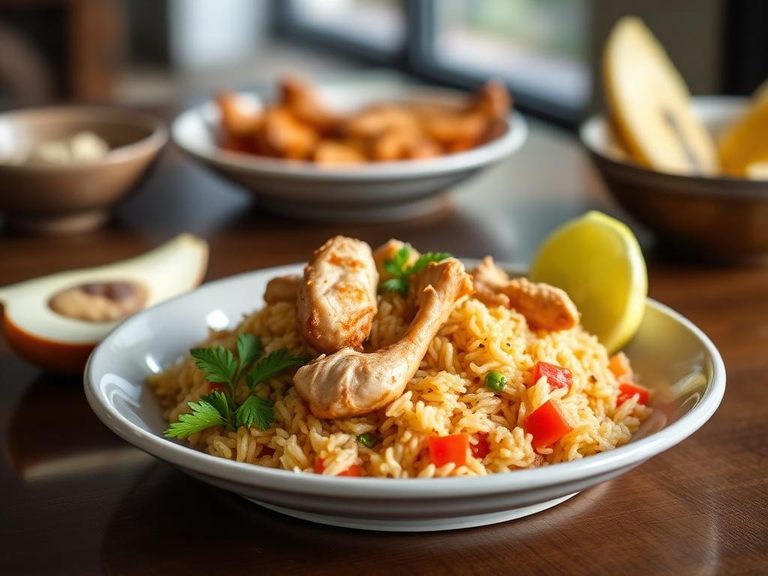
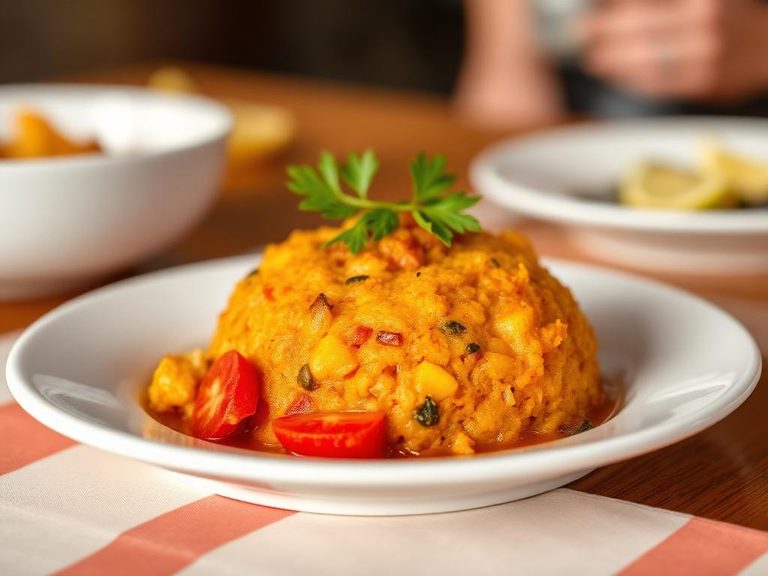
Arroz con gandules is a quintessential Puerto Rican rice dish, where long-grain rice is simmered with pigeon peas (gandules) and a savory sofrito base, often enriched with olives and capers. The result is a fragrant, slightly chewy rice with a nutty, earthy undertone from the peas and a rich, savory depth. Nutritionally, it's a solid source of carbohydrates and provides a modest amount of plant-based protein and fiber.
Calorie split: 8% protein · 68% carbs · 25% fat
↓ Full nutrition💚 Why it's loved
People love arroz con gandules for its deeply savory, aromatic flavor profile and its central role in festive meals and family gatherings, especially in Puerto Rico. It's incredibly versatile, pairing perfectly with roasted meats, stews, or as a standalone dish.
⚠️ Watch-outs & how to enjoy it better
The dish can be high in sodium and carbohydrates, which may be a concern for those managing blood sugar or blood pressure. To mitigate this, use low-sodium broth, limit added salt, and pair it with a protein and non-starchy vegetable to balance the meal and slow carb absorption.
Key benefits
- Provides a good source of complex carbohydrates for sustained energy.
- Contains plant-based protein and dietary fiber from pigeon peas.
- The sofrito base often includes herbs and vegetables like peppers and onions.
- A traditional staple in Caribbean cuisine, often served as a side or main dish.
🍽️ Popular dishes
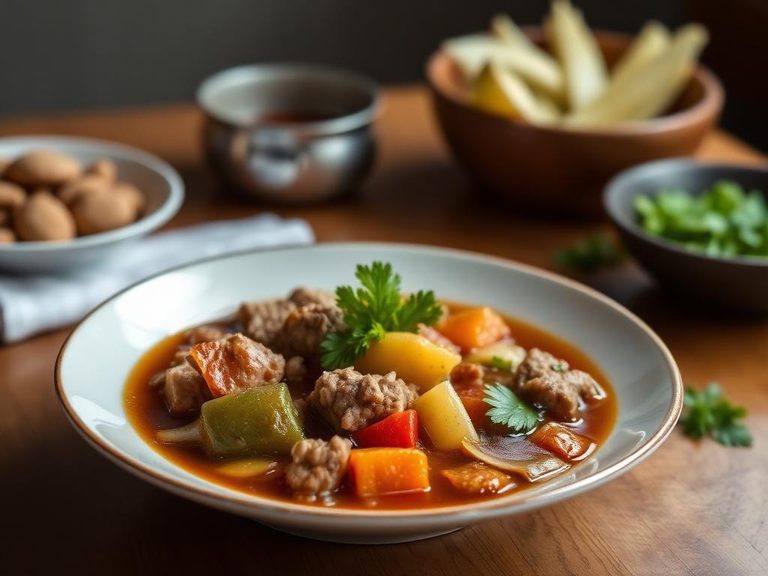
🌍 Where it's eaten
💡 Did you know?
The pigeon pea (gandul) is a nitrogen-fixing legume, meaning it naturally enriches the soil it grows in, making it a sustainable crop in tropical agriculture.
Full nutrition (USDA data · scales with serving)
| Water | 58.9 g |
| Energy | 182 kcal |
| Energy | 761 kj |
| Protein | 3.5 g |
| Total lipid (fat) | 5.0 g |
| Ash | 1.9 g |
| Carbohydrate, by difference | 30.8 g |
| Fiber, total dietary | 1.4 g |
| Starch | 28.4 g |
| Calcium, Ca | 8.0 mg |
| Iron, Fe | 0.29 mg |
| Magnesium, Mg | 14.0 mg |
| Phosphorus, P | 54.0 mg |
| Potassium, K | 84.0 mg |
| Sodium, Na | 583 mg |
| Zinc, Zn | 0.74 mg |
| Copper, Cu | 0.13 mg |
| Manganese, Mn | 0.59 mg |
| Thiamin | 0.03 mg |
| Riboflavin | 0.01 mg |
| Niacin | 0.53 mg |
| Pantothenic acid | 0.24 mg |
| Vitamin B-6 | 0.04 mg |
| Vitamin E (alpha-tocopherol) | 0.68 mg |
| Tocopherol, beta | 0.06 mg |
| Tocopherol, gamma | 3.0 mg |
| Tocopherol, delta | 1.0 mg |
| Tocotrienol, alpha | 0.05 mg |
| Tocotrienol, beta | 0.00 mg |
| Tocotrienol, gamma | 0.19 mg |
| Tocotrienol, delta | 0.00 mg |
| Vitamin K (phylloquinone) | 12.6 ug |
| Vitamin K (Dihydrophylloquinone) | 0.00 ug |
| Vitamin K (Menaquinone-4) | 0.00 ug |
Fat & fatty acid profile (per 100g)
| Fatty acids, total saturated | 0.76 g |
| SFA 6:0 | 0.00 g |
| SFA 8:0 | 0.00 g |
| SFA 10:0 | 0.03 g |
| SFA 12:0 | 0.00 g |
| SFA 14:0 | 0.01 g |
| SFA 15:0 | 0.00 g |
| SFA 16:0 | 0.51 g |
| SFA 17:0 | 0.00 g |
| SFA 18:0 | 0.17 g |
| SFA 20:0 | 0.01 g |
| SFA 22:0 | 0.01 g |
| SFA 24:0 | 0.01 g |
| Fatty acids, total monounsaturated | 1.0 g |
| MUFA 14:1 | 0.00 g |
| MUFA 15:1 | 0.00 g |
| MUFA 16:1 | 0.01 g |
| MUFA 16:1 c | 0.01 g |
| MUFA 17:1 | 0.00 g |
| MUFA 18:1 | 0.98 g |
| MUFA 18:1 c | 0.98 g |
| MUFA 20:1 | 0.02 g |
| MUFA 22:1 | 0.00 g |
| MUFA 22:1 c | 0.00 g |
| MUFA 24:1 c | 0.00 g |
| Fatty acids, total polyunsaturated | 2.3 g |
| PUFA 18:2 | 2.1 g |
| PUFA 18:2 n-6 c,c | 2.1 g |
| PUFA 18:2 CLAs | 0.00 g |
| PUFA 18:3 | 0.25 g |
| PUFA 18:3 n-3 c,c,c (ALA) | 0.25 g |
| PUFA 18:3 n-6 c,c,c | 0.00 g |
| PUFA 18:4 | 0.00 g |
| PUFA 20:2 n-6 c,c | 0.00 g |
| PUFA 20:3 | 0.00 g |
| PUFA 20:3 n-3 | 0.00 g |
| PUFA 20:3 n-6 | 0.00 g |
| PUFA 20:4 | 0.00 g |
| PUFA 20:5 n-3 (EPA) | 0.00 g |
| PUFA 22:4 | 0.00 g |
| PUFA 22:5 n-3 (DPA) | 0.00 g |
| PUFA 22:6 n-3 (DHA) | 0.00 g |
| Fatty acids, total trans | 0.01 g |
| Fatty acids, total trans-monoenoic | 0.00 g |
| TFA 16:1 t | 0.00 g |
| TFA 18:1 t | 0.00 g |
| TFA 22:1 t | 0.00 g |
| TFA 18:2 t not further defined | 0.01 g |
| Fatty acids, total trans-polyenoic | 0.01 g |
Amino acid profile (per 100g)
| Tryptophan | 0.05 g |
| Threonine | 0.11 g |
| Isoleucine | 0.13 g |
| Leucine | 0.26 g |
| Lysine | 0.12 g |
| Methionine | 0.07 g |
| Cystine | 0.06 g |
| Phenylalanine | 0.17 g |
| Tyrosine | 0.10 g |
| Valine | 0.18 g |
| Arginine | 0.25 g |
| Histidine | 0.09 g |
| Alanine | 0.17 g |
| Aspartic acid | 0.31 g |
| Glutamic acid | 0.84 g |
| Glycine | 0.14 g |
| Proline | 0.11 g |
| Serine | 0.16 g |
FAQ
What are pigeon peas (gandules)?
Pigeon peas are small, round, greenish-brown legumes with a nutty, earthy flavor. They are a staple in Caribbean, Indian, and African cuisines.
Is arroz con gandules gluten-free?
Yes, the basic ingredients (rice, pigeon peas, sofrito) are naturally gluten-free. However, always check for cross-contamination or added seasonings that might contain gluten.
How can I make arroz con gandules healthier?
Use brown rice for more fiber, reduce added salt, and add more vegetables like bell peppers or carrots to the sofrito. Pairing it with lean protein and a side salad also helps balance the meal.
Nutrient density (calculated · NRF9.3)
Nutrient Rich Foods index: beneficial nutrients (protein, fiber, vitamins, minerals) minus saturated fat, added sugar & sodium, per 100 kcal.
NRF9.3 index — Fulgoni, Keast & Drewnowski, 2009. Computed from USDA nutrients.
Weight-loss friendliness (composite index)
Energy density 1.82 kcal/g · 8% calories from protein · 1.4 g fiber · 0.0 g sugar per 100 g.
Composite of energy density (Rolls et al., 1999), protein & fiber satiety, minus sugar. A calculated heuristic — ranks satiety-per-calorie, not a clinical measure.
Dietary load (calculated from USDA values)
Potential renal acid load. Positive = acid-forming, negative = alkaline-forming.
Sodium-to-potassium ratio: 6.94 (lower is better — aim for ≤ 1)
Sodium:potassium per WHO potassium guidance. Computed from USDA nutrients.