

ON THE BORDER, refried beans
Whole food · Restaurant Foods

Photo: Wikipedia
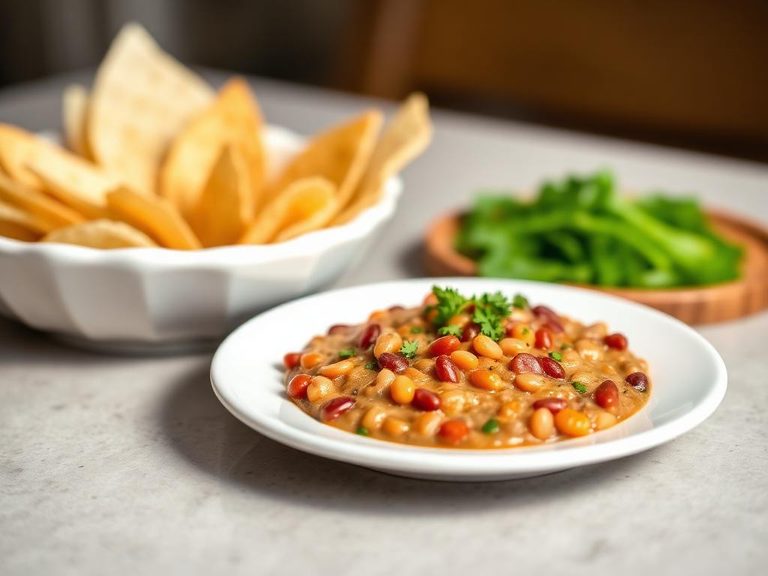
On The Border's refried beans are a creamy, savory blend of pinto beans, mashed and simmered with traditional seasonings for a rich, earthy flavor. The texture is velvety with a slight graininess, offering a satisfying mouthfeel that pairs perfectly with crispy tortilla chips or warm flour tortillas. Nutritionally, they are a standout for their high fiber content (8.2g per 100g) and solid plant-based protein (7.3g per 100g), making them a filling, nutrient-dense side.
Calorie split: 20% protein · 49% carbs · 31% fat
↓ Full nutrition💚 Why it's loved
People love these refried beans for their deep, comforting umami flavor and incredibly smooth, dip-like consistency that makes them a perfect vehicle for salsa and cheese. They are a cultural staple, embodying the heartiness of Tex-Mex cuisine and serving as a versatile foundation for countless meals.
⚠️ Watch-outs & how to enjoy it better
The primary caution is their potential sodium content, common in restaurant-style preparations, which can be high for those monitoring salt intake. They are also a legume, a common allergen for some. To counteract, pair them with fresh, low-sodium toppings like diced avocado, cilantro, or a squeeze of lime, and practice portion control by using them as a side rather than the main dish.
Key benefits
- Excellent source of dietary fiber for digestive health
- Good plant-based protein source
- Low in sugar (less than 1g per 100g)
- Provides complex carbohydrates for sustained energy
- Contains essential minerals like iron and magnesium
🍽️ Popular dishes
🌍 Where it's eaten
💡 Did you know?
The term 'refried' is a mistranslation from the Spanish 'frijoles refritos,' which actually means 'well-fried beans' or 're-fried beans,' implying they are mashed and fried in lard or oil after being boiled, not fried twice.
Full nutrition (USDA data · scales with serving)
| Water | 68.2 g |
| Energy | 144 kcal |
| Energy | 604 kj |
| Protein | 7.3 g |
| Total lipid (fat) | 5.0 g |
| Ash | 2.0 g |
| Carbohydrate, by difference | 17.5 g |
| Fiber, total dietary | 8.2 g |
| Total Sugars | 0.84 g |
| Sucrose | 0.84 g |
| Glucose | 0.00 g |
| Fructose | 0.00 g |
| Lactose | 0.00 g |
| Maltose | 0.00 g |
| Galactose | 0.00 g |
| Starch | 10.0 g |
| Calcium, Ca | 57.0 mg |
| Iron, Fe | 1.7 mg |
| Magnesium, Mg | 47.0 mg |
| Phosphorus, P | 137 mg |
| Potassium, K | 423 mg |
| Sodium, Na | 378 mg |
| Zinc, Zn | 0.98 mg |
| Copper, Cu | 0.20 mg |
| Manganese, Mn | 0.40 mg |
| Selenium, Se | 8.8 ug |
| Vitamin C, total ascorbic acid | 0.00 mg |
| Thiamin | 0.14 mg |
| Riboflavin | 0.10 mg |
| Niacin | 0.52 mg |
| Pantothenic acid | 0.28 mg |
| Folate, total | 36.0 ug |
| Folate, food | 36.0 ug |
| Choline, total | 55.7 mg |
| Betaine | 13.9 mg |
| Vitamin B-12 | 0.10 ug |
| Vitamin E (alpha-tocopherol) | 0.10 mg |
| Tocopherol, beta | 0.00 mg |
| Tocopherol, gamma | 1.6 mg |
| Tocopherol, delta | 0.05 mg |
| Tocotrienol, alpha | 0.00 mg |
| Tocotrienol, beta | 0.00 mg |
| Tocotrienol, gamma | 0.00 mg |
| Tocotrienol, delta | 0.00 mg |
| Vitamin K (phylloquinone) | 2.1 ug |
| Vitamin K (Dihydrophylloquinone) | 0.00 ug |
| Vitamin K (Menaquinone-4) | 1.0 ug |
Fat & fatty acid profile (per 100g)
| Fatty acids, total saturated | 1.8 g |
| SFA 4:0 | 0.03 g |
| SFA 6:0 | 0.02 g |
| SFA 8:0 | 0.01 g |
| SFA 10:0 | 0.04 g |
| SFA 12:0 | 0.04 g |
| SFA 14:0 | 0.14 g |
| SFA 15:0 | 0.01 g |
| SFA 16:0 | 1.0 g |
| SFA 17:0 | 0.02 g |
| SFA 18:0 | 0.45 g |
| SFA 20:0 | 0.01 g |
| SFA 22:0 | 0.00 g |
| SFA 24:0 | 0.01 g |
| Fatty acids, total monounsaturated | 1.6 g |
| MUFA 14:1 | 0.01 g |
| MUFA 15:1 | 0.00 g |
| MUFA 16:1 | 0.08 g |
| MUFA 16:1 c | 0.08 g |
| MUFA 17:1 | 0.01 g |
| MUFA 18:1 | 1.5 g |
| MUFA 18:1 c | 1.5 g |
| MUFA 20:1 | 0.03 g |
| MUFA 22:1 | 0.00 g |
| MUFA 22:1 c | 0.00 g |
| MUFA 24:1 c | 0.00 g |
| Fatty acids, total polyunsaturated | 1.0 g |
| PUFA 18:2 | 0.76 g |
| PUFA 18:2 n-6 c,c | 0.75 g |
| PUFA 18:2 CLAs | 0.01 g |
| PUFA 18:3 | 0.23 g |
| PUFA 18:3 n-3 c,c,c (ALA) | 0.23 g |
| PUFA 18:3 n-6 c,c,c | 0.00 g |
| PUFA 18:3i | 0.00 g |
| PUFA 18:4 | 0.00 g |
| PUFA 20:2 n-6 c,c | 0.02 g |
| PUFA 20:3 | 0.01 g |
| PUFA 20:3 n-3 | 0.00 g |
| PUFA 20:3 n-6 | 0.00 g |
| PUFA 20:4 | 0.01 g |
| PUFA 20:5 n-3 (EPA) | 0.00 g |
| PUFA 22:4 | 0.00 g |
| PUFA 22:5 n-3 (DPA) | 0.00 g |
| PUFA 22:6 n-3 (DHA) | 0.00 g |
| Fatty acids, total trans | 0.04 g |
| Fatty acids, total trans-monoenoic | 0.04 g |
| TFA 16:1 t | 0.00 g |
| TFA 18:1 t | 0.04 g |
| TFA 22:1 t | 0.00 g |
| TFA 18:2 t not further defined | 0.01 g |
| Fatty acids, total trans-polyenoic | 0.01 g |
| Cholesterol | 6.0 mg |
FAQ
Are refried beans vegan?
Traditional recipes often use lard (animal fat), but many restaurant and canned versions, like this one, can be made with vegetable oil. Always check the specific ingredients list to confirm.
How do I reduce the sodium in canned refried beans?
You can rinse them lightly under water in a colander or mix them with unsalted beans or mashed cooked lentils to dilute the sodium content per serving.
Can I use refried beans as a protein source in vegetarian meals?
Absolutely. They are an excellent base for vegetarian burritos, tostadas, or a protein-rich spread on toast, especially when paired with rice or quinoa to form a complete protein.
Nutrient density (calculated · NRF9.3)
Nutrient Rich Foods index: beneficial nutrients (protein, fiber, vitamins, minerals) minus saturated fat, added sugar & sodium, per 100 kcal.
NRF9.3 index — Fulgoni, Keast & Drewnowski, 2009. Computed from USDA nutrients.
Weight-loss friendliness (composite index)
Energy density 1.44 kcal/g · 20% calories from protein · 8.2 g fiber · 0.8 g sugar per 100 g.
Composite of energy density (Rolls et al., 1999), protein & fiber satiety, minus sugar. A calculated heuristic — ranks satiety-per-calorie, not a clinical measure.
Dietary load (calculated from USDA values)
Potential renal acid load. Positive = acid-forming, negative = alkaline-forming.
Sodium-to-potassium ratio: 0.89 (lower is better — aim for ≤ 1)
Sodium:potassium per WHO potassium guidance. Computed from USDA nutrients.