

Milk, buttermilk, fluid, cultured, lowfat
Whole food · Dairy and Egg Products

Photo: Wikipedia
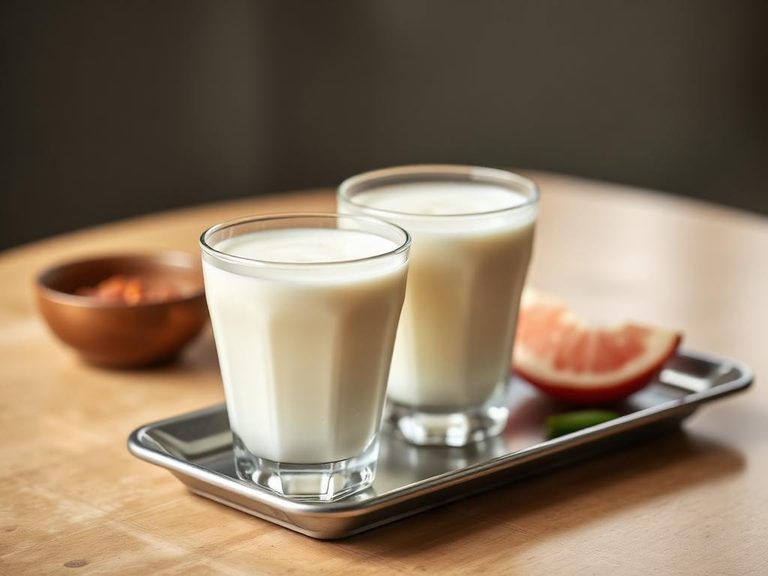
This is cultured, low-fat buttermilk—a tangy, slightly effervescent liquid with a thin, pourable consistency and a clean, yogurt-like sourness. It's a light, refreshing dairy drink with a protein-to-calorie ratio that makes it a surprisingly efficient source of nutrition. Its signature tang comes from the lactic acid fermentation process, which also gives it a subtle complexity beyond plain milk.
Calorie split: 32% protein · 46% carbs · 23% fat
↓ Full nutrition💚 Why it's loved
People love its bright, clean tang that cuts through rich foods and its versatility as both a drink and a baking ingredient. In many cultures, it's a comforting, everyday staple tied to home cooking and traditional remedies.
⚠️ Watch-outs & how to enjoy it better
The strong sour taste can be off-putting to some, and those with lactose intolerance may experience discomfort despite the fermentation. For blood sugar management, the natural sugars (lactose) can still cause a mild spike; pairing it with a source of fat or protein (like nuts or whole-grain toast) can help moderate the glycemic response.
Key benefits
- Excellent source of protein for its calorie count
- Rich in calcium and phosphorus for bone health
- Contains probiotics from live cultures for gut health
- Lower in fat than whole milk or cream
- The lactic acid can aid in mineral absorption
🍽️ Popular dishes
🌍 Where it's eaten
💡 Did you know?
The 'buttermilk' we drink today is a modern cultured product; traditional buttermilk was the thin, tangy liquid left over after churning butter from cream.
Full nutrition (USDA data · scales with serving)
| Water | 90.1 g |
| Energy | 40.0 kcal |
| Energy | 169 kj |
| Protein | 3.3 g |
| Total lipid (fat) | 1.1 g |
| Ash | 0.89 g |
| Carbohydrate, by difference | 4.8 g |
| Fiber, total dietary | 0.00 g |
| Total Sugars | 5.4 g |
| Calcium, Ca | 116 mg |
| Iron, Fe | 0.05 mg |
| Magnesium, Mg | 11.0 mg |
| Phosphorus, P | 89.0 mg |
| Potassium, K | 151 mg |
| Sodium, Na | 148 mg |
| Zinc, Zn | 0.42 mg |
| Copper, Cu | 0.01 mg |
| Manganese, Mn | 0.00 mg |
| Selenium, Se | 2.0 ug |
| Fluoride, F | 4.0 ug |
| Vitamin C, total ascorbic acid | 1.0 mg |
| Thiamin | 0.03 mg |
| Riboflavin | 0.15 mg |
| Niacin | 0.06 mg |
| Pantothenic acid | 0.28 mg |
| Vitamin B-6 | 0.03 mg |
| Folate, total | 5.0 ug |
| Folic acid | 0.00 ug |
| Folate, food | 5.0 ug |
| Folate, DFE | 5.0 ug |
| Choline, total | 17.7 mg |
| Vitamin B-12 | 0.22 ug |
| Vitamin B-12, added | 0.00 ug |
| Vitamin A, RAE | 14.0 ug |
| Retinol | 13.0 ug |
| Carotene, beta | 1.0 ug |
| Carotene, alpha | 0.00 ug |
| Cryptoxanthin, beta | 0.00 ug |
| Vitamin A, IU | 47.0 iu |
| Lycopene | 0.00 ug |
| Lutein + zeaxanthin | 0.00 ug |
| Vitamin E (alpha-tocopherol) | 0.05 mg |
| Vitamin E, added | 0.00 mg |
| Tocopherol, beta | 0.02 mg |
| Tocopherol, gamma | 0.03 mg |
| Tocopherol, delta | 0.02 mg |
| Tocotrienol, alpha | 0.00 mg |
| Tocotrienol, beta | 0.00 mg |
| Tocotrienol, gamma | 0.00 mg |
| Tocotrienol, delta | 0.00 mg |
| Vitamin D (D2 + D3), International Units | 1.0 iu |
| Vitamin D (D2 + D3) | 0.00 ug |
| Vitamin D3 (cholecalciferol) | 0.00 ug |
| Vitamin K (phylloquinone) | 0.10 ug |
| Alcohol, ethyl | 0.00 g |
| Caffeine | 0.00 mg |
| Theobromine | 0.00 mg |
Fat & fatty acid profile (per 100g)
| Fatty acids, total saturated | 0.66 g |
| SFA 4:0 | 0.03 g |
| SFA 6:0 | 0.02 g |
| SFA 8:0 | 0.01 g |
| SFA 10:0 | 0.02 g |
| SFA 12:0 | 0.03 g |
| SFA 14:0 | 0.09 g |
| SFA 16:0 | 0.23 g |
| SFA 18:0 | 0.11 g |
| Fatty acids, total monounsaturated | 0.25 g |
| MUFA 16:1 | 0.02 g |
| MUFA 18:1 | 0.22 g |
| MUFA 20:1 | 0.00 g |
| MUFA 22:1 | 0.00 g |
| Fatty acids, total polyunsaturated | 0.03 g |
| PUFA 18:2 | 0.02 g |
| PUFA 18:3 | 0.01 g |
| PUFA 18:4 | 0.00 g |
| PUFA 20:4 | 0.00 g |
| PUFA 20:5 n-3 (EPA) | 0.00 g |
| PUFA 22:5 n-3 (DPA) | 0.00 g |
| PUFA 22:6 n-3 (DHA) | 0.00 g |
| Cholesterol | 4.0 mg |
Amino acid profile (per 100g)
| Tryptophan | 0.04 g |
| Threonine | 0.14 g |
| Isoleucine | 0.17 g |
| Leucine | 0.31 g |
| Lysine | 0.28 g |
| Methionine | 0.09 g |
| Cystine | 0.02 g |
| Phenylalanine | 0.17 g |
| Tyrosine | 0.17 g |
| Valine | 0.22 g |
| Arginine | 0.10 g |
| Histidine | 0.10 g |
| Alanine | 0.11 g |
| Aspartic acid | 0.28 g |
| Glutamic acid | 0.74 g |
| Glycine | 0.07 g |
| Proline | 0.33 g |
| Serine | 0.20 g |
FAQ
Is buttermilk the same as milk with vinegar or lemon juice added?
No. Authentic cultured buttermilk is made by fermenting milk with specific bacterial cultures (like Lactococcus lactis), which develop its complex flavor and probiotic benefits. A vinegar/lemon juice mixture is a common baking substitute that mimics the acidity but lacks the live cultures and depth of flavor.
Why is it called 'butter'milk if it's low in fat?
The name is a historical artifact. Traditional buttermilk was the tangy liquid remaining after butter was churned from cream. Modern cultured buttermilk is made directly from skim or low-fat milk, hence the low fat content.
Can I use low-fat buttermilk in recipes calling for regular buttermilk?
Yes, for most baking and cooking applications. The key role of buttermilk in recipes is its acidity, which reacts with baking soda to create lift. The slight difference in fat content is usually negligible in the final product.
Nutrient density (calculated · NRF9.3)
Nutrient Rich Foods index: beneficial nutrients (protein, fiber, vitamins, minerals) minus saturated fat, added sugar & sodium, per 100 kcal.
NRF9.3 index — Fulgoni, Keast & Drewnowski, 2009. Computed from USDA nutrients.
Weight-loss friendliness (composite index)
Energy density 0.40 kcal/g · 33% calories from protein · 0.0 g fiber · 5.4 g sugar per 100 g.
Composite of energy density (Rolls et al., 1999), protein & fiber satiety, minus sugar. A calculated heuristic — ranks satiety-per-calorie, not a clinical measure.
Dietary load (calculated from USDA values)
Potential renal acid load. Positive = acid-forming, negative = alkaline-forming.
Sodium-to-potassium ratio: 0.98 (lower is better — aim for ≤ 1)
Sodium:potassium per WHO potassium guidance. Computed from USDA nutrients.