

Beef, cured, dried
Whole food · Sausages and Luncheon Meats

Photo: Wikipedia
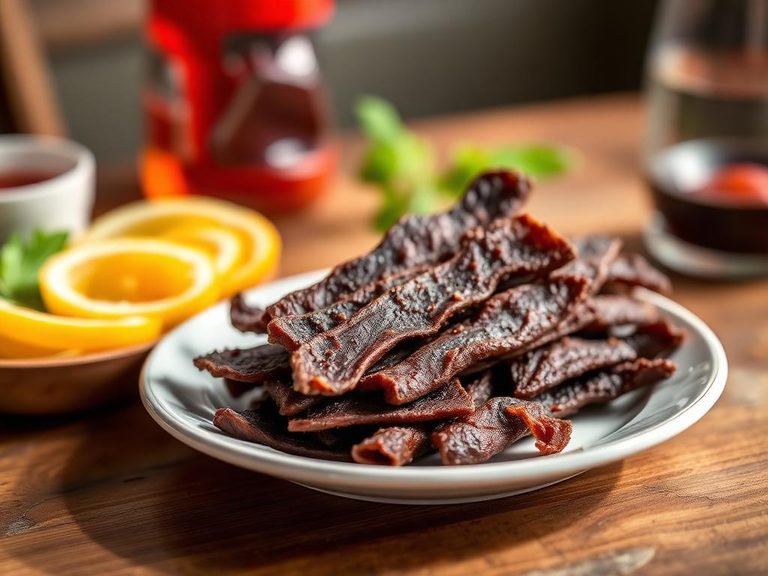
Beef, cured, dried is a concentrated, shelf-stable meat product, often called beef jerky, made by salting and dehydrating lean cuts of beef. The texture is typically tough and chewy, with a savory, salty, and sometimes smoky or sweet flavor profile depending on the cure. Nutritionally, it is a powerhouse of protein (31.1g per 100g) with minimal fat and carbohydrates.
Calorie split: 81% protein · 7% carbs · 11% fat
↓ Full nutrition💚 Why it's loved
People love it for its intense, savory umami flavor and satisfying chew, making it a highly flavorful and filling snack. Its incredible versatility and long shelf life make it a staple for hiking, travel, and quick protein boosts.
⚠️ Watch-outs & how to enjoy it better
The primary downside is its very high sodium content, which can contribute to water retention and is a concern for those managing blood pressure. Many commercial brands also contain added sugars and preservatives like nitrates. To counteract, look for low-sodium, uncured options, control portion size to about 1-2 ounces (28-56g), and pair it with a source of potassium like a banana or avocado to help balance sodium levels.
Key benefits
- Exceptionally high in complete protein for muscle maintenance and satiety.
- Low in fat and carbohydrates, making it suitable for low-carb and keto diets.
- Shelf-stable and portable, providing a convenient, non-perishable protein source.
- Rich in minerals like iron, zinc, and B vitamins, especially B12.
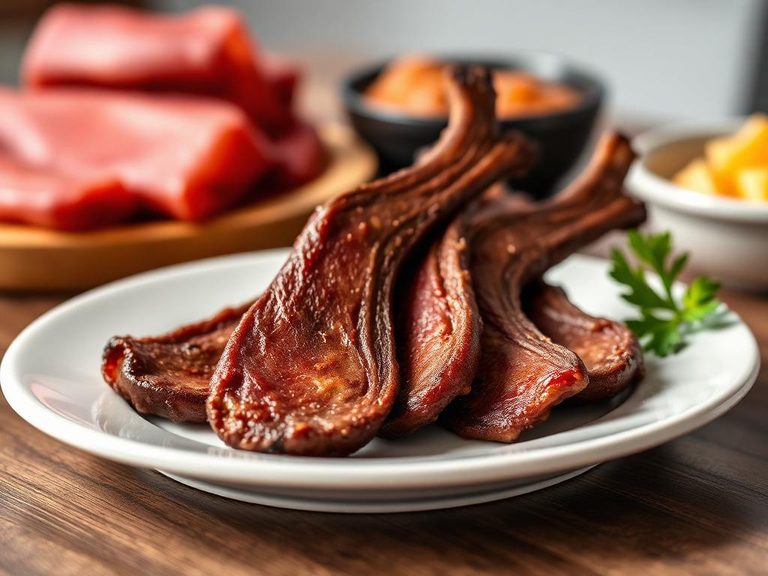
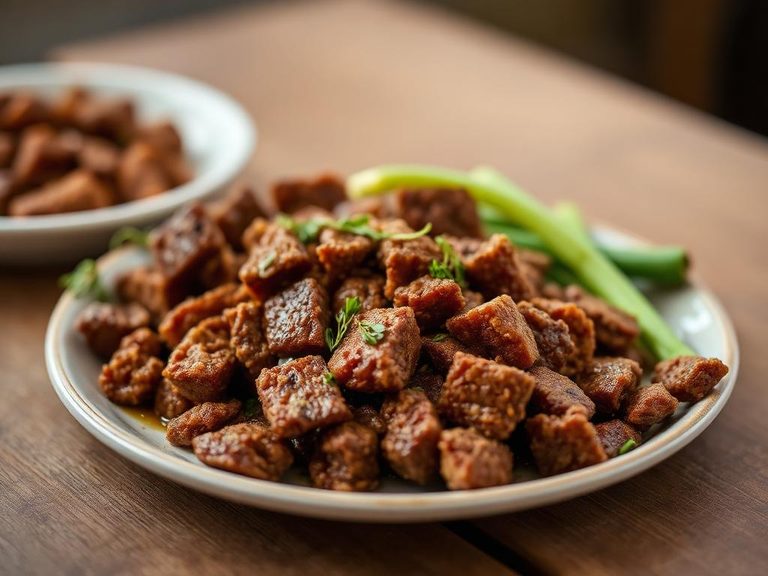
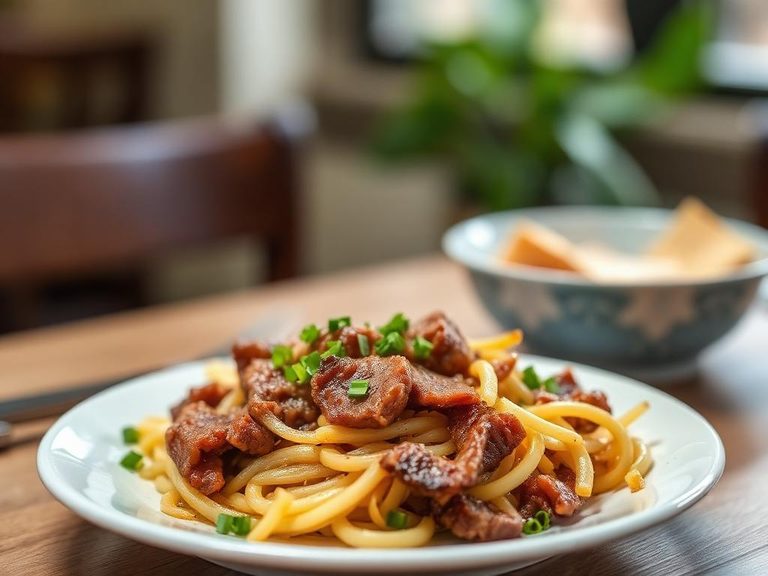
🍽️ Popular dishes
🌍 Where it's eaten
💡 Did you know?
The word 'jerky' comes from the Quechua word 'ch'arki,' meaning 'dried meat,' a preservation technique perfected by the Inca Empire long before refrigeration.
Full nutrition (USDA data · scales with serving)
| Water | 53.8 g |
| Energy | 153 kcal |
| Energy | 640 kj |
| Protein | 31.1 g |
| Total lipid (fat) | 1.9 g |
| Ash | 10.4 g |
| Carbohydrate, by difference | 2.8 g |
| Fiber, total dietary | 0.00 g |
| Total Sugars | 2.7 g |
| Calcium, Ca | 8.0 mg |
| Iron, Fe | 2.4 mg |
| Magnesium, Mg | 19.0 mg |
| Phosphorus, P | 181 mg |
| Potassium, K | 235 mg |
| Sodium, Na | 2790 mg |
| Zinc, Zn | 4.9 mg |
| Copper, Cu | 0.07 mg |
| Manganese, Mn | 0.02 mg |
| Selenium, Se | 32.4 ug |
| Fluoride, F | 8.4 ug |
| Vitamin C, total ascorbic acid | 0.00 mg |
| Thiamin | 0.07 mg |
| Riboflavin | 0.16 mg |
| Niacin | 5.2 mg |
| Pantothenic acid | 0.57 mg |
| Vitamin B-6 | 0.39 mg |
| Folate, total | 10.0 ug |
| Folic acid | 0.00 ug |
| Folate, food | 10.0 ug |
| Folate, DFE | 10.0 ug |
| Choline, total | 0.00 mg |
| Betaine | 0.00 mg |
| Vitamin B-12 | 1.6 ug |
| Vitamin B-12, added | 0.00 ug |
| Vitamin A, RAE | 0.00 ug |
| Retinol | 0.00 ug |
| Carotene, beta | 0.00 ug |
| Carotene, alpha | 0.00 ug |
| Cryptoxanthin, beta | 0.00 ug |
| Vitamin A, IU | 0.00 iu |
| Lycopene | 0.00 ug |
| Lutein + zeaxanthin | 0.00 ug |
| Vitamin E (alpha-tocopherol) | 0.38 mg |
| Vitamin E, added | 0.00 mg |
| Tocopherol, beta | 0.00 mg |
| Tocopherol, gamma | 0.00 mg |
| Tocopherol, delta | 0.00 mg |
| Vitamin D (D2 + D3), International Units | 1.0 iu |
| Vitamin D (D2 + D3) | 0.00 ug |
| Vitamin D3 (cholecalciferol) | 0.00 ug |
| Vitamin K (phylloquinone) | 1.3 ug |
| Vitamin K (Dihydrophylloquinone) | 0.00 ug |
| Alcohol, ethyl | 0.00 g |
| Caffeine | 0.00 mg |
| Theobromine | 0.00 mg |
Fat & fatty acid profile (per 100g)
| Fatty acids, total saturated | 0.95 g |
| SFA 4:0 | 0.00 g |
| SFA 6:0 | 0.00 g |
| SFA 8:0 | 0.00 g |
| SFA 10:0 | 0.00 g |
| SFA 12:0 | 0.00 g |
| SFA 14:0 | 0.07 g |
| SFA 16:0 | 0.59 g |
| SFA 18:0 | 0.29 g |
| Fatty acids, total monounsaturated | 0.84 g |
| MUFA 16:1 | 0.08 g |
| MUFA 18:1 | 0.76 g |
| MUFA 20:1 | 0.00 g |
| MUFA 22:1 | 0.00 g |
| Fatty acids, total polyunsaturated | 0.07 g |
| PUFA 18:2 | 0.06 g |
| PUFA 18:3 | 0.01 g |
| PUFA 18:4 | 0.00 g |
| PUFA 20:4 | 0.01 g |
| PUFA 20:5 n-3 (EPA) | 0.00 g |
| PUFA 22:5 n-3 (DPA) | 0.00 g |
| PUFA 22:6 n-3 (DHA) | 0.00 g |
| Cholesterol | 79.0 mg |
| Phytosterols | 0.00 mg |
Amino acid profile (per 100g)
| Tryptophan | 0.19 g |
| Threonine | 1.1 g |
| Isoleucine | 1.3 g |
| Leucine | 2.3 g |
| Lysine | 2.4 g |
| Methionine | 0.75 g |
| Cystine | 0.37 g |
| Phenylalanine | 1.1 g |
| Tyrosine | 0.92 g |
| Valine | 1.4 g |
| Arginine | 1.9 g |
| Histidine | 0.92 g |
| Alanine | 1.7 g |
| Aspartic acid | 2.6 g |
| Glutamic acid | 4.3 g |
| Glycine | 1.8 g |
| Proline | 1.4 g |
| Serine | 1.1 g |
| Hydroxyproline | 0.30 g |
FAQ
Is beef jerky a good post-workout snack?
Yes, its high protein content is excellent for muscle repair. However, be mindful of the sodium, which can be dehydrating. Pair it with water or a piece of fruit for a more balanced recovery snack.
What's the difference between jerky and biltong?
Both are dried, cured meats. Jerky is typically sliced thin, marinated, and often smoked or cooked with heat. Biltong is usually a thicker cut, cured in vinegar and air-dried, resulting in a different, often less chewy texture.
Can I make my own beef jerky at home?
Absolutely. It requires lean beef, a marinade (soy sauce, spices, etc.), and a food dehydrator or a low-temperature oven. The key is to slice against the grain for tenderness and ensure it's dried thoroughly for safe storage.
Nutrient density (calculated · NRF9.3)
Nutrient Rich Foods index: beneficial nutrients (protein, fiber, vitamins, minerals) minus saturated fat, added sugar & sodium, per 100 kcal.
NRF9.3 index — Fulgoni, Keast & Drewnowski, 2009. Computed from USDA nutrients.
Weight-loss friendliness (composite index)
Energy density 1.53 kcal/g · 81% calories from protein · 0.0 g fiber · 2.7 g sugar per 100 g.
Composite of energy density (Rolls et al., 1999), protein & fiber satiety, minus sugar. A calculated heuristic — ranks satiety-per-calorie, not a clinical measure.
Dietary load (calculated from USDA values)
Potential renal acid load. Positive = acid-forming, negative = alkaline-forming.
Sodium-to-potassium ratio: 11.87 (lower is better — aim for ≤ 1)
Sodium:potassium per WHO potassium guidance. Computed from USDA nutrients.