

Snacks, peas, roasted, wasabi-flavored
Whole food · Snacks

Photo: Wikipedia
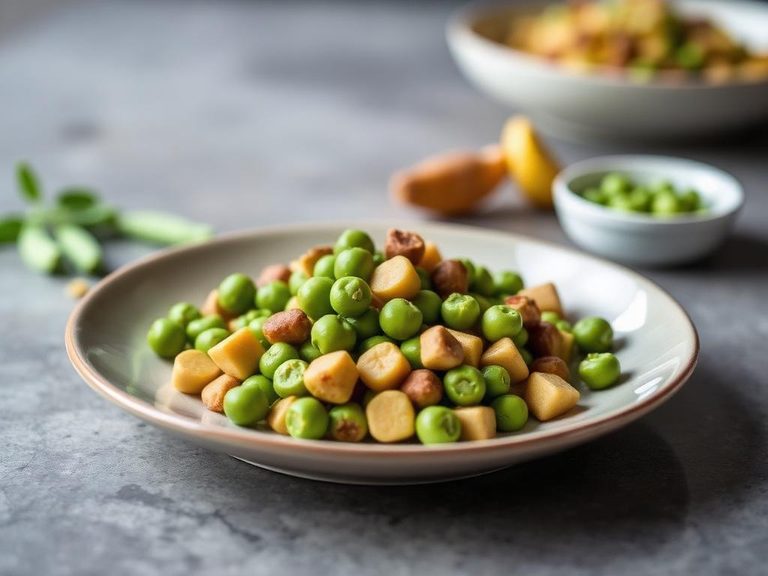
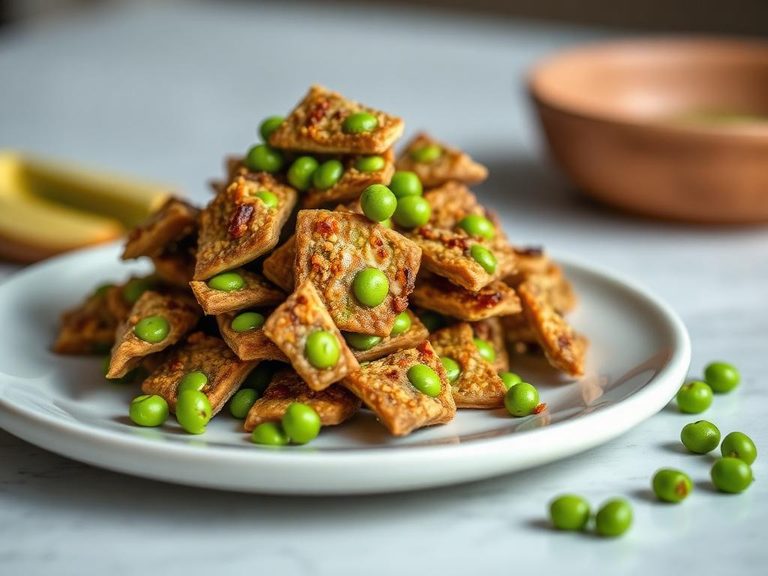
These are whole green peas, dehydrated and roasted until shatteringly crisp, then dusted with a sharp, sinus-clearing wasabi powder. The flavor is a bold, savory punch with a lingering, fiery heat that hits the nose more than the tongue. Despite the indulgent crunch and intense seasoning, they pack a notable 14g of plant-based protein per 100g serving.
Calorie split: 13% protein · 58% carbs · 29% fat
↓ Full nutrition💚 Why it's loved
People love the addictive combination of a satisfying, airy crunch with the bold, pungent kick of wasabi that provides a unique sensory experience. It's a popular savory snack in Japanese-inspired cuisine and a go-to for those seeking a flavorful, protein-rich alternative to chips.
⚠️ Watch-outs & how to enjoy it better
The wasabi seasoning can be intense for some palates and may cause a brief, sharp nasal sensation. Those watching sodium intake should be cautious, as seasoned snacks often contain added salt. To mitigate, pair with a hydrating beverage, choose low-sodium versions if available, and practice portion control by measuring out a single serving.
Key benefits
- High in plant-based protein for a snack food
- Good source of dietary fiber for digestive health
- Provides iron and folate from the pea base
- Crunchy texture satisfies savory snack cravings
- Wasabi contains compounds with potential anti-inflammatory properties
🍽️ Popular dishes
🌍 Where it's eaten
💡 Did you know?
The 'wasabi' flavor on most commercial snacks is typically derived from horseradish, mustard, and food coloring, as true wasabi (Wasabia japonica) is prohibitively expensive and difficult to cultivate.
Full nutrition (USDA data · scales with serving)
| Water | 6.9 g |
| Energy | 432 kcal |
| Energy | 1808 kj |
| Protein | 14.1 g |
| Total lipid (fat) | 14.1 g |
| Ash | 2.6 g |
| Carbohydrate, by difference | 62.2 g |
| Fiber, total dietary | 3.8 g |
| Total Sugars | 14.1 g |
| Sucrose | 12.7 g |
| Glucose | 0.24 g |
| Fructose | 0.78 g |
| Lactose | 0.00 g |
| Maltose | 0.34 g |
| Galactose | 0.00 g |
| Calcium, Ca | 123 mg |
| Iron, Fe | 3.8 mg |
| Magnesium, Mg | 102 mg |
| Phosphorus, P | 270 mg |
| Potassium, K | 732 mg |
| Sodium, Na | 300 mg |
| Zinc, Zn | 3.3 mg |
| Copper, Cu | 0.44 mg |
| Manganese, Mn | 1.3 mg |
| Selenium, Se | 7.2 ug |
| Fluoride, F | 0.00 ug |
| Vitamin C, total ascorbic acid | 0.00 mg |
| Thiamin | 0.61 mg |
| Riboflavin | 0.31 mg |
| Niacin | 5.1 mg |
| Pantothenic acid | 0.48 mg |
| Vitamin B-6 | 0.55 mg |
| Folate, total | 138 ug |
| Folic acid | 0.00 ug |
| Folate, food | 138 ug |
| Folate, DFE | 138 ug |
| Choline, total | 57.9 mg |
| Vitamin B-12 | 0.00 ug |
| Vitamin B-12, added | 0.00 ug |
| Vitamin A, RAE | 77.0 ug |
| Retinol | 0.00 ug |
| Carotene, beta | 901 ug |
| Carotene, alpha | 42.0 ug |
| Cryptoxanthin, beta | 0.00 ug |
| Vitamin A, IU | 1537 iu |
| Lycopene | 0.00 ug |
| Lutein + zeaxanthin | 4930 ug |
| Vitamin E (alpha-tocopherol) | 2.3 mg |
| Vitamin E, added | 0.00 mg |
| Tocopherol, beta | 0.00 mg |
| Tocopherol, gamma | 1.9 mg |
| Tocopherol, delta | 0.03 mg |
| Tocotrienol, alpha | 2.8 mg |
| Tocotrienol, beta | 0.00 mg |
| Tocotrienol, gamma | 1.9 mg |
| Tocotrienol, delta | 0.15 mg |
| Vitamin D (D2 + D3), International Units | 0.00 iu |
| Vitamin D (D2 + D3) | 0.00 ug |
| Vitamin K (phylloquinone) | 50.3 ug |
| Alcohol, ethyl | 0.00 g |
| Caffeine | 0.00 mg |
| Theobromine | 0.00 mg |
Fat & fatty acid profile (per 100g)
| Fatty acids, total saturated | 5.3 g |
| SFA 4:0 | 0.00 g |
| SFA 6:0 | 0.00 g |
| SFA 8:0 | 0.00 g |
| SFA 10:0 | 0.00 g |
| SFA 12:0 | 0.01 g |
| SFA 14:0 | 0.10 g |
| SFA 16:0 | 4.7 g |
| SFA 18:0 | 0.46 g |
| Fatty acids, total monounsaturated | 5.8 g |
| MUFA 16:1 | 0.05 g |
| MUFA 18:1 | 5.7 g |
| MUFA 20:1 | 0.01 g |
| MUFA 22:1 | 0.00 g |
| Fatty acids, total polyunsaturated | 2.0 g |
| PUFA 18:2 | 1.8 g |
| PUFA 18:3 | 0.13 g |
| PUFA 18:4 | 0.00 g |
| PUFA 20:4 | 0.00 g |
| PUFA 20:5 n-3 (EPA) | 0.00 g |
| PUFA 22:5 n-3 (DPA) | 0.00 g |
| PUFA 22:6 n-3 (DHA) | 0.00 g |
| Cholesterol | 0.00 mg |
| Phytosterols | 0.00 mg |
Amino acid profile (per 100g)
Estimated from Snacks, corn-based, extruded, chips, plain — USDA does not publish this profile for Snacks.
| Tryptophan | 0.05 g |
| Threonine | 0.25 g |
| Isoleucine | 0.23 g |
| Leucine | 0.80 g |
| Lysine | 0.18 g |
| Methionine | 0.14 g |
| Cystine | 0.12 g |
| Phenylalanine | 0.32 g |
| Tyrosine | 0.27 g |
| Valine | 0.33 g |
| Arginine | 0.33 g |
| Histidine | 0.20 g |
| Alanine | 0.49 g |
| Aspartic acid | 0.46 g |
| Glutamic acid | 1.2 g |
| Glycine | 0.27 g |
| Proline | 0.57 g |
| Serine | 0.31 g |
FAQ
Are wasabi peas gluten-free?
It depends on the brand. While peas are naturally gluten-free, some manufacturers use wheat-based ingredients in the seasoning or process them in facilities that handle wheat. Always check the label for a certified gluten-free claim.
Why are they so crunchy?
The peas are first soaked, then often fried or baked at a low temperature to remove moisture. This process creates a porous, airy internal structure that results in a light, shattering crunch rather than a hard, dense one.
Can I make them at home?
Yes! Soak dried green peas, pat them very dry, then roast or air-fry them until crisp. Toss with a mixture of wasabi powder, salt, and a tiny bit of oil. The key is ensuring the peas are completely dry before cooking for maximum crunch.
Nutrient density (calculated · NRF9.3)
Nutrient Rich Foods index: beneficial nutrients (protein, fiber, vitamins, minerals) minus saturated fat, added sugar & sodium, per 100 kcal.
NRF9.3 index — Fulgoni, Keast & Drewnowski, 2009. Computed from USDA nutrients.
Weight-loss friendliness (composite index)
Energy density 4.32 kcal/g · 13% calories from protein · 3.8 g fiber · 14.1 g sugar per 100 g.
Composite of energy density (Rolls et al., 1999), protein & fiber satiety, minus sugar. A calculated heuristic — ranks satiety-per-calorie, not a clinical measure.
Dietary load (calculated from USDA values)
Potential renal acid load. Positive = acid-forming, negative = alkaline-forming.
Sodium-to-potassium ratio: 0.41 (lower is better — aim for ≤ 1)
Sodium:potassium per WHO potassium guidance. Computed from USDA nutrients.