

Pepperidge Farm, Goldfish, Baked Snack Crackers, Original
Whole food · Baked Products
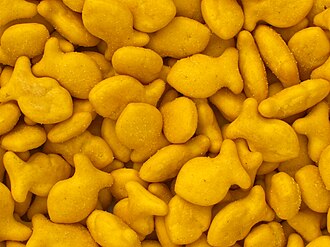
Photo: Wikipedia
Pepperidge Farm Goldfish are iconic, fish-shaped baked snack crackers with a satisfyingly crisp texture and a mild, savory cheddar cheese flavor. They are a carbohydrate-dense snack, providing about 66 grams of carbs per 100 grams, making them a quick source of energy.
Calorie split: 8% protein · 56% carbs · 36% fat
↓ Full nutrition💚 Why it's loved
People love Goldfish for their playful shape, addictive crunch, and savory, cheesy flavor that appeals to both kids and adults. They are a nostalgic, versatile snack enjoyed straight from the bag, in lunchboxes, or as a crunchy topping for soups and salads.
⚠️ Watch-outs & how to enjoy it better
As a refined carbohydrate snack, they can cause a rapid rise in blood sugar, which is a consideration for individuals managing diabetes or insulin resistance. They are also a common wheat (gluten) and milk allergen. To counteract this, pair a small handful with a source of protein or healthy fat (like cheese, nuts, or hummus) to slow digestion and promote satiety, and practice strict portion control.
Key benefits
- Provides quick energy from carbohydrates
- Contains a moderate amount of protein for a cracker
- Baked, not fried, reducing fat content compared to some chips
- Convenient, portable, and shelf-stable snack
- Low in sugar, with only about 1 gram per 100g
🍽️ Popular dishes

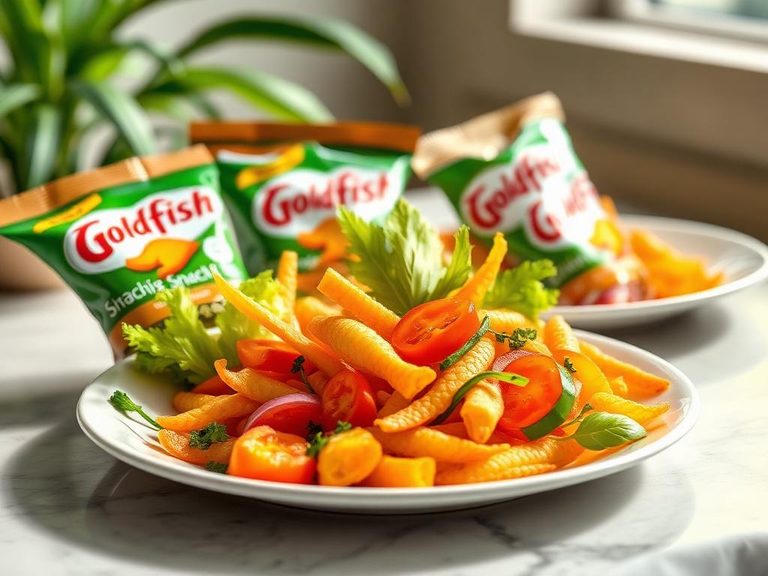

🌍 Where it's eaten
💡 Did you know?
The Goldfish cracker was invented in 1964 by Margaret Rudkin, the founder of Pepperidge Farm, who was inspired by a traditional Swiss fish-shaped cookie called 'Fischli'.
Full nutrition (USDA data · scales with serving)
| Water | 3.5 g |
| Energy | 467 kcal |
| Energy | 1953 kj |
| Protein | 9.4 g |
| Total lipid (fat) | 18.4 g |
| Ash | 2.9 g |
| Carbohydrate, by difference | 65.8 g |
| Fiber, total dietary | 2.4 g |
| Total Sugars | 1.0 g |
| Sucrose | 0.00 g |
| Glucose | 0.00 g |
| Fructose | 0.00 g |
| Lactose | 0.00 g |
| Maltose | 1.0 g |
| Galactose | 0.00 g |
| Starch | 59.4 g |
| Calcium, Ca | 74.0 mg |
| Iron, Fe | 4.7 mg |
| Magnesium, Mg | 23.0 mg |
| Phosphorus, P | 156 mg |
| Potassium, K | 169 mg |
| Sodium, Na | 947 mg |
| Zinc, Zn | 0.97 mg |
| Copper, Cu | 0.13 mg |
| Manganese, Mn | 0.53 mg |
| Selenium, Se | 4.0 ug |
| Thiamin | 0.83 mg |
| Riboflavin | 0.51 mg |
| Niacin | 6.6 mg |
| Pantothenic acid | 0.69 mg |
| Vitamin B-6 | 0.06 mg |
| Folate, total | 153 ug |
| Folate, food | 153 ug |
| Vitamin E (alpha-tocopherol) | 3.7 mg |
| Tocopherol, beta | 0.17 mg |
| Tocopherol, gamma | 5.8 mg |
| Tocopherol, delta | 0.10 mg |
| Tocotrienol, alpha | 0.10 mg |
| Tocotrienol, beta | 0.83 mg |
| Tocotrienol, gamma | 0.00 mg |
| Tocotrienol, delta | 0.00 mg |
| Vitamin K (phylloquinone) | 27.7 ug |
| Vitamin K (Dihydrophylloquinone) | 0.00 ug |
| Vitamin K (Menaquinone-4) | 0.00 ug |
Fat & fatty acid profile (per 100g)
| Fatty acids, total saturated | 1.4 g |
| SFA 4:0 | 0.00 g |
| SFA 6:0 | 0.00 g |
| SFA 8:0 | 0.00 g |
| SFA 10:0 | 0.00 g |
| SFA 12:0 | 0.00 g |
| SFA 14:0 | 0.01 g |
| SFA 15:0 | 0.01 g |
| SFA 16:0 | 0.84 g |
| SFA 17:0 | 0.01 g |
| SFA 18:0 | 0.37 g |
| SFA 20:0 | 0.11 g |
| SFA 22:0 | 0.05 g |
| SFA 24:0 | 0.03 g |
| Fatty acids, total monounsaturated | 11.0 g |
| MUFA 14:1 | 0.00 g |
| MUFA 15:1 | 0.00 g |
| MUFA 16:1 | 0.06 g |
| MUFA 16:1 c | 0.06 g |
| MUFA 17:1 | 0.01 g |
| MUFA 18:1 | 10.7 g |
| MUFA 18:1 c | 10.7 g |
| MUFA 20:1 | 0.20 g |
| MUFA 22:1 | 0.01 g |
| MUFA 22:1 c | 0.01 g |
| MUFA 24:1 c | 0.02 g |
| Fatty acids, total polyunsaturated | 4.3 g |
| PUFA 18:2 | 3.9 g |
| PUFA 18:2 n-6 c,c | 3.9 g |
| PUFA 18:2 CLAs | 0.01 g |
| PUFA 18:3 | 0.44 g |
| PUFA 18:3 n-3 c,c,c (ALA) | 0.42 g |
| PUFA 18:3 n-6 c,c,c | 0.02 g |
| PUFA 18:3i | 0.00 g |
| PUFA 18:4 | 0.00 g |
| PUFA 20:2 n-6 c,c | 0.01 g |
| PUFA 20:3 | 0.00 g |
| PUFA 20:3 n-3 | 0.00 g |
| PUFA 20:3 n-6 | 0.00 g |
| PUFA 20:4 | 0.00 g |
| PUFA 20:5 n-3 (EPA) | 0.00 g |
| PUFA 22:4 | 0.00 g |
| PUFA 22:5 n-3 (DPA) | 0.00 g |
| PUFA 22:6 n-3 (DHA) | 0.00 g |
| Fatty acids, total trans | 0.03 g |
| Fatty acids, total trans-monoenoic | 0.01 g |
| TFA 16:1 t | 0.00 g |
| TFA 18:1 t | 0.01 g |
| TFA 22:1 t | 0.00 g |
| TFA 18:2 t not further defined | 0.02 g |
| Fatty acids, total trans-polyenoic | 0.02 g |
FAQ
Are Goldfish crackers healthy?
Goldfish are a baked, low-sugar snack, but they are made from refined white flour and are calorie-dense. They can be part of a balanced diet in moderation, especially when paired with protein or vegetables to create a more complete snack.
Do Goldfish contain gluten?
Yes, the original Goldfish crackers are made with enriched wheat flour and contain gluten. They are not suitable for individuals with celiac disease or gluten sensitivity.
Why are Goldfish so addictive?
Their appeal lies in the combination of a light, crispy texture, a savory umami flavor from cheese and seasonings, and the fun, interactive shape. This creates a satisfying sensory experience that encourages repeated eating.
Nutrient density (calculated · NRF9.3)
Nutrient Rich Foods index: beneficial nutrients (protein, fiber, vitamins, minerals) minus saturated fat, added sugar & sodium, per 100 kcal.
NRF9.3 index — Fulgoni, Keast & Drewnowski, 2009. Computed from USDA nutrients.
Weight-loss friendliness (composite index)
Energy density 4.67 kcal/g · 8% calories from protein · 2.4 g fiber · 1.0 g sugar per 100 g.
Composite of energy density (Rolls et al., 1999), protein & fiber satiety, minus sugar. A calculated heuristic — ranks satiety-per-calorie, not a clinical measure.
Dietary load (calculated from USDA values)
Potential renal acid load. Positive = acid-forming, negative = alkaline-forming.
Sodium-to-potassium ratio: 5.60 (lower is better — aim for ≤ 1)
Sodium:potassium per WHO potassium guidance. Computed from USDA nutrients.