

Oil, industrial, palm kernel (hydrogenated) , used for whipped toppings, non-dairy
Whole food · Fats and Oils
This is a highly refined, hydrogenated palm kernel oil engineered specifically for the food industry. It has a neutral flavor and a smooth, creamy texture when whipped, providing a stable, non-dairy base for whipped toppings. Nutritionally, it is a pure, dense source of fat, delivering 884 kcal per 100g with no protein, carbs, or fiber.
Calorie split: 0% protein · 0% carbs · 100% fat
↓ Full nutrition💚 Why it's loved
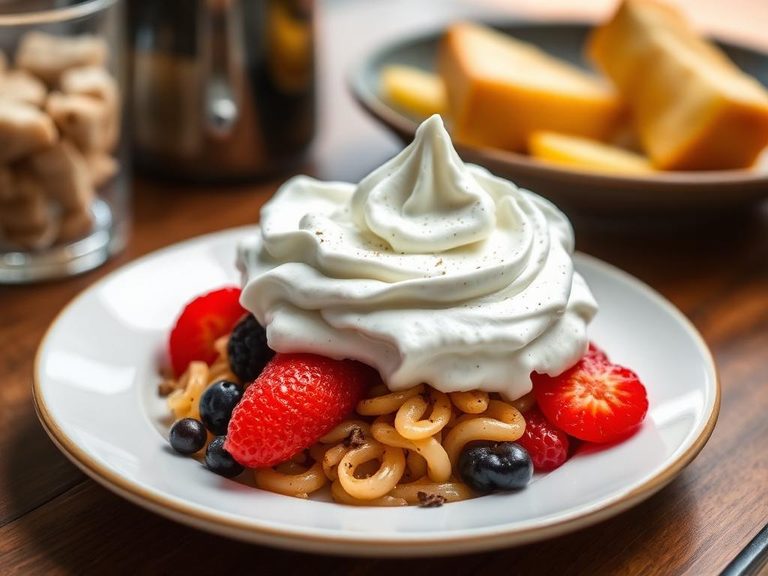
Food manufacturers and bakers love it for its functional properties—it whips into a stiff, stable foam that holds its shape on pies, cakes, and hot beverages without the dairy allergen concerns or rapid melting of real cream.
⚠️ Watch-outs & how to enjoy it better
This oil is very high in saturated fat and may contain trace trans fats from hydrogenation, which health-conscious consumers often limit. To counteract this, use it sparingly as an occasional treat rather than a daily staple, and balance meals with fiber-rich foods like vegetables or whole grains.
Key benefits
- Provides excellent structure and stability for whipped toppings
- Offers a neutral flavor that doesn't compete with other ingredients
- Resists melting at room temperature, maintaining texture in desserts
- Cost-effective ingredient for large-scale food production
- Long shelf life due to hydrogenation process
🍽️ Popular dishes



🌍 Where it's eaten
💡 Did you know?
Palm kernel oil comes from the seed (kernel) inside the palm fruit, not from the fleshy fruit itself, which is where regular palm oil comes from.
Full nutrition (USDA data · scales with serving)
| Water | 0.04 g |
| Energy | 884 kcal |
| Energy | 3699 kj |
| Protein | 0.00 g |
| Total lipid (fat) | 100 g |
| Ash | 0.01 g |
| Carbohydrate, by difference | 0.00 g |
| Fiber, total dietary | 0.00 g |
| Total Sugars | 0.00 g |
| Calcium, Ca | 1.0 mg |
| Iron, Fe | 0.15 mg |
| Magnesium, Mg | 0.00 mg |
| Phosphorus, P | 0.00 mg |
| Potassium, K | 2.0 mg |
| Sodium, Na | 6.0 mg |
| Zinc, Zn | 0.04 mg |
| Copper, Cu | 0.00 mg |
| Manganese, Mn | 0.00 mg |
| Selenium, Se | 0.00 ug |
| Vitamin C, total ascorbic acid | 0.00 mg |
| Thiamin | 0.00 mg |
| Riboflavin | 0.00 mg |
| Niacin | 0.00 mg |
| Pantothenic acid | 0.00 mg |
| Vitamin B-6 | 0.00 mg |
| Folate, total | 0.00 ug |
| Folic acid | 0.00 ug |
| Folate, food | 0.00 ug |
| Folate, DFE | 0.00 ug |
| Choline, total | 0.20 mg |
| Vitamin B-12 | 0.00 ug |
| Vitamin B-12, added | 0.00 ug |
| Vitamin A, RAE | 0.00 ug |
| Retinol | 0.00 ug |
| Carotene, beta | 0.00 ug |
| Carotene, alpha | 0.00 ug |
| Cryptoxanthin, beta | 0.00 ug |
| Vitamin A, IU | 0.00 iu |
| Lycopene | 0.00 ug |
| Lutein + zeaxanthin | 0.00 ug |
| Vitamin E (alpha-tocopherol) | 3.8 mg |
| Vitamin E, added | 0.00 mg |
| Vitamin K (phylloquinone) | 24.7 ug |
| Alcohol, ethyl | 0.00 g |
| Caffeine | 0.00 mg |
| Theobromine | 0.00 mg |
Fat & fatty acid profile (per 100g)
| Fatty acids, total saturated | 89.0 g |
| SFA 4:0 | 0.07 g |
| SFA 6:0 | 0.33 g |
| SFA 8:0 | 3.9 g |
| SFA 10:0 | 3.3 g |
| SFA 12:0 | 45.3 g |
| SFA 14:0 | 13.9 g |
| SFA 16:0 | 7.4 g |
| SFA 18:0 | 14.6 g |
| SFA 20:0 | 0.21 g |
| Fatty acids, total monounsaturated | 4.9 g |
| MUFA 16:1 | 0.00 g |
| MUFA 18:1 | 4.9 g |
| MUFA 18:1 c | 1.3 g |
| MUFA 20:1 | 0.00 g |
| MUFA 22:1 | 0.00 g |
| Fatty acids, total polyunsaturated | 0.00 g |
| PUFA 18:2 | 0.00 g |
| PUFA 18:2 n-6 c,c | 0.00 g |
| PUFA 18:3 | 0.00 g |
| PUFA 18:3i | 0.00 g |
| PUFA 18:4 | 0.00 g |
| PUFA 20:4 | 0.00 g |
| PUFA 20:5 n-3 (EPA) | 0.00 g |
| PUFA 22:5 n-3 (DPA) | 0.00 g |
| PUFA 22:6 n-3 (DHA) | 0.00 g |
| Fatty acids, total trans | 3.7 g |
| Fatty acids, total trans-monoenoic | 3.7 g |
| TFA 18:1 t | 3.7 g |
| Fatty acids, total trans-polyenoic | 0.00 g |
| Cholesterol | 0.00 mg |
| Phytosterols | 95.0 mg |
Amino acid profile (per 100g)
| Tryptophan | 0.00 g |
| Threonine | 0.00 g |
| Isoleucine | 0.00 g |
| Leucine | 0.00 g |
| Lysine | 0.00 g |
| Methionine | 0.00 g |
| Cystine | 0.00 g |
| Phenylalanine | 0.00 g |
| Tyrosine | 0.00 g |
| Valine | 0.00 g |
| Arginine | 0.00 g |
| Histidine | 0.00 g |
| Alanine | 0.00 g |
| Aspartic acid | 0.00 g |
| Glutamic acid | 0.00 g |
| Glycine | 0.00 g |
| Proline | 0.00 g |
| Serine | 0.00 g |
FAQ
Is this the same as regular palm oil?
No. They come from different parts of the oil palm fruit. Palm oil is pressed from the fleshy fruit, while palm kernel oil is extracted from the seed inside. Palm kernel oil is higher in saturated fat and is often hydrogenated for specific food uses like whipped toppings.
Why is it used instead of dairy cream?
It's used for its superior stability, longer shelf life, lower cost, and because it's dairy-free, making it suitable for vegans and those with lactose intolerance or milk allergies. It also holds its shape better in certain applications.
What does 'hydrogenated' mean in this context?
Hydrogenation is a process that adds hydrogen to liquid vegetable oils to make them more solid at room temperature. This improves texture and shelf life but can create trans fats, which is why many food manufacturers are now moving toward alternative processes.
Nutrient density (calculated · NRF9.3)
Nutrient Rich Foods index: beneficial nutrients (protein, fiber, vitamins, minerals) minus saturated fat, added sugar & sodium, per 100 kcal.
NRF9.3 index — Fulgoni, Keast & Drewnowski, 2009. Computed from USDA nutrients.
Weight-loss friendliness (composite index)
Energy density 8.84 kcal/g · 0% calories from protein · 0.0 g fiber · 0.0 g sugar per 100 g.
Composite of energy density (Rolls et al., 1999), protein & fiber satiety, minus sugar. A calculated heuristic — ranks satiety-per-calorie, not a clinical measure.
Dietary load (calculated from USDA values)
Potential renal acid load. Positive = acid-forming, negative = alkaline-forming.
Sodium-to-potassium ratio: 3.00 (lower is better — aim for ≤ 1)
Sodium:potassium per WHO potassium guidance. Computed from USDA nutrients.