

CRACKER BARREL, farm raised catfish platter
Whole food · Restaurant Foods

Photo: Wikipedia
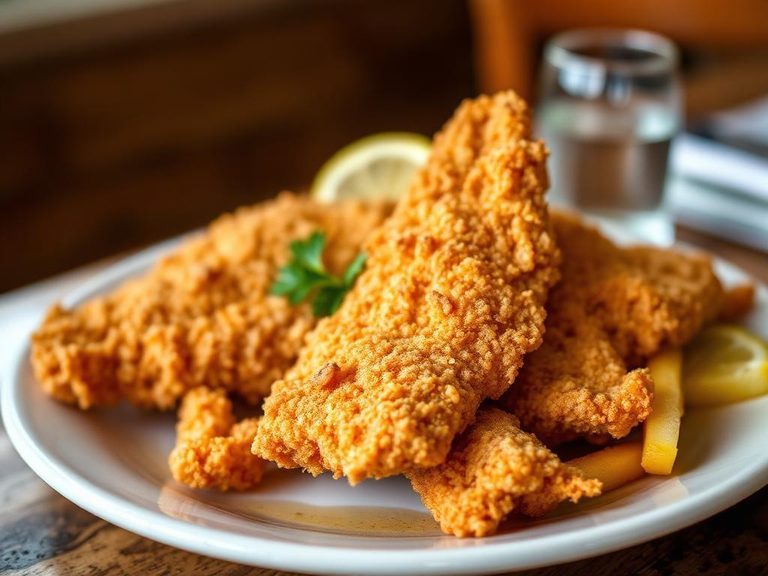
This is a classic Southern diner platter featuring tender, farm-raised catfish fillets coated in a seasoned cornmeal crust and fried to a golden crisp. The exterior offers a satisfying crunch, giving way to mild, flaky, and moist white fish inside. Nutritionally, it's a high-protein, moderate-fat dish with minimal carbohydrates, making it a hearty centerpiece.
Calorie split: 34% protein · 8% carbs · 58% fat
↓ Full nutrition💚 Why it's loved
People adore the comforting contrast of the crunchy, savory cornmeal crust against the delicate, mild fish. It's a beloved staple of Southern U.S. cuisine, evoking nostalgia for family meals and roadside diners.
⚠️ Watch-outs & how to enjoy it better
The deep-frying method significantly increases the calorie and fat content compared to other preparations. Those monitoring sodium or saturated fat intake should be cautious, as the breading and frying oil add substantial amounts. To counteract this, pair the platter with a large portion of steamed or roasted non-starchy vegetables (like collard greens or green beans) to add fiber and volume, and consider eating only one fillet while sharing the sides.
Key benefits
- Excellent source of lean, complete protein
- Rich in essential minerals like phosphorus and selenium
- Provides heart-healthy omega-3 fatty acids
- Low in carbohydrates and sugar
- Farm-raised sourcing ensures consistent availability
🍽️ Popular dishes

🌍 Where it's eaten
💡 Did you know?
Farm-raised catfish are often raised in flooded ponds that mimic their natural habitat, and they are typically fed a grain-based diet, which contributes to their mild, non-muddy flavor.
Full nutrition (USDA data · scales with serving)
| Water | 52.3 g |
| Energy | 266 kcal |
| Energy | 1115 kj |
| Protein | 22.9 g |
| Total lipid (fat) | 17.1 g |
| Ash | 2.4 g |
| Carbohydrate, by difference | 5.3 g |
| Fiber, total dietary | 1.6 g |
| Calcium, Ca | 43.0 mg |
| Iron, Fe | 0.71 mg |
| Magnesium, Mg | 34.0 mg |
| Phosphorus, P | 470 mg |
| Potassium, K | 434 mg |
| Sodium, Na | 414 mg |
| Zinc, Zn | 0.94 mg |
| Copper, Cu | 0.05 mg |
| Manganese, Mn | 0.07 mg |
| Selenium, Se | 0.00 ug |
| Thiamin | 0.11 mg |
| Riboflavin | 0.09 mg |
| Niacin | 3.1 mg |
| Pantothenic acid | 0.61 mg |
| Vitamin B-6 | 0.18 mg |
| Vitamin B-12 | 3.1 ug |
| Vitamin A, RAE | 0.00 ug |
| Retinol | 0.00 ug |
| Vitamin A, IU | 0.00 iu |
| Vitamin K (phylloquinone) | 24.7 ug |
| Vitamin K (Dihydrophylloquinone) | 0.00 ug |
| Vitamin K (Menaquinone-4) | 0.00 ug |
Fat & fatty acid profile (per 100g)
| Fatty acids, total saturated | 3.2 g |
| SFA 8:0 | 0.01 g |
| SFA 10:0 | 0.01 g |
| SFA 12:0 | 0.01 g |
| SFA 14:0 | 0.05 g |
| SFA 15:0 | 0.01 g |
| SFA 16:0 | 2.0 g |
| SFA 17:0 | 0.02 g |
| SFA 18:0 | 1.0 g |
| SFA 20:0 | 0.05 g |
| SFA 22:0 | 0.05 g |
| SFA 24:0 | 0.02 g |
| Fatty acids, total monounsaturated | 4.6 g |
| MUFA 14:1 | 0.00 g |
| MUFA 15:1 | 0.00 g |
| MUFA 16:1 | 0.08 g |
| MUFA 16:1 c | 0.08 g |
| MUFA 17:1 | 0.00 g |
| MUFA 18:1 | 4.4 g |
| MUFA 18:1 c | 4.3 g |
| MUFA 20:1 | 0.13 g |
| MUFA 22:1 | 0.01 g |
| MUFA 22:1 c | 0.01 g |
| MUFA 24:1 c | 0.00 g |
| Fatty acids, total polyunsaturated | 7.6 g |
| PUFA 18:2 | 6.7 g |
| PUFA 18:2 n-6 c,c | 6.5 g |
| PUFA 18:2 CLAs | 0.03 g |
| PUFA 18:3 | 0.69 g |
| PUFA 18:3 n-3 c,c,c (ALA) | 0.68 g |
| PUFA 18:3 n-6 c,c,c | 0.01 g |
| PUFA 18:4 | 0.00 g |
| PUFA 20:2 n-6 c,c | 0.03 g |
| PUFA 20:3 | 0.05 g |
| PUFA 20:3 n-3 | 0.00 g |
| PUFA 20:3 n-6 | 0.05 g |
| PUFA 20:4 | 0.06 g |
| PUFA 20:5 n-3 (EPA) | 0.01 g |
| PUFA 22:4 | 0.02 g |
| PUFA 22:5 n-3 (DPA) | 0.01 g |
| PUFA 22:6 n-3 (DHA) | 0.07 g |
| Fatty acids, total trans | 0.19 g |
| Fatty acids, total trans-monoenoic | 0.09 g |
| TFA 16:1 t | 0.00 g |
| TFA 18:1 t | 0.09 g |
| TFA 22:1 t | 0.00 g |
| TFA 18:2 t not further defined | 0.10 g |
| Fatty acids, total trans-polyenoic | 0.10 g |
| Cholesterol | 67.0 mg |
Amino acid profile (per 100g)
| Tryptophan | 0.25 g |
| Threonine | 1.1 g |
| Isoleucine | 1.1 g |
| Leucine | 1.9 g |
| Lysine | 2.2 g |
| Methionine | 0.66 g |
| Cystine | 0.23 g |
| Phenylalanine | 0.95 g |
| Tyrosine | 0.73 g |
| Valine | 2.0 g |
| Arginine | 1.5 g |
| Histidine | 0.51 g |
| Alanine | 1.4 g |
| Aspartic acid | 2.4 g |
| Glutamic acid | 3.6 g |
| Glycine | 1.1 g |
| Proline | 0.91 g |
| Serine | 0.94 g |
FAQ
Is catfish a healthy fish to eat?
Yes, catfish is a good source of protein and omega-3 fatty acids. However, the preparation method (like deep-frying) greatly affects its overall healthiness. Grilled or baked catfish is a leaner option.
What does farm-raised catfish taste like?
Farm-raised catfish has a mild, slightly sweet, and clean flavor without the 'muddy' taste sometimes associated with wild-caught varieties. Its texture is firm yet tender and flaky when cooked.
Why is catfish often fried in cornmeal?
The cornmeal crust is a traditional Southern technique. It creates a deliciously crunchy, golden exterior that protects the delicate fish during frying and adds a savory, slightly gritty texture that pairs perfectly with the mild flesh.
Nutrient density (calculated · NRF9.3)
Nutrient Rich Foods index: beneficial nutrients (protein, fiber, vitamins, minerals) minus saturated fat, added sugar & sodium, per 100 kcal.
NRF9.3 index — Fulgoni, Keast & Drewnowski, 2009. Computed from USDA nutrients.
Weight-loss friendliness (composite index)
Energy density 2.66 kcal/g · 34% calories from protein · 1.6 g fiber · 0.0 g sugar per 100 g.
Composite of energy density (Rolls et al., 1999), protein & fiber satiety, minus sugar. A calculated heuristic — ranks satiety-per-calorie, not a clinical measure.
Dietary load (calculated from USDA values)
Potential renal acid load. Positive = acid-forming, negative = alkaline-forming.
Sodium-to-potassium ratio: 0.95 (lower is better — aim for ≤ 1)
Sodium:potassium per WHO potassium guidance. Computed from USDA nutrients.