Nectarines, raw
Whole food · Fruits and Fruit Juices

Photo: Wikipedia
A nectarine is a smooth-skinned peach, offering a juicy, sweet-tart flavor with a firm yet yielding texture. Its vibrant orange-red flesh is packed with vitamins A and C, and its low calorie count makes it a refreshing, nutrient-dense snack.
💚 Why it's loved
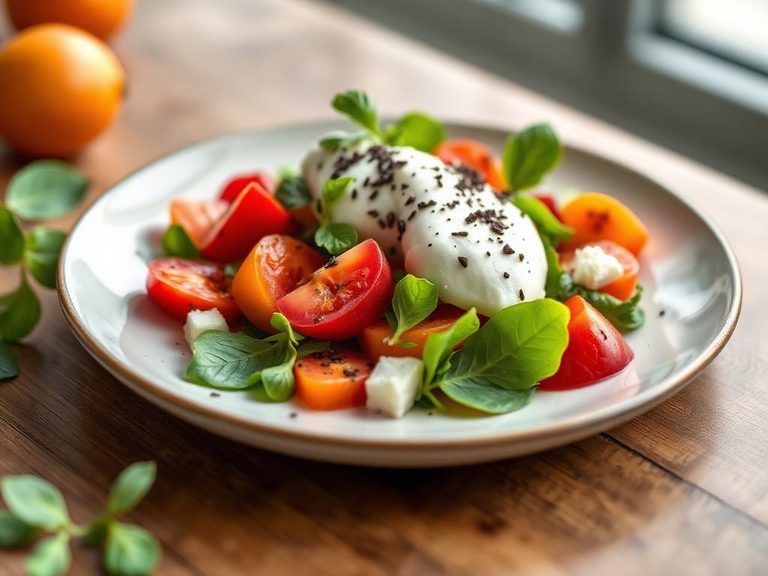
People love nectarines for their intense, honeyed sweetness and satisfying crunch, enjoying them fresh off the tree or sliced into summer salads. They are a beloved symbol of summer harvests in many cultures.
⚠️ Watch-outs & how to enjoy it better
Nectarines have a moderate glycemic index, which can cause blood sugar spikes if eaten in large quantities alone. To counteract this, pair them with a source of protein or healthy fat, like Greek yogurt or a handful of nuts, to slow sugar absorption.
Key benefits
- Rich in beta-carotene, which supports eye health.
- Good source of vitamin C for immune function.
- Contains potassium to help regulate blood pressure.
- Provides dietary fiber for digestive health.
- Low in calories and naturally fat-free.
🍽️ Popular dishes

🌍 Where it's eaten
💡 Did you know?
Nectarines are not a hybrid of a peach and a plum; they are a natural genetic variant of the peach, differing by a single recessive gene that results in their smooth skin.
Full nutrition (scales with serving)
| Water | 87.6 g |
| Energy | 44.0 kcal |
| Energy | 185 kj |
| Protein | 1.1 g |
| Total lipid (fat) | 0.32 g |
| Ash | 0.48 g |
| Carbohydrate, by difference | 10.6 g |
| Fiber, total dietary | 1.7 g |
| Total Sugars | 7.9 g |
| Sucrose | 4.9 g |
| Glucose | 1.6 g |
| Fructose | 1.4 g |
| Lactose | 0.00 g |
| Maltose | 0.00 g |
| Galactose | 0.00 g |
| Starch | 0.07 g |
| Calcium, Ca | 6.0 mg |
| Iron, Fe | 0.28 mg |
| Magnesium, Mg | 9.0 mg |
| Phosphorus, P | 26.0 mg |
| Potassium, K | 201 mg |
| Sodium, Na | 0.00 mg |
| Zinc, Zn | 0.17 mg |
| Copper, Cu | 0.09 mg |
| Manganese, Mn | 0.05 mg |
| Selenium, Se | 0.00 ug |
| Vitamin C, total ascorbic acid | 5.4 mg |
| Thiamin | 0.03 mg |
| Riboflavin | 0.03 mg |
| Niacin | 1.1 mg |
| Pantothenic acid | 0.18 mg |
| Vitamin B-6 | 0.03 mg |
| Folate, total | 5.0 ug |
| Folic acid | 0.00 ug |
| Folate, food | 5.0 ug |
| Folate, DFE | 5.0 ug |
| Choline, total | 6.2 mg |
| Betaine | 0.20 mg |
| Vitamin B-12 | 0.00 ug |
| Vitamin B-12, added | 0.00 ug |
| Vitamin A, RAE | 17.0 ug |
| Retinol | 0.00 ug |
| Carotene, beta | 150 ug |
| Carotene, alpha | 0.00 ug |
| Cryptoxanthin, beta | 98.0 ug |
| Vitamin A, IU | 332 iu |
| Lycopene | 0.00 ug |
| Lutein + zeaxanthin | 130 ug |
| Vitamin E (alpha-tocopherol) | 0.77 mg |
| Vitamin E, added | 0.00 mg |
| Tocopherol, beta | 0.01 mg |
| Tocopherol, gamma | 0.01 mg |
| Tocopherol, delta | 0.01 mg |
| Tocotrienol, alpha | 0.00 mg |
| Tocotrienol, beta | 0.00 mg |
| Tocotrienol, gamma | 0.00 mg |
| Tocotrienol, delta | 0.00 mg |
| Vitamin D (D2 + D3), International Units | 0.00 iu |
| Vitamin D (D2 + D3) | 0.00 ug |
| Vitamin K (phylloquinone) | 2.2 ug |
| Vitamin K (Dihydrophylloquinone) | 0.00 ug |
| Alcohol, ethyl | 0.00 g |
| Caffeine | 0.00 mg |
| Theobromine | 0.00 mg |
Fat & fatty acid profile (per 100g)
| Fatty acids, total saturated | 0.03 g |
| SFA 4:0 | 0.00 g |
| SFA 6:0 | 0.00 g |
| SFA 8:0 | 0.00 g |
| SFA 10:0 | 0.00 g |
| SFA 12:0 | 0.00 g |
| SFA 14:0 | 0.00 g |
| SFA 16:0 | 0.02 g |
| SFA 18:0 | 0.00 g |
| Fatty acids, total monounsaturated | 0.09 g |
| MUFA 16:1 | 0.00 g |
| MUFA 18:1 | 0.09 g |
| MUFA 20:1 | 0.00 g |
| MUFA 22:1 | 0.00 g |
| Fatty acids, total polyunsaturated | 0.11 g |
| PUFA 18:2 | 0.11 g |
| PUFA 18:3 | 0.00 g |
| PUFA 18:4 | 0.00 g |
| PUFA 20:4 | 0.00 g |
| PUFA 20:5 n-3 (EPA) | 0.00 g |
| PUFA 22:5 n-3 (DPA) | 0.00 g |
| PUFA 22:6 n-3 (DHA) | 0.00 g |
| Fatty acids, total trans | 0.00 g |
| Cholesterol | 0.00 mg |
Amino acid profile (per 100g)
| Tryptophan | 0.01 g |
| Threonine | 0.01 g |
| Isoleucine | 0.01 g |
| Leucine | 0.01 g |
| Lysine | 0.02 g |
| Methionine | 0.01 g |
| Cystine | 0.01 g |
| Phenylalanine | 0.02 g |
| Tyrosine | 0.01 g |
| Valine | 0.01 g |
| Arginine | 0.01 g |
| Histidine | 0.01 g |
| Alanine | 0.02 g |
| Aspartic acid | 0.57 g |
| Glutamic acid | 0.03 g |
| Glycine | 0.01 g |
| Proline | 0.01 g |
| Serine | 0.02 g |
FAQ
What's the difference between a nectarine and a peach?
The primary difference is skin texture. Nectarines have smooth, fuzz-free skin due to a recessive gene, while peaches have fuzzy skin. Their flavor, nutrition, and flesh are otherwise very similar.
How do I pick a ripe nectarine?
Look for a creamy yellow background color (not green), give it a gentle squeeze—it should yield slightly to pressure—and it should have a strong, sweet aroma at the stem end.
Can I eat the skin of a nectarine?
Yes, the skin is edible and a good source of fiber and antioxidants. Simply wash it thoroughly before eating.