

Stew, mutton, corn, squash (Navajo)
Whole food · American Indian/Alaska Native Foods
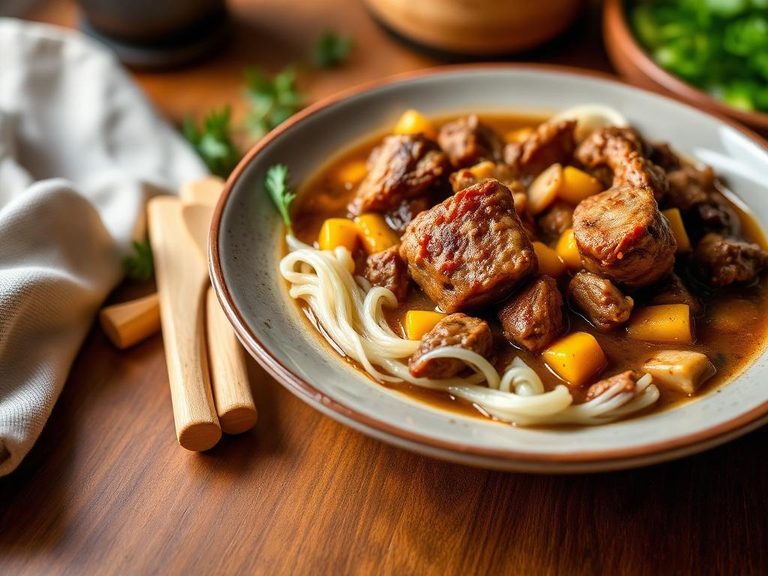
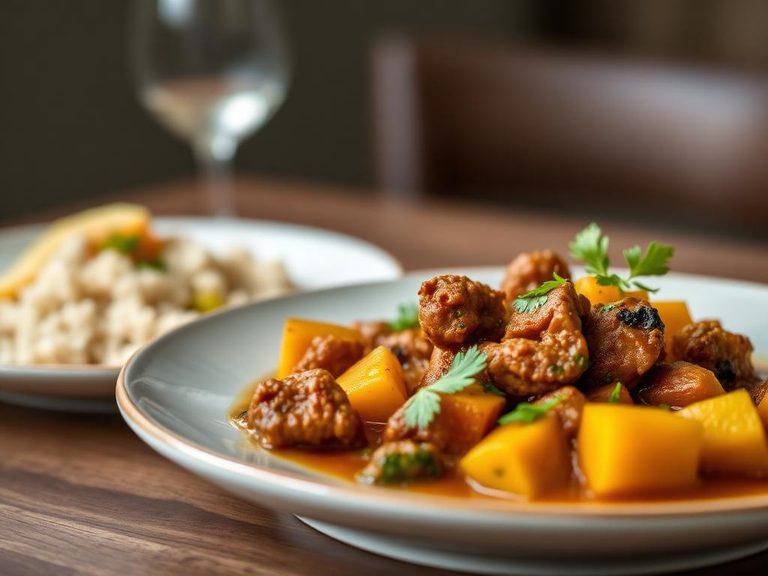
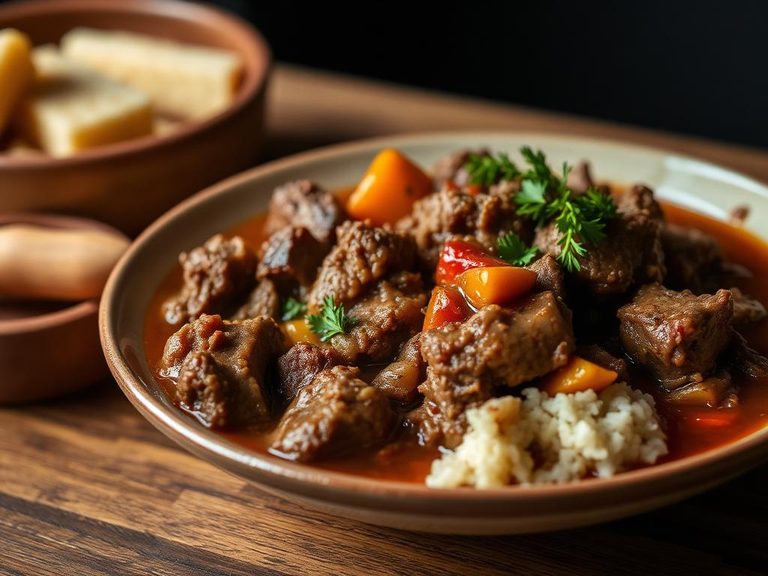
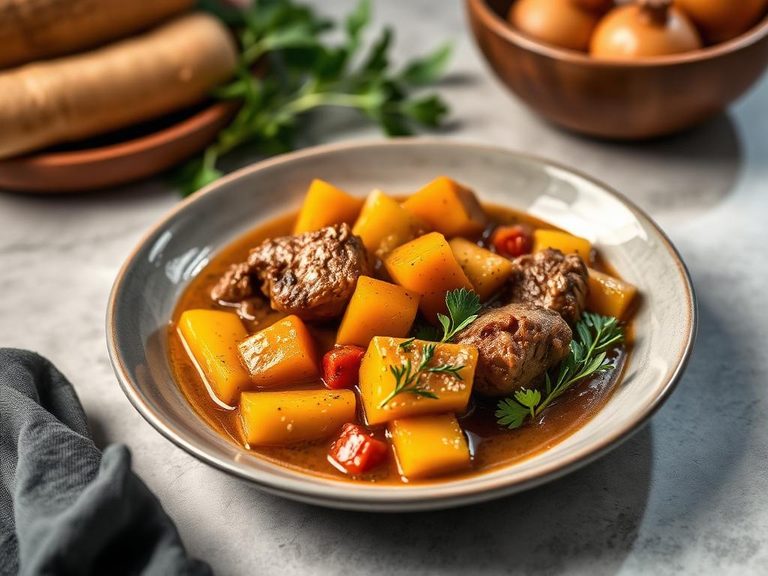
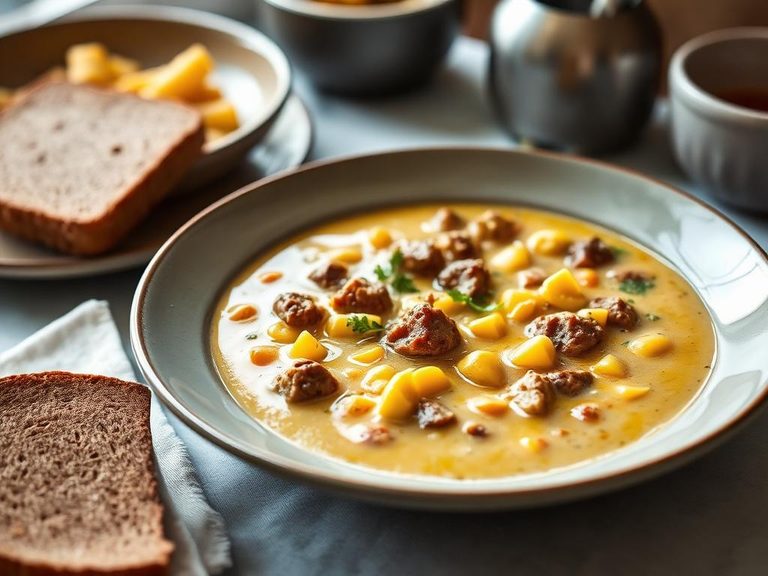
A hearty, slow-simmered stew combining tender mutton, sweet corn, and soft squash, creating a rich, savory broth with a comforting, slightly sweet depth. Its texture is a satisfying mix of melt-in-the-mouth meat and creamy vegetables. Nutritionally, it offers a solid protein base with a moderate calorie count, making it a filling yet balanced meal.
Calorie split: 34% protein · 28% carbs · 38% fat
↓ Full nutrition💚 Why it's loved
It's beloved for its profound, comforting warmth and the way the savory mutton flavors meld with the natural sweetness of the corn and squash. The dish is a cultural staple, representing communal cooking and resourceful use of local, seasonal ingredients.
⚠️ Watch-outs & how to enjoy it better
The mutton can be high in saturated fat, and traditional recipes may be sodium-heavy. For those monitoring fat intake, trimming the meat before cooking and using low-sodium broth can help. The squash and corn, while nutritious, have a moderate glycemic load, which can be balanced by the stew's protein and fiber content.
Key benefits
- High-quality protein from mutton supports muscle maintenance.
- Squash provides beta-carotene, a precursor to vitamin A.
- Corn adds dietary fiber and essential minerals like magnesium.
- A complete, warming meal in one pot, reducing the need for multiple dishes.
🍽️ Popular dishes
🌍 Where it's eaten
💡 Did you know?
The combination of meat, corn, and squash is known as the 'Three Sisters' in many Native American agricultural traditions, representing a symbiotic planting trio that sustains soil health and provides complementary nutrition.
Full nutrition (USDA data · scales with serving)
| Water | 76.1 g |
| Energy | 103 kcal |
| Energy | 430 kj |
| Protein | 8.6 g |
| Total lipid (fat) | 4.3 g |
| Ash | 3.6 g |
| Carbohydrate, by difference | 7.3 g |
| Fiber, total dietary | 1.7 g |
| Total Sugars | 0.61 g |
| Sucrose | 0.25 g |
| Glucose | 0.18 g |
| Fructose | 0.18 g |
| Lactose | 0.00 g |
| Maltose | 0.00 g |
| Galactose | 0.00 g |
| Calcium, Ca | 38.0 mg |
| Iron, Fe | 1.2 mg |
| Magnesium, Mg | 21.0 mg |
| Phosphorus, P | 111 mg |
| Potassium, K | 199 mg |
| Sodium, Na | 49.0 mg |
| Zinc, Zn | 1.9 mg |
| Copper, Cu | 0.06 mg |
| Manganese, Mn | 0.09 mg |
| Selenium, Se | 8.4 ug |
| Vitamin C, total ascorbic acid | 0.00 mg |
| Thiamin | 0.03 mg |
| Riboflavin | 0.11 mg |
| Niacin | 2.0 mg |
| Pantothenic acid | 0.27 mg |
| Vitamin B-6 | 0.11 mg |
| Folate, total | 18.0 ug |
| Folate, food | 18.0 ug |
| Vitamin B-12 | 1.2 ug |
| Vitamin A, RAE | 0.00 ug |
| Retinol | 0.00 ug |
| Vitamin A, IU | 0.00 iu |
| Vitamin E (alpha-tocopherol) | 0.37 mg |
| Tocopherol, beta | 0.00 mg |
| Tocopherol, gamma | 0.00 mg |
| Tocopherol, delta | 0.00 mg |
| Tocotrienol, alpha | 0.00 mg |
| Tocotrienol, beta | 0.00 mg |
| Tocotrienol, gamma | 0.00 mg |
| Tocotrienol, delta | 0.00 mg |
| Vitamin K (phylloquinone) | 1.8 ug |
| Vitamin K (Dihydrophylloquinone) | 0.00 ug |
Fat & fatty acid profile (per 100g)
| Fatty acids, total saturated | 1.7 g |
| SFA 8:0 | 0.00 g |
| SFA 10:0 | 0.00 g |
| SFA 12:0 | 0.00 g |
| SFA 14:0 | 0.08 g |
| SFA 15:0 | 0.02 g |
| SFA 16:0 | 0.87 g |
| SFA 17:0 | 0.06 g |
| SFA 18:0 | 0.69 g |
| SFA 20:0 | 0.01 g |
| SFA 22:0 | 0.01 g |
| Fatty acids, total monounsaturated | 1.7 g |
| MUFA 14:1 | 0.00 g |
| MUFA 15:1 | 0.00 g |
| MUFA 16:1 | 0.07 g |
| MUFA 17:1 | 0.03 g |
| MUFA 18:1 | 1.6 g |
| MUFA 20:1 | 0.01 g |
| Fatty acids, total polyunsaturated | 0.38 g |
| PUFA 18:2 | 0.31 g |
| PUFA 18:3 | 0.06 g |
| PUFA 18:3 n-3 c,c,c (ALA) | 0.05 g |
| PUFA 18:3 n-6 c,c,c | 0.01 g |
| PUFA 20:2 n-6 c,c | 0.00 g |
| PUFA 20:3 | 0.00 g |
| PUFA 20:4 | 0.01 g |
| Cholesterol | 43.0 mg |
Amino acid profile (per 100g)
| Tryptophan | 0.06 g |
| Threonine | 0.31 g |
| Isoleucine | 0.34 g |
| Leucine | 0.68 g |
| Lysine | 0.56 g |
| Methionine | 0.21 g |
| Cystine | 0.09 g |
| Phenylalanine | 0.33 g |
| Tyrosine | 0.23 g |
| Valine | 0.39 g |
| Arginine | 0.47 g |
| Histidine | 0.22 g |
| Alanine | 0.55 g |
| Aspartic acid | 0.68 g |
| Glutamic acid | 1.2 g |
| Glycine | 0.55 g |
| Proline | 0.47 g |
| Serine | 0.31 g |
FAQ
Can I use a different meat?
Yes, beef or lamb are common substitutes, though they will alter the traditional flavor profile. Chicken or turkey can be used for a lighter version.
Is this stew gluten-free?
The core ingredients are naturally gluten-free, but always check any added thickeners or broths for hidden gluten.
How can I make it richer?
Searing the mutton well before simmering builds a deeper flavor base. Adding a splash of red wine or using bone-in mutton can also enhance the broth's richness.
Nutrient density (calculated · NRF9.3)
Nutrient Rich Foods index: beneficial nutrients (protein, fiber, vitamins, minerals) minus saturated fat, added sugar & sodium, per 100 kcal.
NRF9.3 index — Fulgoni, Keast & Drewnowski, 2009. Computed from USDA nutrients.
Weight-loss friendliness (composite index)
Energy density 1.03 kcal/g · 33% calories from protein · 1.7 g fiber · 0.6 g sugar per 100 g.
Composite of energy density (Rolls et al., 1999), protein & fiber satiety, minus sugar. A calculated heuristic — ranks satiety-per-calorie, not a clinical measure.
Dietary load (calculated from USDA values)
Potential renal acid load. Positive = acid-forming, negative = alkaline-forming.
Sodium-to-potassium ratio: 0.25 (lower is better — aim for ≤ 1)
Sodium:potassium per WHO potassium guidance. Computed from USDA nutrients.