

BURGER KING, WHOPPER, no cheese
Whole food · Fast Foods
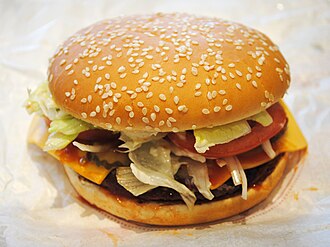
Photo: Wikipedia
The Burger King Whopper, without cheese, is a flame-grilled beef patty nestled in a soft sesame seed bun, topped with crisp lettuce, ripe tomato, sliced onion, tangy pickles, and a generous swirl of creamy mayonnaise and ketchup. Its signature char from the flame-grilling process delivers a smoky, savory flavor with a satisfyingly juicy texture. Nutritionally, it provides a solid 10.74g of protein per 100g, making it a more protein-focused fast-food option compared to many chicken sandwiches.
Calorie split: 18% protein · 32% carbs · 50% fat
↓ Full nutrition💚 Why it's loved
People love it for its iconic, flame-grilled smokiness that sets it apart from other fast-food burgers, delivering a classic, satisfying American flavor profile. Its customizable nature and status as a cultural staple make it a reliable comfort food choice.
⚠️ Watch-outs & how to enjoy it better
The meal can be high in sodium and refined carbohydrates from the bun, which may cause blood-sugar spikes or water retention for some. To counteract this, pair it with a side salad instead of fries, drink water, and consider eating half the bun to reduce the glycemic load.
Key benefits
- Good source of protein for muscle maintenance
- Contains fresh vegetable toppings like lettuce and tomato
- Flame-grilling adds flavor without breading or frying
- Provides quick energy from carbohydrates
- A familiar, consistent meal for calorie tracking
🍽️ Popular dishes
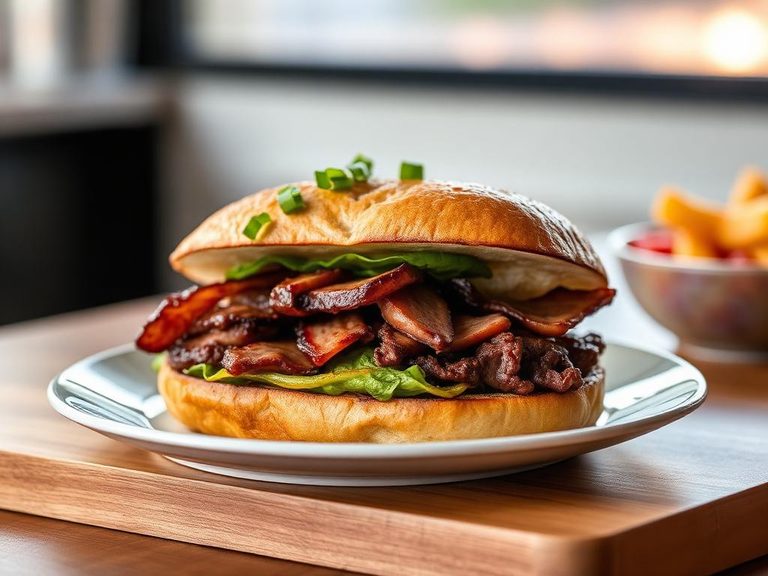
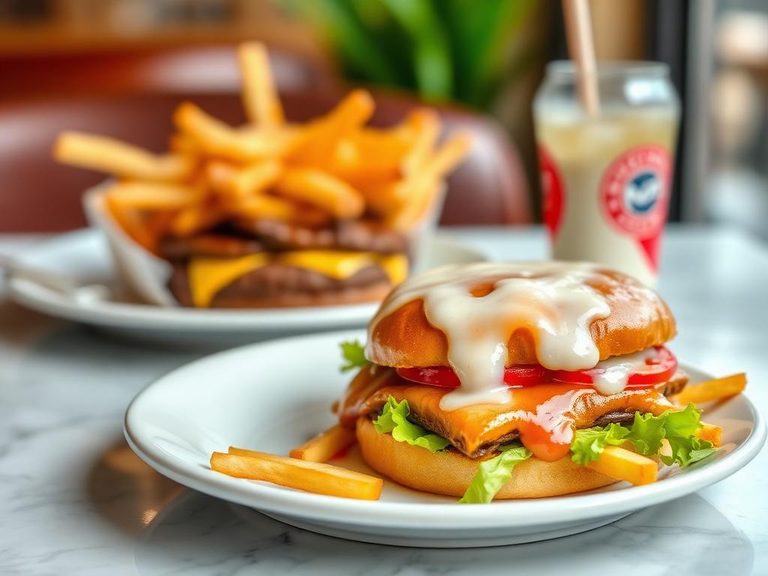
🌍 Where it's eaten
💡 Did you know?
The Whopper was created in 1957 by Burger King co-founder James McLamore, and its name was chosen to suggest a burger with a big taste or 'whopper' of a sandwich.
Full nutrition (USDA data · scales with serving)
| Water | 56.4 g |
| Energy | 233 kcal |
| Energy | 974 kj |
| Protein | 10.7 g |
| Total lipid (fat) | 12.8 g |
| Ash | 1.4 g |
| Carbohydrate, by difference | 18.6 g |
| Fiber, total dietary | 1.8 g |
| Total Sugars | 4.2 g |
| Sucrose | 1.7 g |
| Glucose | 0.00 g |
| Fructose | 1.7 g |
| Lactose | 0.00 g |
| Maltose | 0.67 g |
| Galactose | 0.11 g |
| Starch | 13.5 g |
| Calcium, Ca | 39.0 mg |
| Iron, Fe | 4.4 mg |
| Magnesium, Mg | 18.0 mg |
| Phosphorus, P | 90.0 mg |
| Potassium, K | 169 mg |
| Sodium, Na | 313 mg |
| Zinc, Zn | 2.8 mg |
| Copper, Cu | 0.01 mg |
| Manganese, Mn | 0.18 mg |
| Selenium, Se | 18.2 ug |
| Vitamin C, total ascorbic acid | 0.20 mg |
| Thiamin | 0.21 mg |
| Riboflavin | 0.17 mg |
| Niacin | 2.9 mg |
| Pantothenic acid | 0.17 mg |
| Vitamin B-6 | 0.09 mg |
| Folate, total | 47.0 ug |
| Folic acid | 33.0 ug |
| Folate, food | 14.0 ug |
| Folate, DFE | 70.0 ug |
| Vitamin E (alpha-tocopherol) | 0.15 mg |
| Tocopherol, beta | 1.9 mg |
| Tocopherol, gamma | 0.45 mg |
| Tocopherol, delta | 0.39 mg |
| Tocotrienol, beta | 0.00 mg |
| Tocotrienol, gamma | 0.00 mg |
| Tocotrienol, delta | 0.00 mg |
| Vitamin K (phylloquinone) | 19.5 ug |
| Vitamin K (Dihydrophylloquinone) | 0.40 ug |
Fat & fatty acid profile (per 100g)
| Fatty acids, total saturated | 4.3 g |
| SFA 4:0 | 0.00 g |
| SFA 6:0 | 0.00 g |
| SFA 8:0 | 0.01 g |
| SFA 10:0 | 0.01 g |
| SFA 12:0 | 0.04 g |
| SFA 13:0 | 0.00 g |
| SFA 14:0 | 0.25 g |
| SFA 15:0 | 0.04 g |
| SFA 16:0 | 2.4 g |
| SFA 17:0 | 0.10 g |
| SFA 18:0 | 1.3 g |
| SFA 20:0 | 0.01 g |
| SFA 22:0 | 0.01 g |
| SFA 24:0 | 0.01 g |
| Fatty acids, total monounsaturated | 4.7 g |
| MUFA 14:1 | 0.07 g |
| MUFA 15:1 | 0.00 g |
| MUFA 16:1 | 0.33 g |
| MUFA 17:1 | 0.07 g |
| MUFA 18:1 | 4.2 g |
| MUFA 20:1 | 0.01 g |
| MUFA 22:1 | 0.00 g |
| Fatty acids, total polyunsaturated | 3.4 g |
| PUFA 18:2 | 0.07 g |
| PUFA 18:2 n-6 c,c | 2.8 g |
| PUFA 18:2 i | 0.07 g |
| PUFA 18:3 | 0.28 g |
| PUFA 18:3 n-3 c,c,c (ALA) | 0.28 g |
| PUFA 18:3 n-6 c,c,c | 0.00 g |
| PUFA 18:4 | 0.00 g |
| PUFA 20:2 n-6 c,c | 0.00 g |
| PUFA 20:3 | 0.00 g |
| PUFA 20:4 | 0.01 g |
| PUFA 20:5 n-3 (EPA) | 0.00 g |
| PUFA 22:5 n-3 (DPA) | 0.00 g |
| PUFA 22:6 n-3 (DHA) | 0.00 g |
| Cholesterol | 30.0 mg |
Amino acid profile (per 100g)
| Tryptophan | 0.07 g |
| Threonine | 0.37 g |
| Isoleucine | 0.34 g |
| Leucine | 0.76 g |
| Lysine | 0.59 g |
| Methionine | 0.21 g |
| Phenylalanine | 0.46 g |
| Tyrosine | 0.27 g |
| Valine | 0.42 g |
| Arginine | 0.57 g |
| Histidine | 0.25 g |
| Alanine | 0.51 g |
| Aspartic acid | 0.75 g |
| Glutamic acid | 2.3 g |
| Glycine | 0.76 g |
| Proline | 0.99 g |
| Serine | 0.46 g |
| Hydroxyproline | 0.17 g |
FAQ
How does the no-cheese version differ nutritionally?
Removing the cheese slice reduces the total fat and calorie count by approximately 50-70 calories and about 4-5 grams of fat, making it a slightly leaner option.
Is it a good post-workout meal?
The protein content can aid muscle recovery, but the high sodium and refined carbs make it less ideal than a dedicated protein-and-complex-carb meal. It's better as an occasional option.
What are the main allergens?
Common allergens include wheat (in the bun), soy (in the patty and sauces), and milk (may be present in mayonnaise or cross-contact). Always check the official allergen guide.
Nutrient density (calculated · NRF9.3)
Nutrient Rich Foods index: beneficial nutrients (protein, fiber, vitamins, minerals) minus saturated fat, added sugar & sodium, per 100 kcal.
NRF9.3 index — Fulgoni, Keast & Drewnowski, 2009. Computed from USDA nutrients.
Weight-loss friendliness (composite index)
Energy density 2.33 kcal/g · 18% calories from protein · 1.8 g fiber · 4.2 g sugar per 100 g.
Composite of energy density (Rolls et al., 1999), protein & fiber satiety, minus sugar. A calculated heuristic — ranks satiety-per-calorie, not a clinical measure.
Dietary load (calculated from USDA values)
Potential renal acid load. Positive = acid-forming, negative = alkaline-forming.
Sodium-to-potassium ratio: 1.85 (lower is better — aim for ≤ 1)
Sodium:potassium per WHO potassium guidance. Computed from USDA nutrients.