

Stew, hominy with mutton (Navajo)
Whole food · American Indian/Alaska Native Foods
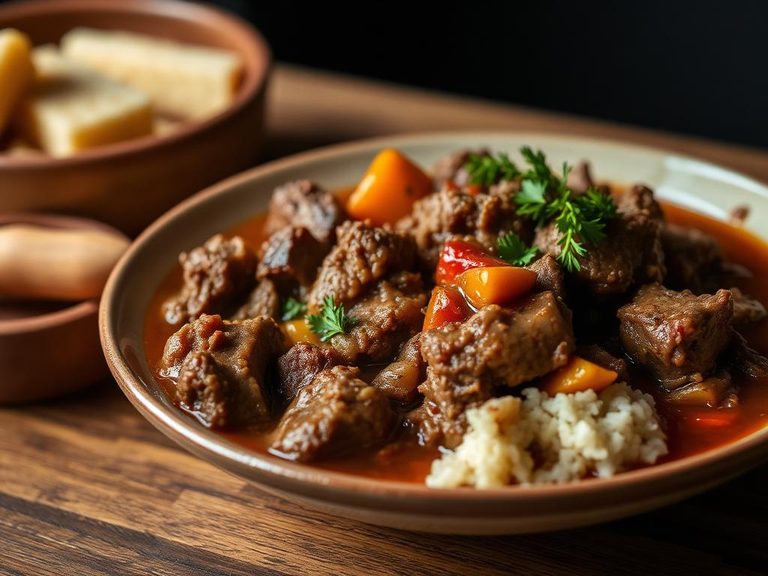
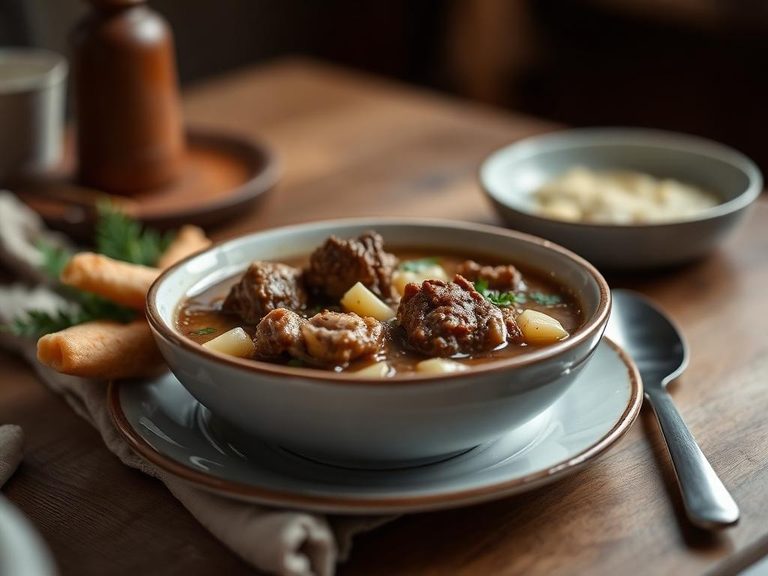
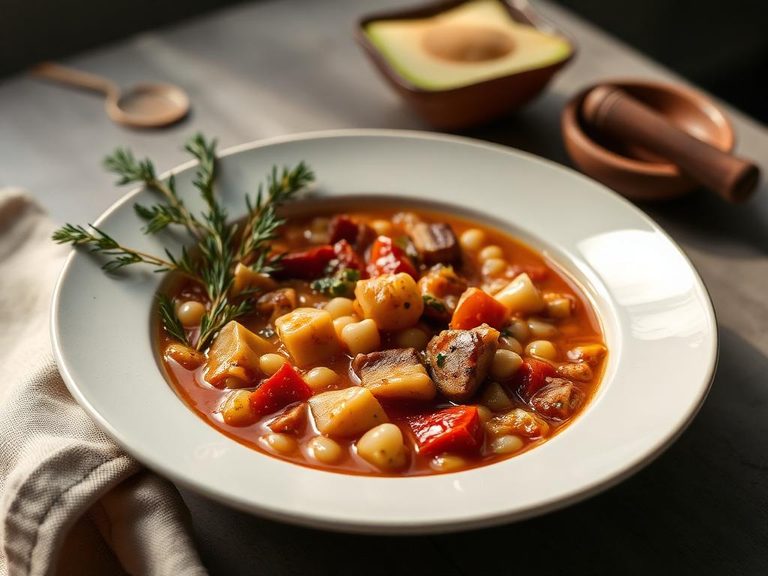
A hearty, savory stew of tender mutton and puffy white hominy kernels, simmered until the broth is rich and the corn is soft and slightly chewy. It delivers a comforting, earthy flavor with a subtle sweetness from the corn and a deep, meaty savoriness. Nutritionally, it's a lean, protein-rich dish with a good balance of complex carbohydrates and fiber.
Calorie split: 32% protein · 45% carbs · 22% fat
↓ Full nutrition💚 Why it's loved
People love it for its deeply satisfying, rustic flavor and the comforting texture contrast between the tender meat and the soft, popping hominy. It's a cherished cultural staple, often associated with gatherings and traditional Navajo cuisine, making it a dish of both nourishment and heritage.
⚠️ Watch-outs & how to enjoy it better
The stew can be high in sodium depending on the recipe and seasoning, which may be a concern for some. The hominy, while nutritious, is a starchy carbohydrate that can affect blood sugar levels if consumed in large portions. To counteract this, pair it with extra non-starchy vegetables and practice portion control. If using a canned broth or pre-seasoned meat, rinse the hominy and choose low-sodium options to better control salt intake.
Key benefits
- Excellent source of complete protein from mutton
- Provides sustained energy from complex carbohydrates in hominy
- Good source of dietary fiber for digestive health
- Naturally low in fat and sugar
- Rich in essential minerals like iron and zinc from the meat
🍽️ Popular dishes
🌍 Where it's eaten
💡 Did you know?
Hominy is made from dried corn kernels that have been treated with an alkali in a process called nixtamalization, which unlocks nutrients like niacin and gives the kernels their distinctive puffy texture.
Full nutrition (USDA data · scales with serving)
| Water | 81.6 g |
| Energy | 83.0 kcal |
| Energy | 347 kj |
| Protein | 6.7 g |
| Total lipid (fat) | 2.1 g |
| Ash | 0.26 g |
| Carbohydrate, by difference | 9.4 g |
| Fiber, total dietary | 2.0 g |
| Total Sugars | 0.11 g |
| Sucrose | 0.11 g |
| Glucose | 0.00 g |
| Fructose | 0.00 g |
| Lactose | 0.00 g |
| Maltose | 0.00 g |
| Galactose | 0.00 g |
| Starch | 6.2 g |
| Calcium, Ca | 8.0 mg |
| Iron, Fe | 0.81 mg |
| Magnesium, Mg | 20.0 mg |
| Phosphorus, P | 82.0 mg |
| Potassium, K | 118 mg |
| Sodium, Na | 45.0 mg |
| Zinc, Zn | 1.2 mg |
| Copper, Cu | 0.05 mg |
| Manganese, Mn | 0.09 mg |
| Selenium, Se | 4.1 ug |
| Vitamin C, total ascorbic acid | 0.00 mg |
| Thiamin | 0.03 mg |
| Riboflavin | 0.07 mg |
| Niacin | 1.5 mg |
| Vitamin B-6 | 0.09 mg |
| Folate, total | 0.00 ug |
| Folate, food | 0.00 ug |
| Vitamin B-12 | 0.64 ug |
| Vitamin A, RAE | 0.00 ug |
| Retinol | 0.00 ug |
| Vitamin A, IU | 0.00 iu |
| Vitamin E (alpha-tocopherol) | 0.37 mg |
| Tocopherol, beta | 0.00 mg |
| Tocopherol, gamma | 0.76 mg |
| Tocopherol, delta | 0.00 mg |
| Tocotrienol, alpha | 0.00 mg |
| Tocotrienol, beta | 0.00 mg |
| Tocotrienol, gamma | 0.00 mg |
| Tocotrienol, delta | 0.00 mg |
| Vitamin K (phylloquinone) | 0.70 ug |
| Vitamin K (Dihydrophylloquinone) | 0.00 ug |
Fat & fatty acid profile (per 100g)
| Fatty acids, total saturated | 0.73 g |
| SFA 8:0 | 0.00 g |
| SFA 10:0 | 0.00 g |
| SFA 12:0 | 0.00 g |
| SFA 14:0 | 0.03 g |
| SFA 15:0 | 0.01 g |
| SFA 16:0 | 0.39 g |
| SFA 17:0 | 0.02 g |
| SFA 18:0 | 0.27 g |
| SFA 20:0 | 0.00 g |
| SFA 22:0 | 0.00 g |
| Fatty acids, total monounsaturated | 0.90 g |
| MUFA 14:1 | 0.00 g |
| MUFA 15:1 | 0.00 g |
| MUFA 16:1 | 0.04 g |
| MUFA 17:1 | 0.02 g |
| MUFA 18:1 | 0.83 g |
| MUFA 20:1 | 0.00 g |
| Fatty acids, total polyunsaturated | 0.29 g |
| PUFA 18:2 | 0.23 g |
| PUFA 18:3 | 0.02 g |
| PUFA 18:3 n-3 c,c,c (ALA) | 0.02 g |
| PUFA 18:3 n-6 c,c,c | 0.00 g |
| PUFA 20:2 n-6 c,c | 0.00 g |
| PUFA 20:3 | 0.00 g |
| PUFA 20:4 | 0.01 g |
| Cholesterol | 13.0 mg |
Amino acid profile (per 100g)
| Tryptophan | 0.04 g |
| Threonine | 0.24 g |
| Isoleucine | 0.25 g |
| Leucine | 0.54 g |
| Lysine | 0.43 g |
| Methionine | 0.16 g |
| Cystine | 0.07 g |
| Phenylalanine | 0.26 g |
| Tyrosine | 0.18 g |
| Valine | 0.29 g |
| Arginine | 0.39 g |
| Histidine | 0.16 g |
| Alanine | 0.42 g |
| Aspartic acid | 0.53 g |
| Glutamic acid | 0.99 g |
| Glycine | 0.45 g |
| Proline | 0.39 g |
| Serine | 0.25 g |
FAQ
Is this stew gluten-free?
Yes, traditional Navajo mutton stew with hominy is naturally gluten-free, as its primary ingredients are meat, corn, and broth. Always check any added seasonings or thickeners for hidden gluten.
Can I make this with a different meat?
While mutton is traditional, you can substitute with beef or lamb for a similar rich flavor. The cooking time may vary depending on the cut and toughness of the meat.
What is hominy exactly?
Hominy is corn that has been treated with an alkali solution (nixtamalization), which removes the hull and germ. This process gives it a larger, softer texture and enhances its nutritional value.
Nutrient density (calculated · NRF9.3)
Nutrient Rich Foods index: beneficial nutrients (protein, fiber, vitamins, minerals) minus saturated fat, added sugar & sodium, per 100 kcal.
NRF9.3 index — Fulgoni, Keast & Drewnowski, 2009. Computed from USDA nutrients.
Weight-loss friendliness (composite index)
Energy density 0.83 kcal/g · 32% calories from protein · 2.0 g fiber · 0.1 g sugar per 100 g.
Composite of energy density (Rolls et al., 1999), protein & fiber satiety, minus sugar. A calculated heuristic — ranks satiety-per-calorie, not a clinical measure.
Dietary load (calculated from USDA values)
Potential renal acid load. Positive = acid-forming, negative = alkaline-forming.
Sodium-to-potassium ratio: 0.38 (lower is better — aim for ≤ 1)
Sodium:potassium per WHO potassium guidance. Computed from USDA nutrients.