

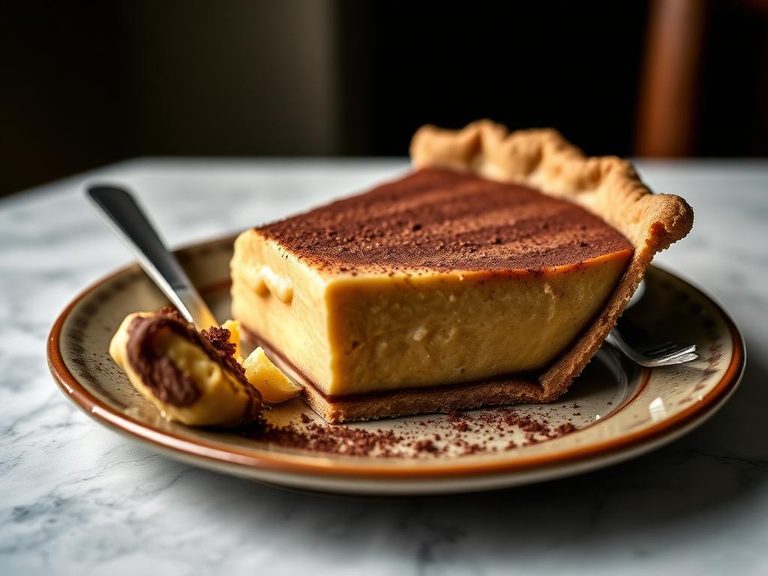
Pie, chocolate creme, commercially prepared
Whole food · Baked Products

Photo: Wikipedia
A classic dessert featuring a flaky, buttery crust cradling a rich, velvety chocolate custard filling, often topped with a cloud of whipped cream or a dusting of cocoa. Its texture is a delightful contrast between the crisp pastry and the smooth, cool cream, offering a deep, sweet chocolate flavor that is both comforting and indulgent. Nutritionally, it is a high-energy treat, delivering significant calories, fat, and sugar per 100g, with minimal fiber.
Calorie split: 4% protein · 41% carbs · 54% fat
↓ Full nutrition💚 Why it's loved
People adore it for the harmonious blend of textures—the shattering crust against the silky chocolate filling—and its nostalgic, comforting flavor that evokes memories of diners and family gatherings. Its versatility as a dessert that can be served chilled or at room temperature makes it a reliable crowd-pleaser for any occasion.
⚠️ Watch-outs & how to enjoy it better
The high sugar and fat content can lead to blood-sugar spikes and may not be suitable for those monitoring calorie intake or managing conditions like diabetes. To mitigate this, pair a smaller slice with a source of protein (like nuts or Greek yogurt) to slow sugar absorption, and practice portion control by choosing a thin slice or sharing. Be mindful of common allergens like wheat, dairy, and eggs.
Key benefits
- Quick source of energy from carbohydrates and fats
- Provides a small amount of protein from dairy and flour
- Can serve as a satisfying dessert for portion-controlled indulgence
- Offers a rich, comforting flavor profile that can boost mood
- Widely available and convenient for celebrations or treats
🍽️ Popular dishes





🌍 Where it's eaten
💡 Did you know?
The first known recipe for a chocolate cream pie appears in an 1850 American cookbook, but it was the 19th-century rise of commercial baking and refrigeration that turned it into a nationwide diner staple.
Full nutrition (USDA data · scales with serving)
| Water | 33.9 g |
| Energy | 353 kcal |
| Energy | 1477 kj |
| Protein | 4.2 g |
| Total lipid (fat) | 22.4 g |
| Ash | 1.1 g |
| Carbohydrate, by difference | 38.4 g |
| Fiber, total dietary | 0.80 g |
| Total Sugars | 27.4 g |
| Calcium, Ca | 66.0 mg |
| Iron, Fe | 1.5 mg |
| Magnesium, Mg | 19.0 mg |
| Phosphorus, P | 79.0 mg |
| Potassium, K | 161 mg |
| Sodium, Na | 266 mg |
| Zinc, Zn | 0.44 mg |
| Copper, Cu | 0.12 mg |
| Manganese, Mn | 0.16 mg |
| Selenium, Se | 6.0 ug |
| Vitamin C, total ascorbic acid | 0.00 mg |
| Thiamin | 0.09 mg |
| Riboflavin | 0.14 mg |
| Niacin | 0.60 mg |
| Pantothenic acid | 0.23 mg |
| Vitamin B-6 | 0.02 mg |
| Folate, total | 19.0 ug |
| Folic acid | 13.0 ug |
| Folate, food | 6.0 ug |
| Folate, DFE | 28.0 ug |
| Choline, total | 17.9 mg |
| Vitamin B-12 | 0.12 ug |
| Vitamin B-12, added | 0.00 ug |
| Vitamin A, RAE | 46.0 ug |
| Retinol | 45.0 ug |
| Carotene, beta | 10.0 ug |
| Carotene, alpha | 0.00 ug |
| Cryptoxanthin, beta | 0.00 ug |
| Vitamin A, IU | 166 iu |
| Lycopene | 0.00 ug |
| Lutein + zeaxanthin | 8.0 ug |
| Vitamin E (alpha-tocopherol) | 1.1 mg |
| Vitamin E, added | 0.00 mg |
| Vitamin D (D2 + D3), International Units | 3.0 iu |
| Vitamin D (D2 + D3) | 0.10 ug |
| Vitamin K (phylloquinone) | 9.5 ug |
| Alcohol, ethyl | 0.00 g |
| Caffeine | 0.00 mg |
| Theobromine | 56.0 mg |
Fat & fatty acid profile (per 100g)
| Fatty acids, total saturated | 12.4 g |
| SFA 4:0 | 0.23 g |
| SFA 6:0 | 0.11 g |
| SFA 8:0 | 0.25 g |
| SFA 10:0 | 0.28 g |
| SFA 12:0 | 1.2 g |
| SFA 13:0 | 0.00 g |
| SFA 14:0 | 1.1 g |
| SFA 15:0 | 0.05 g |
| SFA 16:0 | 5.6 g |
| SFA 17:0 | 0.06 g |
| SFA 18:0 | 3.4 g |
| SFA 20:0 | 0.10 g |
| SFA 22:0 | 0.10 g |
| SFA 24:0 | 0.00 g |
| Fatty acids, total monounsaturated | 7.3 g |
| MUFA 14:1 | 0.01 g |
| MUFA 15:1 | 0.00 g |
| MUFA 16:1 | 0.04 g |
| MUFA 17:1 | 0.00 g |
| MUFA 18:1 | 7.3 g |
| MUFA 20:1 | 0.00 g |
| MUFA 22:1 | 0.00 g |
| Fatty acids, total polyunsaturated | 1.1 g |
| PUFA 18:2 | 1.0 g |
| PUFA 18:3 | 0.09 g |
| PUFA 18:4 | 0.00 g |
| PUFA 20:2 n-6 c,c | 0.00 g |
| PUFA 20:3 | 0.00 g |
| PUFA 20:4 | 0.00 g |
| PUFA 20:5 n-3 (EPA) | 0.00 g |
| PUFA 22:5 n-3 (DPA) | 0.00 g |
| PUFA 22:6 n-3 (DHA) | 0.00 g |
| Fatty acids, total trans | 2.5 g |
| Cholesterol | 12.0 mg |
Amino acid profile (per 100g)
Estimated from Pie Crust, Cookie-type, Chocolate, Ready Crust — USDA does not publish this profile for Pie.
| Tryptophan | 0.08 g |
| Threonine | 0.20 g |
| Isoleucine | 0.23 g |
| Leucine | 0.38 g |
| Lysine | 0.24 g |
| Methionine | 0.07 g |
| Cystine | 0.11 g |
| Phenylalanine | 0.28 g |
| Tyrosine | 0.16 g |
| Valine | 0.32 g |
| Arginine | 0.29 g |
| Histidine | 0.11 g |
| Alanine | 0.24 g |
| Aspartic acid | 0.45 g |
| Glutamic acid | 1.3 g |
| Glycine | 0.24 g |
| Proline | 0.42 g |
| Serine | 0.26 g |
FAQ
Is chocolate cream pie the same as chocolate mousse pie?
No, chocolate cream pie typically uses a cooked custard or pudding filling, while chocolate mousse pie features a lighter, aerated mousse made with whipped cream and melted chocolate.
Can I make a healthier version at home?
Yes, you can use a whole-grain crust, reduce sugar in the filling, and opt for dark chocolate or Greek yogurt to increase protein and reduce fat.
Why is the filling sometimes grainy?
Graininess can occur if the custard is overcooked or if the chocolate isn't fully melted; using a double boiler and stirring constantly helps achieve a smooth texture.
How should I store leftover pie?
Keep it refrigerated in an airtight container for up to 3-4 days; the crust may soften, so serving chilled is best.
Nutrient density (calculated · NRF9.3)
Nutrient Rich Foods index: beneficial nutrients (protein, fiber, vitamins, minerals) minus saturated fat, added sugar & sodium, per 100 kcal.
NRF9.3 index — Fulgoni, Keast & Drewnowski, 2009. Computed from USDA nutrients.
Weight-loss friendliness (composite index)
Energy density 3.53 kcal/g · 5% calories from protein · 0.8 g fiber · 27.4 g sugar per 100 g.
Composite of energy density (Rolls et al., 1999), protein & fiber satiety, minus sugar. A calculated heuristic — ranks satiety-per-calorie, not a clinical measure.
Dietary load (calculated from USDA values)
Potential renal acid load. Positive = acid-forming, negative = alkaline-forming.
Sodium-to-potassium ratio: 1.65 (lower is better — aim for ≤ 1)
Sodium:potassium per WHO potassium guidance. Computed from USDA nutrients.