

Beverages, Acai berry drink, fortified
Whole food · Beverages

Photo: Wikipedia
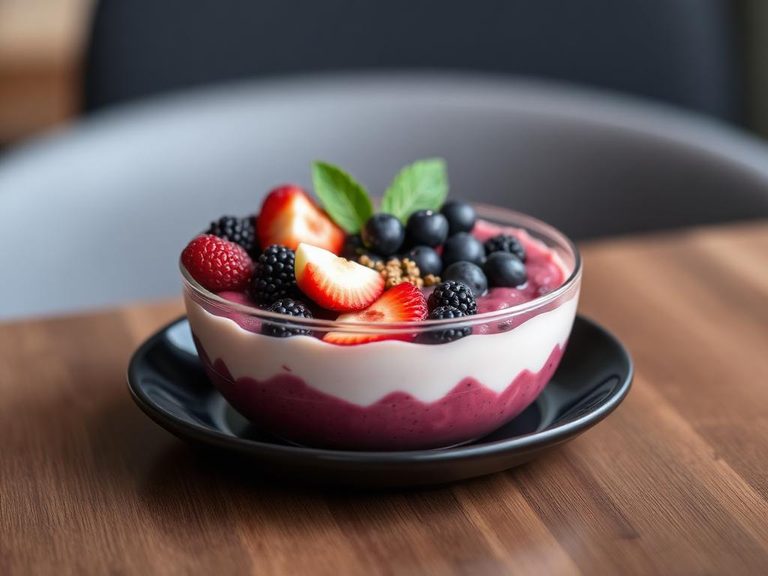
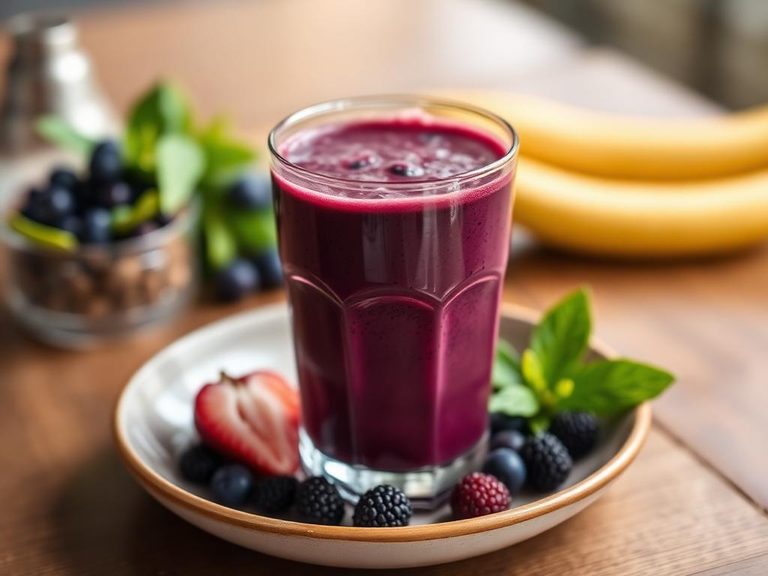
A vibrant, deep-purple beverage made from the acai palm fruit, often blended into a thick, smoothie-like consistency with a rich, earthy flavor reminiscent of wild berries and a hint of dark chocolate. Fortified versions are typically lighter in texture than traditional acai bowls, offering a convenient, drinkable format. Nutritionally, it provides a moderate calorie count with a notable carbohydrate content primarily from natural and added sugars.
Calorie split: 5% protein · 83% carbs · 12% fat
↓ Full nutrition💚 Why it's loved
People love it for its unique, complex flavor profile that balances tartness with deep, earthy sweetness, making it a refreshing and indulgent treat. Its vibrant color and association with wellness trends also contribute to its popularity as a versatile base for smoothies and bowls.
⚠️ Watch-outs & how to enjoy it better
The primary downside is the high sugar content (11.1g per 100g), which can cause blood-sugar spikes, especially in individuals with insulin sensitivity or diabetes. To counteract this, pair it with a source of protein (like Greek yogurt or a protein powder) or healthy fat (like nut butter or chia seeds) to slow sugar absorption and increase satiety.
Key benefits
- Source of antioxidants, particularly anthocyanins from acai.
- Provides dietary fiber for digestive health.
- Fortified with additional vitamins and minerals.
- Offers a convenient way to consume fruit-based nutrients.
- Contains heart-healthy plant compounds.
🍽️ Popular dishes
🌍 Where it's eaten
💡 Did you know?
The acai berry is technically a drupe, not a true berry, and its seed makes up about 80% of its total weight, which is why it's almost always processed into a pulp before consumption.
Full nutrition (USDA data · scales with serving)
| Water | 84.9 g |
| Energy | 62.0 kcal |
| Energy | 260 kj |
| Protein | 0.83 g |
| Total lipid (fat) | 0.83 g |
| Ash | 0.62 g |
| Carbohydrate, by difference | 12.8 g |
| Fiber, total dietary | 1.2 g |
| Total Sugars | 11.1 g |
| Sucrose | 0.80 g |
| Glucose | 3.7 g |
| Fructose | 6.6 g |
| Lactose | 0.00 g |
| Maltose | 0.00 g |
| Galactose | 0.00 g |
| Calcium, Ca | 19.0 mg |
| Iron, Fe | 0.16 mg |
| Magnesium, Mg | 11.0 mg |
| Phosphorus, P | 13.0 mg |
| Potassium, K | 130 mg |
| Sodium, Na | 13.0 mg |
| Zinc, Zn | 0.11 mg |
| Copper, Cu | 0.08 mg |
| Manganese, Mn | 1.7 mg |
| Selenium, Se | 0.00 ug |
| Vitamin C, total ascorbic acid | 42.1 mg |
| Thiamin | 0.03 mg |
| Riboflavin | 0.04 mg |
| Niacin | 9.1 mg |
| Pantothenic acid | 3.3 mg |
| Vitamin B-6 | 1.1 mg |
| Folate, total | 4.0 ug |
| Folic acid | 0.00 ug |
| Folate, food | 4.0 ug |
| Folate, DFE | 4.0 ug |
| Choline, total | 0.00 mg |
| Vitamin B-12 | 3.4 ug |
| Vitamin B-12, added | 3.4 ug |
| Vitamin A, RAE | 485 ug |
| Retinol | 0.00 ug |
| Carotene, beta | 5784 ug |
| Carotene, alpha | 46.0 ug |
| Cryptoxanthin, beta | 23.0 ug |
| Vitamin A, IU | 9698 iu |
| Lycopene | 899 ug |
| Lutein + zeaxanthin | 783 ug |
| Vitamin E (alpha-tocopherol) | 11.1 mg |
| Vitamin E, added | 6.8 mg |
| Tocopherol, beta | 0.00 mg |
| Tocopherol, gamma | 0.10 mg |
| Tocopherol, delta | 0.00 mg |
| Tocotrienol, alpha | 0.00 mg |
| Tocotrienol, beta | 0.00 mg |
| Tocotrienol, gamma | 0.00 mg |
| Tocotrienol, delta | 0.00 mg |
| Vitamin D (D2 + D3), International Units | 0.00 iu |
| Vitamin D (D2 + D3) | 0.00 ug |
| Vitamin K (phylloquinone) | 16.7 ug |
| Alcohol, ethyl | 0.00 g |
| Caffeine | 0.00 mg |
| Theobromine | 0.00 mg |
Fat & fatty acid profile (per 100g)
| Fatty acids, total saturated | 0.00 g |
| SFA 4:0 | 0.00 g |
| SFA 6:0 | 0.00 g |
| SFA 8:0 | 0.00 g |
| SFA 10:0 | 0.00 g |
| SFA 12:0 | 0.00 g |
| SFA 14:0 | 0.00 g |
| SFA 16:0 | 0.00 g |
| SFA 18:0 | 0.00 g |
| Fatty acids, total monounsaturated | 0.00 g |
| MUFA 16:1 | 0.00 g |
| MUFA 18:1 | 0.00 g |
| MUFA 20:1 | 0.00 g |
| MUFA 22:1 | 0.00 g |
| Fatty acids, total polyunsaturated | 0.00 g |
| PUFA 18:2 | 0.00 g |
| PUFA 18:3 | 0.00 g |
| PUFA 18:4 | 0.00 g |
| PUFA 20:4 | 0.00 g |
| PUFA 20:5 n-3 (EPA) | 0.00 g |
| PUFA 22:5 n-3 (DPA) | 0.00 g |
| PUFA 22:6 n-3 (DHA) | 0.00 g |
| Cholesterol | 0.00 mg |
Amino acid profile (per 100g)
Estimated from Beverages, carbonated, tonic water — USDA does not publish this profile for Beverages.
| Tryptophan | 0.00 g |
| Threonine | 0.00 g |
| Isoleucine | 0.00 g |
| Leucine | 0.00 g |
| Lysine | 0.00 g |
| Methionine | 0.00 g |
| Cystine | 0.00 g |
| Phenylalanine | 0.00 g |
| Tyrosine | 0.00 g |
| Valine | 0.00 g |
| Arginine | 0.00 g |
| Histidine | 0.00 g |
| Alanine | 0.00 g |
| Aspartic acid | 0.00 g |
| Glutamic acid | 0.00 g |
| Glycine | 0.00 g |
| Proline | 0.00 g |
| Serine | 0.00 g |
FAQ
Is fortified acai drink the same as acai juice?
Not exactly. A fortified acai drink is typically a processed beverage that may contain added sugars, vitamins, and minerals, whereas pure acai juice would be just the pressed fruit liquid, which is less common due to the berry's high seed content.
Can I use this drink in recipes instead of fresh acai?
Yes, it can be used as a liquid base in smoothies, popsicles, or even salad dressings, but be mindful of its added sugars and adjust the recipe's sweetness accordingly.
Is the sugar in this drink natural or added?
It's likely a combination. Acai berries contain natural sugars, but fortified drinks almost always have significant added sugars to enhance palatability, so checking the nutrition label for 'added sugars' is key.
Nutrient density (calculated · NRF9.3)
Nutrient Rich Foods index: beneficial nutrients (protein, fiber, vitamins, minerals) minus saturated fat, added sugar & sodium, per 100 kcal.
NRF9.3 index — Fulgoni, Keast & Drewnowski, 2009. Computed from USDA nutrients.
Weight-loss friendliness (composite index)
Energy density 0.62 kcal/g · 5% calories from protein · 1.2 g fiber · 11.1 g sugar per 100 g.
Composite of energy density (Rolls et al., 1999), protein & fiber satiety, minus sugar. A calculated heuristic — ranks satiety-per-calorie, not a clinical measure.
Dietary load (calculated from USDA values)
Potential renal acid load. Positive = acid-forming, negative = alkaline-forming.
Sodium-to-potassium ratio: 0.10 (lower is better — aim for ≤ 1)
Sodium:potassium per WHO potassium guidance. Computed from USDA nutrients.