

Babyfood, peas and brown rice
Whole food · Baby Foods

Photo: Wikipedia
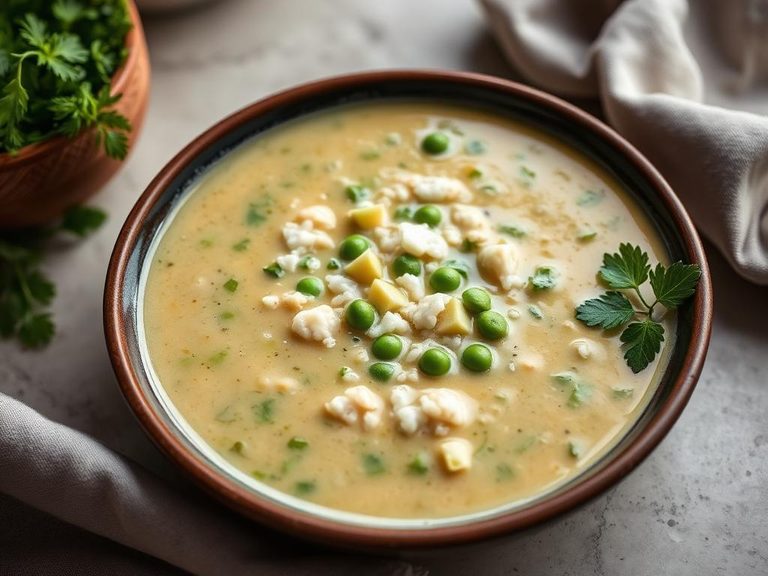
This is a simple, wholesome baby food combining sweet green peas and mild, nutty brown rice into a smooth, slightly textured puree. It offers a gentle, earthy flavor with a subtle natural sweetness from the peas, making it a gentle introduction to savory solids. Nutritionally, it's a low-calorie, high-fiber option that provides plant-based protein and complex carbohydrates for steady energy.
Calorie split: 21% protein · 72% carbs · 7% fat
↓ Full nutrition💚 Why it's loved
Parents appreciate its clean, simple ingredient list and the convenience of a nutrient-dense, ready-to-serve meal. Babies often enjoy the naturally sweet taste and soft texture, which helps them transition to more complex flavors.
⚠️ Watch-outs & how to enjoy it better
The natural sugars in peas can cause mild digestive gas or bloating in some sensitive infants. To minimize this, introduce small portions first and ensure the peas are well-cooked, which breaks down some of the complex sugars. The brown rice component is very low in arsenic compared to white rice, but rinsing the rice before cooking can further reduce any trace minerals.
Key benefits
- Excellent source of dietary fiber for digestive health.
- Provides plant-based protein for growth and development.
- Contains complex carbohydrates from brown rice for sustained energy.
- Low in fat and naturally low in sodium.
- Rich in vitamins like vitamin K and folate from the peas.
🍽️ Popular dishes
🌍 Where it's eaten
💡 Did you know?
The combination of peas and rice creates a complete protein, providing all nine essential amino acids, a principle used in many traditional cuisines worldwide.
Full nutrition (USDA data · scales with serving)
| Water | 84.1 g |
| Energy | 64.0 kcal |
| Energy | 268 kj |
| Protein | 3.4 g |
| Total lipid (fat) | 0.50 g |
| Ash | 0.51 g |
| Carbohydrate, by difference | 11.5 g |
| Fiber, total dietary | 2.5 g |
| Total Sugars | 2.9 g |
| Starch | 0.68 g |
| Calcium, Ca | 14.0 mg |
| Iron, Fe | 1.5 mg |
| Magnesium, Mg | 25.0 mg |
| Phosphorus, P | 52.0 mg |
| Potassium, K | 93.0 mg |
| Sodium, Na | 6.0 mg |
| Zinc, Zn | 0.46 mg |
| Copper, Cu | 0.08 mg |
| Selenium, Se | 1.2 ug |
| Fluoride, F | 39.4 ug |
| Vitamin C, total ascorbic acid | 3.0 mg |
| Thiamin | 0.10 mg |
| Riboflavin | 0.08 mg |
| Niacin | 1.4 mg |
| Vitamin B-6 | 0.06 mg |
| Folate, total | 16.0 ug |
| Folic acid | 0.00 ug |
| Folate, food | 16.0 ug |
| Folate, DFE | 16.0 ug |
| Choline, total | 14.7 mg |
| Vitamin B-12 | 0.00 ug |
| Vitamin B-12, added | 0.00 ug |
| Vitamin A, RAE | 19.0 ug |
| Retinol | 0.00 ug |
| Carotene, beta | 228 ug |
| Carotene, alpha | 11.0 ug |
| Cryptoxanthin, beta | 0.00 ug |
| Vitamin A, IU | 390 iu |
| Lycopene | 0.00 ug |
| Lutein + zeaxanthin | 1261 ug |
| Vitamin E (alpha-tocopherol) | 0.07 mg |
| Vitamin E, added | 0.00 mg |
| Vitamin D (D2 + D3), International Units | 0.00 iu |
| Vitamin D (D2 + D3) | 0.00 ug |
| Vitamin K (phylloquinone) | 12.6 ug |
| Alcohol, ethyl | 0.00 g |
| Caffeine | 0.00 mg |
| Theobromine | 0.00 mg |
Fat & fatty acid profile (per 100g)
| Fatty acids, total saturated | 0.10 g |
| SFA 4:0 | 0.00 g |
| SFA 6:0 | 0.00 g |
| SFA 8:0 | 0.00 g |
| SFA 10:0 | 0.00 g |
| SFA 12:0 | 0.00 g |
| SFA 14:0 | 0.00 g |
| SFA 15:0 | 0.00 g |
| SFA 16:0 | 0.09 g |
| SFA 17:0 | 0.00 g |
| SFA 18:0 | 0.01 g |
| SFA 20:0 | 0.00 g |
| SFA 22:0 | 0.00 g |
| SFA 24:0 | 0.00 g |
| Fatty acids, total monounsaturated | 0.18 g |
| MUFA 14:1 | 0.00 g |
| MUFA 15:1 | 0.00 g |
| MUFA 16:1 | 0.00 g |
| MUFA 17:1 | 0.00 g |
| MUFA 18:1 | 0.18 g |
| MUFA 20:1 | 0.00 g |
| MUFA 22:1 | 0.00 g |
| MUFA 24:1 c | 0.00 g |
| Fatty acids, total polyunsaturated | 0.18 g |
| PUFA 18:2 | 0.17 g |
| PUFA 18:3 | 0.01 g |
| PUFA 18:4 | 0.00 g |
| PUFA 20:2 n-6 c,c | 0.00 g |
| PUFA 20:3 | 0.00 g |
| PUFA 20:4 | 0.00 g |
| PUFA 20:5 n-3 (EPA) | 0.00 g |
| PUFA 22:4 | 0.00 g |
| PUFA 22:5 n-3 (DPA) | 0.00 g |
| PUFA 22:6 n-3 (DHA) | 0.00 g |
| Fatty acids, total trans | 0.00 g |
| Cholesterol | 0.00 mg |
Amino acid profile (per 100g)
Estimated from Babyfood, grape juice, no sugar, canned — USDA does not publish this profile for Babyfood.
| Threonine | 0.02 g |
| Isoleucine | 0.01 g |
| Leucine | 0.02 g |
| Lysine | 0.02 g |
| Methionine | 0.03 g |
| Cystine | 0.01 g |
| Phenylalanine | 0.02 g |
| Tyrosine | 0.02 g |
| Valine | 0.02 g |
| Arginine | 0.06 g |
| Histidine | 0.03 g |
| Alanine | 0.04 g |
| Aspartic acid | 0.10 g |
| Glutamic acid | 0.18 g |
| Glycine | 0.03 g |
| Proline | 0.03 g |
| Serine | 0.04 g |
FAQ
Is this a good first food for a 6-month-old?
Yes, it's an excellent choice. The smooth, pureed texture is ideal, and the combination offers balanced nutrition. Always introduce single foods first to check for allergies, though peas and rice are very low-risk.
Why is brown rice used instead of white?
Brown rice is a whole grain, retaining its bran and germ layers. This provides more fiber, B vitamins, and minerals like magnesium compared to refined white rice, making it more nutritious for growing babies.
Can I mix this with other foods?
Absolutely. It's a versatile base. You can mix in a little pureed chicken for extra protein, a touch of mild cheese for calcium, or other vegetable purees like carrot or sweet potato to expand flavor exposure.
Nutrient density (calculated · NRF9.3)
Nutrient Rich Foods index: beneficial nutrients (protein, fiber, vitamins, minerals) minus saturated fat, added sugar & sodium, per 100 kcal.
NRF9.3 index — Fulgoni, Keast & Drewnowski, 2009. Computed from USDA nutrients.
Weight-loss friendliness (composite index)
Energy density 0.64 kcal/g · 21% calories from protein · 2.5 g fiber · 2.9 g sugar per 100 g.
Composite of energy density (Rolls et al., 1999), protein & fiber satiety, minus sugar. A calculated heuristic — ranks satiety-per-calorie, not a clinical measure.
Dietary load (calculated from USDA values)
Potential renal acid load. Positive = acid-forming, negative = alkaline-forming.
Sodium-to-potassium ratio: 0.06 (lower is better — aim for ≤ 1)
Sodium:potassium per WHO potassium guidance. Computed from USDA nutrients.