

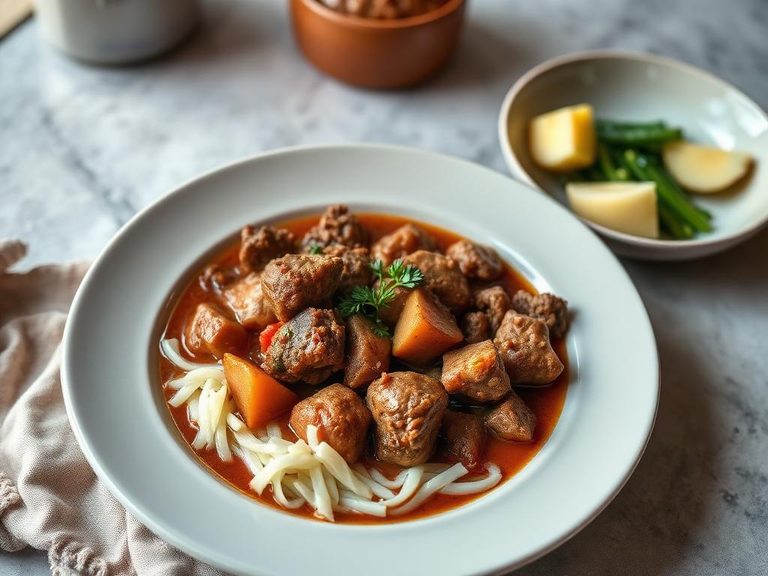
Stew, dumpling with mutton (Navajo)
Whole food · American Indian/Alaska Native Foods
This hearty Navajo stew features tender, slow-cooked mutton and soft, pillowy dumplings in a savory broth. The meat is rich and gamey, while the dumplings provide a comforting, starchy contrast. It's a protein-packed, energy-dense dish, with over 8g of protein per 100g to fuel you through the day.
Calorie split: 35% protein · 32% carbs · 34% fat
↓ Full nutrition💚 Why it's loved
People love it for its deep, savory flavor and the comforting, filling combination of meat and dumplings. It's a cherished cultural dish that embodies warmth, tradition, and communal eating in Navajo cuisine.
⚠️ Watch-outs & how to enjoy it better
The rich, fatty mutton and dense dumplings can be heavy, potentially causing digestive discomfort for some. Those monitoring saturated fat intake should enjoy it in moderation. To balance, pair with a side of leafy greens or a vinegar-based slaw to cut the richness and add fiber.
Key benefits
- Excellent source of high-quality protein for muscle maintenance.
- Provides a dense, efficient source of calories and energy.
- A traditional, warming dish ideal for cold weather or high-altitude climates.
- Offers a complete meal with both protein and carbohydrates in one bowl.
🍽️ Popular dishes
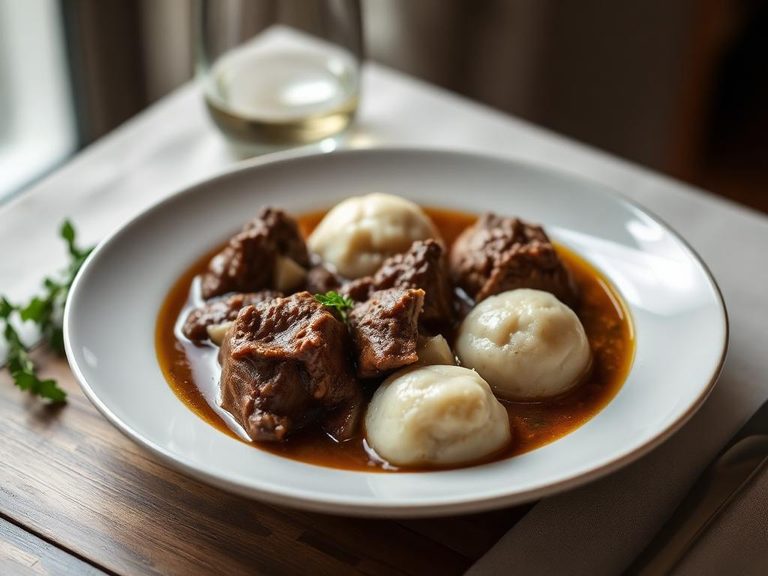
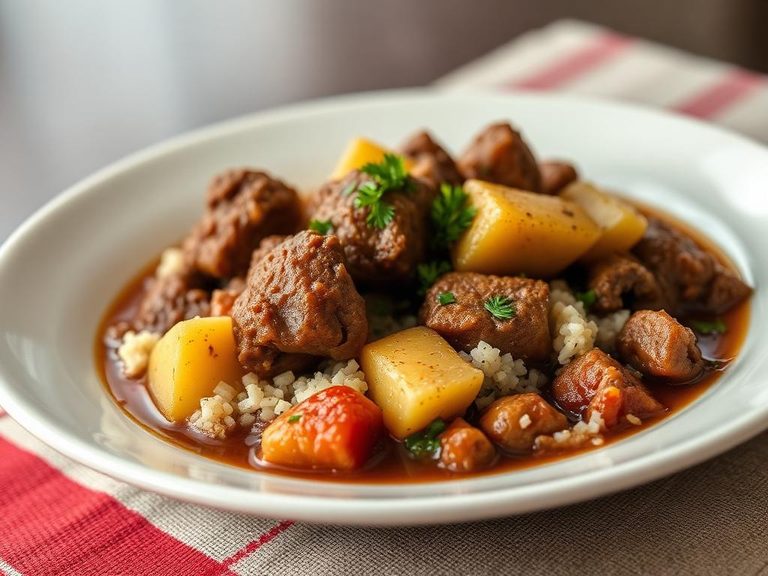
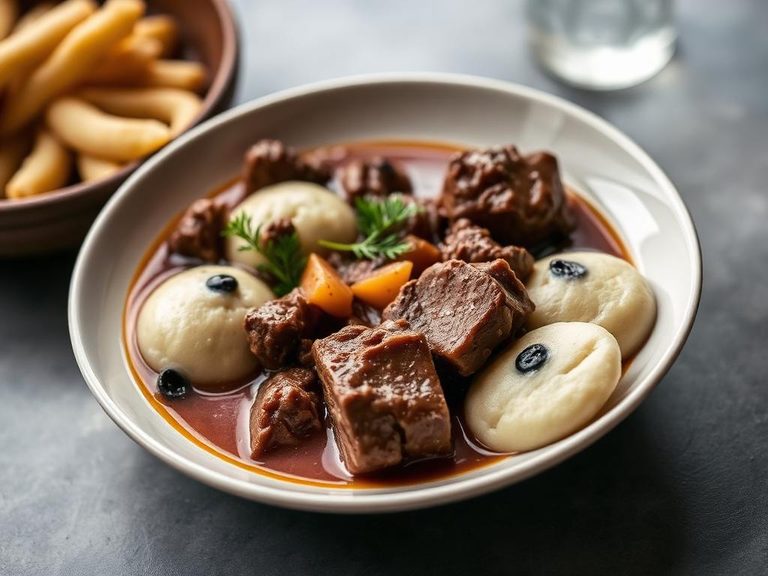
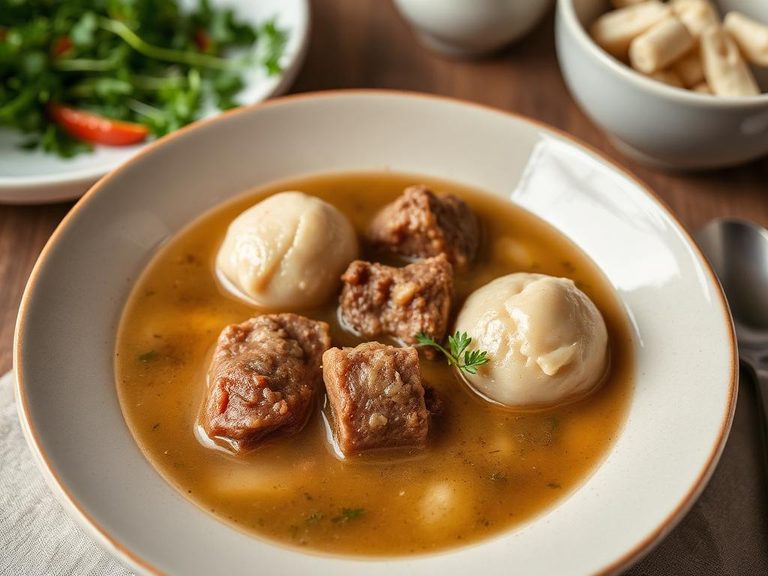
🌍 Where it's eaten
💡 Did you know?
The dumplings in this stew are sometimes made with blue cornmeal, a traditional Navajo staple, giving them a distinctive color and subtle earthy flavor.
Full nutrition (USDA data · scales with serving)
| Water | 79.2 g |
| Energy | 101 kcal |
| Energy | 422 kj |
| Protein | 8.7 g |
| Total lipid (fat) | 3.8 g |
| Ash | 0.27 g |
| Carbohydrate, by difference | 8.0 g |
| Total Sugars | 0.21 g |
| Sucrose | 0.00 g |
| Glucose | 0.00 g |
| Fructose | 0.00 g |
| Lactose | 0.00 g |
| Maltose | 0.21 g |
| Galactose | 0.00 g |
| Starch | 7.8 g |
| Calcium, Ca | 14.0 mg |
| Iron, Fe | 1.8 mg |
| Magnesium, Mg | 8.0 mg |
| Phosphorus, P | 63.0 mg |
| Potassium, K | 82.0 mg |
| Sodium, Na | 46.0 mg |
| Zinc, Zn | 1.9 mg |
| Copper, Cu | 0.05 mg |
| Manganese, Mn | 0.06 mg |
| Selenium, Se | 10.2 ug |
| Vitamin C, total ascorbic acid | 0.00 mg |
| Thiamin | 0.07 mg |
| Riboflavin | 0.09 mg |
| Niacin | 2.0 mg |
| Pantothenic acid | 0.16 mg |
| Vitamin B-6 | 0.04 mg |
| Folate, total | 41.0 ug |
| Folate, food | 41.0 ug |
| Vitamin B-12 | 0.82 ug |
| Vitamin A, RAE | 0.00 ug |
| Retinol | 0.00 ug |
| Vitamin A, IU | 0.00 iu |
| Vitamin E (alpha-tocopherol) | 0.37 mg |
| Tocopherol, beta | 0.00 mg |
| Tocopherol, gamma | 0.00 mg |
| Tocopherol, delta | 0.00 mg |
| Tocotrienol, alpha | 0.00 mg |
| Tocotrienol, beta | 0.00 mg |
| Tocotrienol, gamma | 0.00 mg |
| Tocotrienol, delta | 0.00 mg |
| Vitamin K (phylloquinone) | 1.7 ug |
| Vitamin K (Dihydrophylloquinone) | 0.00 ug |
Fat & fatty acid profile (per 100g)
| Fatty acids, total saturated | 1.7 g |
| SFA 8:0 | 0.00 g |
| SFA 10:0 | 0.00 g |
| SFA 12:0 | 0.00 g |
| SFA 14:0 | 0.08 g |
| SFA 15:0 | 0.02 g |
| SFA 16:0 | 0.81 g |
| SFA 17:0 | 0.06 g |
| SFA 18:0 | 0.74 g |
| SFA 20:0 | 0.01 g |
| SFA 22:0 | 0.00 g |
| Fatty acids, total monounsaturated | 1.5 g |
| MUFA 14:1 | 0.00 g |
| MUFA 15:1 | 0.00 g |
| MUFA 16:1 | 0.06 g |
| MUFA 17:1 | 0.03 g |
| MUFA 18:1 | 1.4 g |
| MUFA 20:1 | 0.01 g |
| Fatty acids, total polyunsaturated | 0.27 g |
| PUFA 18:2 | 0.19 g |
| PUFA 18:3 | 0.01 g |
| PUFA 18:3 n-3 c,c,c (ALA) | 0.05 g |
| PUFA 18:3 n-6 c,c,c | 0.01 g |
| PUFA 20:2 n-6 c,c | 0.00 g |
| PUFA 20:3 | 0.00 g |
| PUFA 20:4 | 0.01 g |
| Cholesterol | 28.0 mg |
Amino acid profile (per 100g)
Estimated from Stew, hominy with mutton (Navajo) — USDA does not publish this profile for Stew.
| Tryptophan | 0.04 g |
| Threonine | 0.24 g |
| Isoleucine | 0.25 g |
| Leucine | 0.54 g |
| Lysine | 0.43 g |
| Methionine | 0.16 g |
| Cystine | 0.07 g |
| Phenylalanine | 0.26 g |
| Tyrosine | 0.18 g |
| Valine | 0.29 g |
| Arginine | 0.39 g |
| Histidine | 0.16 g |
| Alanine | 0.42 g |
| Aspartic acid | 0.53 g |
| Glutamic acid | 0.99 g |
| Glycine | 0.45 g |
| Proline | 0.39 g |
| Serine | 0.25 g |
FAQ
What is the difference between mutton and lamb?
Mutton comes from mature sheep (over 1 year old) and has a stronger, gamier flavor and firmer texture. Lamb is from younger sheep and is more tender and mild. This stew traditionally uses mutton for its robust flavor.
Can I make this with beef or chicken?
Yes, you can substitute beef chuck or chicken thighs, though the flavor profile will change. The traditional taste relies on the unique richness of mutton.
Are the dumplings cooked in the stew?
Yes, the dumpling dough is typically dropped directly into the simmering stew broth, where it steams and cooks to become soft and fluffy.
Nutrient density (calculated · NRF9.3)
Nutrient Rich Foods index: beneficial nutrients (protein, fiber, vitamins, minerals) minus saturated fat, added sugar & sodium, per 100 kcal.
NRF9.3 index — Fulgoni, Keast & Drewnowski, 2009. Computed from USDA nutrients.
Weight-loss friendliness (composite index)
Energy density 1.01 kcal/g · 34% calories from protein · 0.0 g fiber · 0.2 g sugar per 100 g.
Composite of energy density (Rolls et al., 1999), protein & fiber satiety, minus sugar. A calculated heuristic — ranks satiety-per-calorie, not a clinical measure.
Dietary load (calculated from USDA values)
Potential renal acid load. Positive = acid-forming, negative = alkaline-forming.
Sodium-to-potassium ratio: 0.56 (lower is better — aim for ≤ 1)
Sodium:potassium per WHO potassium guidance. Computed from USDA nutrients.