

Mollusks, clam, mixed species, canned, liquid
Whole food · Finfish and Shellfish Products

Photo: Wikipedia
This is the savory, mineral-rich liquid brine or juice from canned mixed clams, often referred to as clam juice or clam broth. It possesses a delicate, briny, and umami-forward flavor with a thin, watery texture, serving as a potent flavor enhancer rather than a substantial food. Nutritionally, it is extremely low in calories, providing a negligible amount of protein and virtually no fat, carbs, or fiber.
Calorie split: 73% protein · 18% carbs · 8% fat
↓ Full nutrition💚 Why it's loved
People love it for its ability to instantly impart a rich, oceanic depth to soups, stews, and pasta sauces without adding significant calories or fat. It's a secret weapon for home cooks to create restaurant-quality seafood flavor in a simple, accessible way.
⚠️ Watch-outs & how to enjoy it better
The primary downside is its very high sodium content, which can be a concern for those monitoring salt intake. To counteract this, use it in moderation, dilute it with unsalted water or stock, and balance it with acidic ingredients like lemon juice or vinegar to enhance flavor without needing extra salt.
Key benefits
- Adds deep umami and briny flavor to dishes with minimal calories.
- Provides a source of iodine and selenium, trace minerals essential for thyroid and immune function.
- Serves as a convenient, ready-to-use base for seafood soups, chowders, and sauces.
- A low-fat, low-carb liquid for enhancing the flavor profile of various recipes.
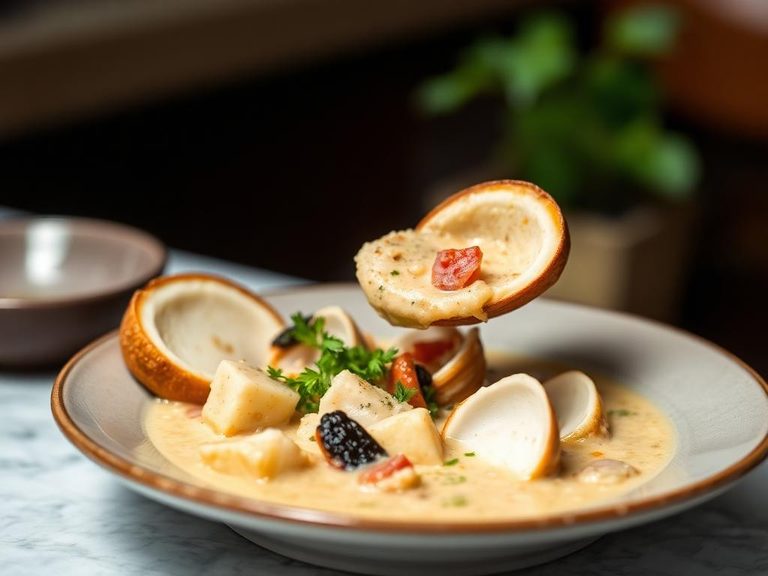
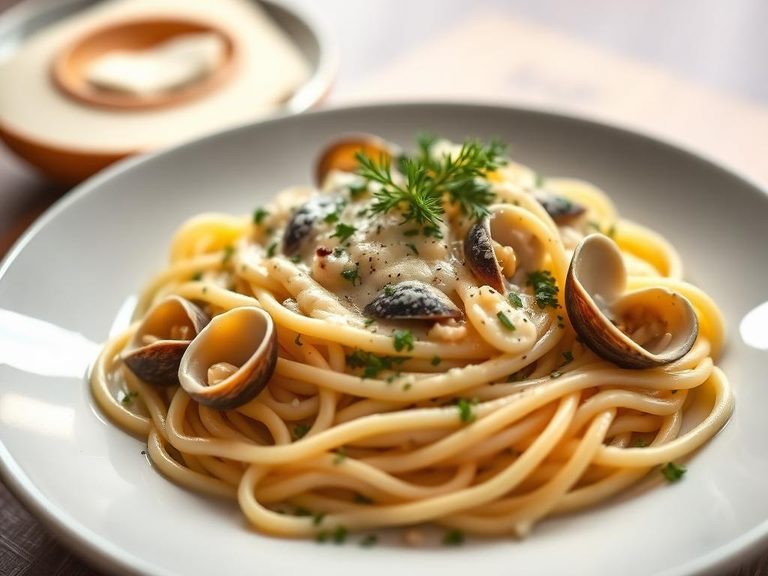
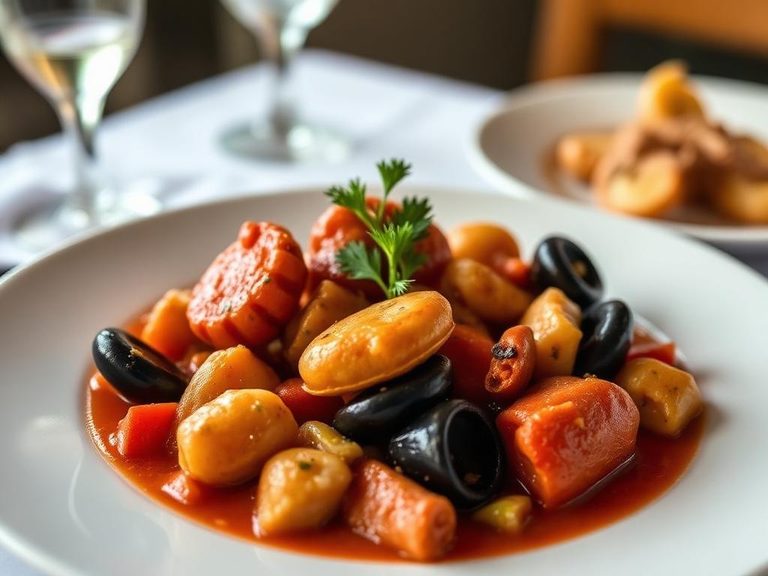
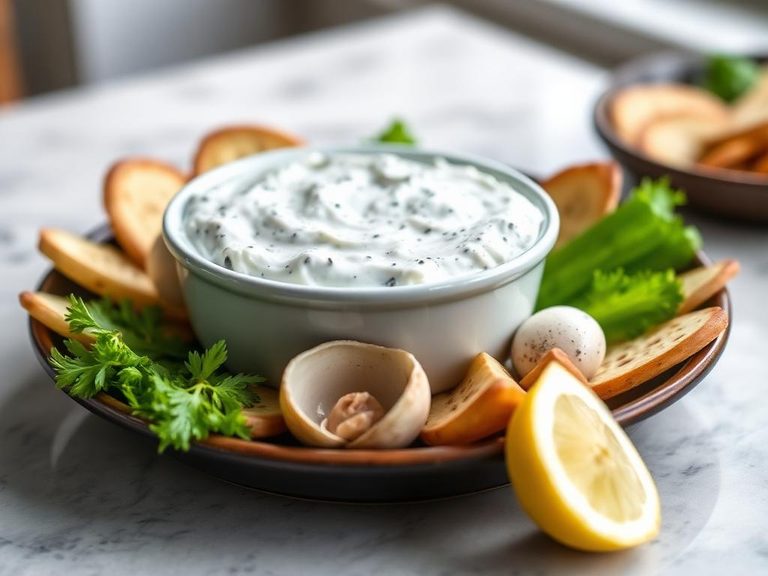
🍽️ Popular dishes
🌍 Where it's eaten
💡 Did you know?
The liquid from canned clams is essentially a natural, concentrated seafood stock, and its umami flavor comes from glutamates that are released from the clam meat during the canning process.
Full nutrition (USDA data · scales with serving)
| Water | 97.7 g |
| Energy | 2.0 kcal |
| Energy | 8.0 kj |
| Protein | 0.40 g |
| Total lipid (fat) | 0.02 g |
| Ash | 1.8 g |
| Carbohydrate, by difference | 0.10 g |
| Fiber, total dietary | 0.00 g |
| Total Sugars | 0.00 g |
| Calcium, Ca | 13.0 mg |
| Iron, Fe | 0.30 mg |
| Magnesium, Mg | 11.0 mg |
| Phosphorus, P | 114 mg |
| Potassium, K | 149 mg |
| Sodium, Na | 215 mg |
| Zinc, Zn | 0.10 mg |
| Copper, Cu | 0.39 mg |
| Manganese, Mn | 0.07 mg |
| Selenium, Se | 4.1 ug |
| Vitamin C, total ascorbic acid | 1.0 mg |
| Thiamin | 0.01 mg |
| Riboflavin | 0.02 mg |
| Niacin | 0.18 mg |
| Pantothenic acid | 0.04 mg |
| Vitamin B-6 | 0.01 mg |
| Folate, total | 2.0 ug |
| Folic acid | 0.00 ug |
| Folate, food | 2.0 ug |
| Folate, DFE | 2.0 ug |
| Choline, total | 13.0 mg |
| Vitamin B-12 | 5.0 ug |
| Vitamin B-12, added | 0.00 ug |
| Vitamin A, RAE | 9.0 ug |
| Retinol | 9.0 ug |
| Carotene, beta | 0.00 ug |
| Carotene, alpha | 0.00 ug |
| Cryptoxanthin, beta | 0.00 ug |
| Vitamin A, IU | 30.0 iu |
| Lycopene | 0.00 ug |
| Lutein + zeaxanthin | 0.00 ug |
| Vitamin E (alpha-tocopherol) | 0.31 mg |
| Vitamin E, added | 0.00 mg |
| Tocopherol, beta | 0.00 mg |
| Tocopherol, gamma | 0.00 mg |
| Tocopherol, delta | 0.01 mg |
| Tocotrienol, alpha | 0.00 mg |
| Tocotrienol, beta | 0.00 mg |
| Tocotrienol, gamma | 0.00 mg |
| Vitamin D (D2 + D3), International Units | 0.00 iu |
| Vitamin D (D2 + D3) | 0.00 ug |
| Vitamin D3 (cholecalciferol) | 0.00 ug |
| Vitamin K (phylloquinone) | 0.20 ug |
| Alcohol, ethyl | 0.00 g |
| Caffeine | 0.00 mg |
| Theobromine | 0.00 mg |
Fat & fatty acid profile (per 100g)
| Fatty acids, total saturated | 0.00 g |
| SFA 4:0 | 0.00 g |
| SFA 6:0 | 0.00 g |
| SFA 8:0 | 0.00 g |
| SFA 10:0 | 0.00 g |
| SFA 12:0 | 0.00 g |
| SFA 14:0 | 0.00 g |
| SFA 16:0 | 0.00 g |
| SFA 18:0 | 0.00 g |
| Fatty acids, total monounsaturated | 0.00 g |
| MUFA 16:1 | 0.00 g |
| MUFA 18:1 | 0.00 g |
| MUFA 20:1 | 0.00 g |
| MUFA 22:1 | 0.00 g |
| Fatty acids, total polyunsaturated | 0.01 g |
| PUFA 18:2 | 0.00 g |
| PUFA 18:3 | 0.00 g |
| PUFA 18:4 | 0.00 g |
| PUFA 20:4 | 0.00 g |
| PUFA 20:5 n-3 (EPA) | 0.00 g |
| PUFA 22:5 n-3 (DPA) | 0.00 g |
| PUFA 22:6 n-3 (DHA) | 0.00 g |
| Cholesterol | 3.0 mg |
Amino acid profile (per 100g)
| Threonine | 0.00 g |
| Isoleucine | 0.00 g |
| Leucine | 0.00 g |
| Lysine | 0.00 g |
| Phenylalanine | 0.00 g |
| Tyrosine | 0.00 g |
| Valine | 0.00 g |
| Arginine | 0.00 g |
| Histidine | 0.00 g |
| Alanine | 0.01 g |
| Aspartic acid | 0.00 g |
| Glutamic acid | 0.02 g |
| Glycine | 0.00 g |
| Serine | 0.00 g |
FAQ
Is canned clam liquid the same as clam juice?
Yes, they are essentially the same product. The liquid from canned clams is often labeled as 'clam juice' or 'clam broth' and is used interchangeably in recipes.
Can I use the liquid from canned clams for cooking?
Absolutely. It's a key ingredient in many seafood dishes, adding a rich, briny flavor to chowders, sauces, and soups. It's a convenient way to add depth without making a stock from scratch.
Is canned clam liquid high in sodium?
Yes, it is typically high in sodium because it's a brine. If you're watching your salt intake, look for low-sodium versions or use it sparingly and dilute it with water or unsalted stock.
Nutrient density (calculated · NRF9.3)
Nutrient Rich Foods index: beneficial nutrients (protein, fiber, vitamins, minerals) minus saturated fat, added sugar & sodium, per 100 kcal.
NRF9.3 index — Fulgoni, Keast & Drewnowski, 2009. Computed from USDA nutrients.
Weight-loss friendliness (composite index)
Energy density 0.02 kcal/g · 80% calories from protein · 0.0 g fiber · 0.0 g sugar per 100 g.
Composite of energy density (Rolls et al., 1999), protein & fiber satiety, minus sugar. A calculated heuristic — ranks satiety-per-calorie, not a clinical measure.
Dietary load (calculated from USDA values)
Potential renal acid load. Positive = acid-forming, negative = alkaline-forming.
Sodium-to-potassium ratio: 1.44 (lower is better — aim for ≤ 1)
Sodium:potassium per WHO potassium guidance. Computed from USDA nutrients.