

DIGIORNO Pizza, pepperoni topping, rising crust, frozen, baked
Whole food · Fast Foods
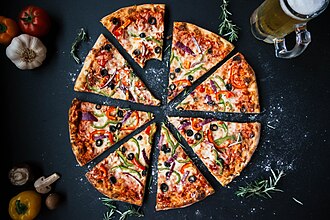
Photo: Wikipedia
This is a classic American frozen pizza that transforms from a pale, doughy disc into a golden, bubbly meal with a satisfyingly chewy crust and a savory, slightly greasy pepperoni topping. The rising crust provides a bread-like texture that crisps on the edges while staying soft inside. Nutritionally, it's a calorie-dense, protein-rich convenience food, with a single serving delivering a significant portion of your daily protein needs.
Calorie split: 19% protein · 47% carbs · 34% fat
↓ Full nutrition💚 Why it's loved
People adore it for the uncomplicated joy of a hot, cheesy, meaty pizza that requires zero prep time beyond turning on the oven. It taps into a deep cultural love for pizza as a universal comfort food, making it a reliable staple for movie nights, busy weeknights, or feeding a crowd.
⚠️ Watch-outs & how to enjoy it better
The high sodium and saturated fat content can be concerning for those monitoring heart health or blood pressure. The refined carbs and added sugars may cause blood-sugar spikes, especially without balancing sides. To counteract, pair a smaller portion with a large, leafy green salad with vinaigrette to add fiber and volume, or add extra vegetables as toppings before baking.
Key benefits
- High in protein for a convenience meal
- Provides a quick source of energy from carbohydrates
- Convenient, shelf-stable meal solution
- Contains dietary fiber from the crust
- Offers a familiar, comforting flavor profile
🍽️ Popular dishes
🌍 Where it's eaten
💡 Did you know?
The 'rising crust' technology was a major innovation in the frozen pizza industry, using a specially formulated dough with live yeast that remains dormant until baked, creating a fresher, bread-like texture that mimics delivery pizza.
Full nutrition (USDA data · scales with serving)
| Water | 43.3 g |
| Energy | 265 kcal |
| Energy | 1110 kj |
| Protein | 12.5 g |
| Total lipid (fat) | 10.1 g |
| Ash | 3.0 g |
| Carbohydrate, by difference | 31.1 g |
| Fiber, total dietary | 2.3 g |
| Total Sugars | 5.1 g |
| Sucrose | 0.00 g |
| Glucose | 2.0 g |
| Fructose | 2.3 g |
| Lactose | 0.00 g |
| Maltose | 0.60 g |
| Galactose | 0.20 g |
| Starch | 24.2 g |
| Calcium, Ca | 157 mg |
| Iron, Fe | 0.95 mg |
| Magnesium, Mg | 27.0 mg |
| Phosphorus, P | 225 mg |
| Potassium, K | 212 mg |
| Sodium, Na | 743 mg |
| Zinc, Zn | 1.4 mg |
| Copper, Cu | 0.12 mg |
| Manganese, Mn | 0.39 mg |
| Selenium, Se | 26.8 ug |
| Vitamin C, total ascorbic acid | 1.3 mg |
| Thiamin | 0.13 mg |
| Riboflavin | 0.08 mg |
| Niacin | 1.6 mg |
| Pantothenic acid | 0.45 mg |
| Vitamin B-6 | 0.14 mg |
| Vitamin B-12 | 0.42 ug |
| Vitamin A, RAE | 41.0 ug |
| Retinol | 41.0 ug |
| Vitamin A, IU | 137 iu |
| Vitamin E (alpha-tocopherol) | 0.88 mg |
| Tocopherol, beta | 0.10 mg |
| Tocopherol, gamma | 1.3 mg |
| Tocopherol, delta | 0.25 mg |
| Tocotrienol, alpha | 0.03 mg |
| Tocotrienol, beta | 0.00 mg |
| Tocotrienol, gamma | 0.01 mg |
| Tocotrienol, delta | 0.00 mg |
| Vitamin K (phylloquinone) | 7.6 ug |
| Vitamin K (Dihydrophylloquinone) | 0.00 ug |
| Vitamin K (Menaquinone-4) | 2.7 ug |
Fat & fatty acid profile (per 100g)
| Fatty acids, total saturated | 3.8 g |
| SFA 4:0 | 0.04 g |
| SFA 6:0 | 0.04 g |
| SFA 8:0 | 0.03 g |
| SFA 10:0 | 0.08 g |
| SFA 12:0 | 0.11 g |
| SFA 14:0 | 0.41 g |
| SFA 15:0 | 0.04 g |
| SFA 16:0 | 2.0 g |
| SFA 17:0 | 0.03 g |
| SFA 18:0 | 0.95 g |
| SFA 20:0 | 0.01 g |
| SFA 22:0 | 0.01 g |
| SFA 24:0 | 0.01 g |
| Fatty acids, total monounsaturated | 2.8 g |
| MUFA 14:1 | 0.03 g |
| MUFA 15:1 | 0.00 g |
| MUFA 16:1 | 0.16 g |
| MUFA 16:1 c | 0.15 g |
| MUFA 17:1 | 0.00 g |
| MUFA 18:1 | 2.5 g |
| MUFA 18:1 c | 2.4 g |
| MUFA 20:1 | 0.04 g |
| MUFA 22:1 | 0.01 g |
| MUFA 22:1 c | 0.01 g |
| MUFA 24:1 c | 0.00 g |
| Fatty acids, total polyunsaturated | 1.8 g |
| PUFA 18:2 | 1.6 g |
| PUFA 18:2 n-6 c,c | 1.5 g |
| PUFA 18:2 CLAs | 0.03 g |
| PUFA 18:3 | 0.15 g |
| PUFA 18:3 n-3 c,c,c (ALA) | 0.15 g |
| PUFA 18:3 n-6 c,c,c | 0.00 g |
| PUFA 18:4 | 0.00 g |
| PUFA 20:2 n-6 c,c | 0.01 g |
| PUFA 20:3 | 0.01 g |
| PUFA 20:3 n-3 | 0.00 g |
| PUFA 20:3 n-6 | 0.01 g |
| PUFA 20:4 | 0.01 g |
| PUFA 20:5 n-3 (EPA) | 0.00 g |
| PUFA 22:4 | 0.01 g |
| PUFA 22:5 n-3 (DPA) | 0.01 g |
| PUFA 22:6 n-3 (DHA) | 0.00 g |
| Fatty acids, total trans | 0.16 g |
| Fatty acids, total trans-monoenoic | 0.12 g |
| TFA 16:1 t | 0.01 g |
| TFA 18:1 t | 0.11 g |
| TFA 22:1 t | 0.00 g |
| TFA 18:2 t not further defined | 0.03 g |
| Fatty acids, total trans-polyenoic | 0.03 g |
| Cholesterol | 18.0 mg |
FAQ
How does the nutrition compare to a fresh pizzeria pizza?
Frozen pizzas like this often have a similar calorie and fat profile to a slice from a chain pizzeria, but can be higher in sodium and preservatives for shelf stability. Fresh pizza may offer more customizable toppings and potentially less processed ingredients.
Is the protein content considered high?
At 12.46g per 100g, a single 118g slice provides about 14.7g of protein, which is a substantial amount for a convenience food and contributes meaningfully to the recommended daily intake.
Can I improve the nutritional value before baking?
Yes. Add a handful of spinach, bell peppers, onions, or mushrooms on top to boost fiber, vitamins, and volume. You can also blot excess grease from the pepperoni after baking with a paper towel.
Nutrient density (calculated · NRF9.3)
Nutrient Rich Foods index: beneficial nutrients (protein, fiber, vitamins, minerals) minus saturated fat, added sugar & sodium, per 100 kcal.
NRF9.3 index — Fulgoni, Keast & Drewnowski, 2009. Computed from USDA nutrients.
Weight-loss friendliness (composite index)
Energy density 2.65 kcal/g · 19% calories from protein · 2.3 g fiber · 5.1 g sugar per 100 g.
Composite of energy density (Rolls et al., 1999), protein & fiber satiety, minus sugar. A calculated heuristic — ranks satiety-per-calorie, not a clinical measure.
Dietary load (calculated from USDA values)
Potential renal acid load. Positive = acid-forming, negative = alkaline-forming.
Sodium-to-potassium ratio: 3.50 (lower is better — aim for ≤ 1)
Sodium:potassium per WHO potassium guidance. Computed from USDA nutrients.