

Cranberries, dried, sweetened (Includes foods for USDA's Food Distribution Program)
Whole food · Fruits and Fruit Juices

Photo: Wikipedia
Sweetened dried cranberries are a chewy, ruby-red snack with a signature tart-sweet punch, often coated in a fine layer of sugar. They are a calorie-dense, high-carb treat, delivering a significant 72.56g of sugar per 100g, primarily from added sweeteners that balance the fruit's natural astringency.
Calorie split: 0% protein · 97% carbs · 3% fat
↓ Full nutrition💚 Why it's loved
People love them for their addictive sweet-tart flavor and satisfying chew, which makes them a versatile ingredient in both sweet and savory contexts. They are a cultural staple in North American cuisine, especially during holidays, and are cherished for their ability to brighten up salads, baked goods, and trail mixes.
⚠️ Watch-outs & how to enjoy it better
The high added sugar content can cause rapid blood-sugar spikes, making them unsuitable for those managing diabetes or seeking low-glycemic foods. To counteract this, pair a small portion (15-20g) with protein (like nuts or yogurt) and healthy fats to slow sugar absorption. Also, be mindful of portion control, as it's easy to over-consume the sweetened variety.
Key benefits
- Provide dietary fiber (5.3g per 100g) for digestive health.
- Contain antioxidants like proanthocyanidins (PACs) linked to urinary tract health.
- Offer a convenient, shelf-stable source of quick energy from carbohydrates.
- Add a vibrant color and texture to a wide range of dishes.
🍽️ Popular dishes
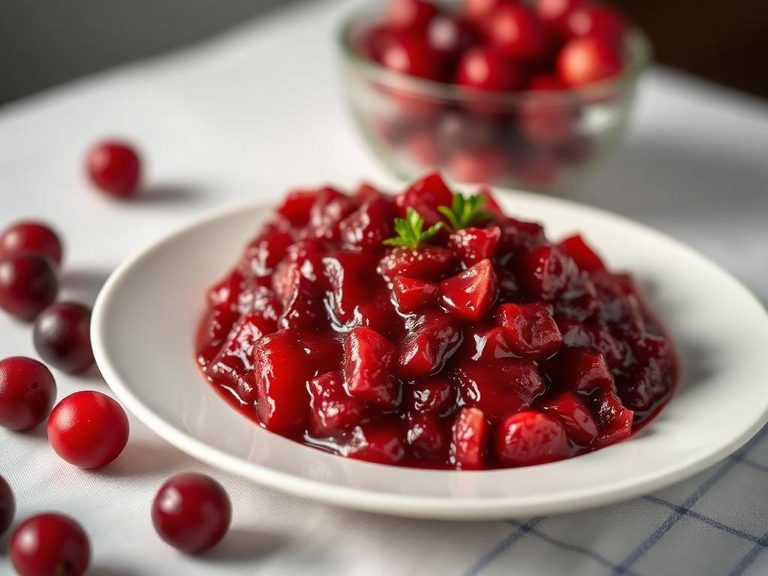
🌍 Where it's eaten
💡 Did you know?
The name 'cranberry' derives from 'craneberry,' as early European settlers thought the flower's stamens resembled a crane's head and neck.
Full nutrition (USDA data · scales with serving)
| Water | 15.8 g |
| Energy | 308 kcal |
| Energy | 1288 kj |
| Protein | 0.17 g |
| Total lipid (fat) | 1.1 g |
| Ash | 0.15 g |
| Carbohydrate, by difference | 82.8 g |
| Fiber, total dietary | 5.3 g |
| Total Sugars | 72.6 g |
| Sucrose | 15.8 g |
| Glucose | 29.7 g |
| Fructose | 27.0 g |
| Lactose | 0.08 g |
| Maltose | 0.00 g |
| Galactose | 0.00 g |
| Calcium, Ca | 9.0 mg |
| Iron, Fe | 0.39 mg |
| Magnesium, Mg | 4.0 mg |
| Phosphorus, P | 8.0 mg |
| Potassium, K | 49.0 mg |
| Sodium, Na | 5.0 mg |
| Zinc, Zn | 0.10 mg |
| Copper, Cu | 0.06 mg |
| Manganese, Mn | 0.18 mg |
| Selenium, Se | 0.60 ug |
| Vitamin C, total ascorbic acid | 0.20 mg |
| Thiamin | 0.01 mg |
| Riboflavin | 0.03 mg |
| Niacin | 0.55 mg |
| Vitamin B-6 | 0.04 mg |
| Folate, total | 0.00 ug |
| Folic acid | 0.00 ug |
| Folate, food | 0.00 ug |
| Folate, DFE | 0.00 ug |
| Choline, total | 8.3 mg |
| Vitamin B-12 | 0.00 ug |
| Vitamin B-12, added | 0.00 ug |
| Vitamin A, RAE | 2.0 ug |
| Retinol | 0.00 ug |
| Carotene, beta | 27.0 ug |
| Carotene, alpha | 0.00 ug |
| Cryptoxanthin, beta | 0.00 ug |
| Vitamin A, IU | 46.0 iu |
| Lycopene | 0.00 ug |
| Lutein + zeaxanthin | 138 ug |
| Vitamin E (alpha-tocopherol) | 2.1 mg |
| Vitamin E, added | 0.00 mg |
| Tocopherol, beta | 0.00 mg |
| Tocopherol, gamma | 0.17 mg |
| Tocopherol, delta | 0.00 mg |
| Vitamin D (D2 + D3), International Units | 0.00 iu |
| Vitamin D (D2 + D3) | 0.00 ug |
| Vitamin K (phylloquinone) | 7.6 ug |
| Alcohol, ethyl | 0.00 g |
| Caffeine | 0.00 mg |
| Theobromine | 0.00 mg |
Fat & fatty acid profile (per 100g)
| Fatty acids, total saturated | 0.09 g |
| SFA 4:0 | 0.00 g |
| SFA 6:0 | 0.00 g |
| SFA 8:0 | 0.00 g |
| SFA 10:0 | 0.01 g |
| SFA 12:0 | 0.00 g |
| SFA 14:0 | 0.00 g |
| SFA 15:0 | 0.00 g |
| SFA 16:0 | 0.03 g |
| SFA 17:0 | 0.00 g |
| SFA 18:0 | 0.02 g |
| SFA 20:0 | 0.00 g |
| SFA 22:0 | 0.01 g |
| SFA 24:0 | 0.01 g |
| Fatty acids, total monounsaturated | 0.30 g |
| MUFA 14:1 | 0.00 g |
| MUFA 15:1 | 0.00 g |
| MUFA 16:1 | 0.01 g |
| MUFA 17:1 | 0.00 g |
| MUFA 18:1 | 0.28 g |
| MUFA 20:1 | 0.01 g |
| MUFA 22:1 | 0.01 g |
| MUFA 24:1 c | 0.00 g |
| Fatty acids, total polyunsaturated | 0.18 g |
| PUFA 18:2 | 0.16 g |
| PUFA 18:2 n-6 c,c | 0.16 g |
| PUFA 18:3 | 0.02 g |
| PUFA 18:3 n-3 c,c,c (ALA) | 0.02 g |
| PUFA 18:3 n-6 c,c,c | 0.00 g |
| PUFA 18:4 | 0.00 g |
| PUFA 20:2 n-6 c,c | 0.00 g |
| PUFA 20:3 | 0.00 g |
| PUFA 20:3 n-3 | 0.00 g |
| PUFA 20:3 n-6 | 0.00 g |
| PUFA 20:4 | 0.00 g |
| PUFA 20:4 n-6 | 0.00 g |
| PUFA 20:5 n-3 (EPA) | 0.00 g |
| PUFA 21:5 | 0.00 g |
| PUFA 22:4 | 0.00 g |
| PUFA 22:5 n-3 (DPA) | 0.00 g |
| PUFA 22:6 n-3 (DHA) | 0.00 g |
| Fatty acids, total trans | 0.00 g |
| Cholesterol | 0.00 mg |
FAQ
Are sweetened dried cranberries the same as craisins?
Yes, 'Craisins' is a popular brand name (from Ocean Spray) for sweetened dried cranberries, but the term is often used generically for the product.
How do sweetened dried cranberries differ from unsweetened dried cranberries?
Sweetened versions have added sugar (often sucrose or apple juice concentrate) to offset the fruit's natural tartness. Unsweetened or 'lightly sweetened' varieties have significantly less added sugar and a more pronounced, tart flavor.
Can I use sweetened dried cranberries in savory dishes?
Absolutely. They are a classic addition to savory recipes like grain salads (e.g., quinoa or wild rice), stuffing, cheese boards, and even some meat glazes, where their sweetness provides a balancing contrast.
Nutrient density (calculated · NRF9.3)
Nutrient Rich Foods index: beneficial nutrients (protein, fiber, vitamins, minerals) minus saturated fat, added sugar & sodium, per 100 kcal.
NRF9.3 index — Fulgoni, Keast & Drewnowski, 2009. Computed from USDA nutrients.
Weight-loss friendliness (composite index)
Energy density 3.08 kcal/g · 0% calories from protein · 5.3 g fiber · 72.6 g sugar per 100 g.
Composite of energy density (Rolls et al., 1999), protein & fiber satiety, minus sugar. A calculated heuristic — ranks satiety-per-calorie, not a clinical measure.
Dietary load (calculated from USDA values)
Potential renal acid load. Positive = acid-forming, negative = alkaline-forming.
Sodium-to-potassium ratio: 0.10 (lower is better — aim for ≤ 1)
Sodium:potassium per WHO potassium guidance. Computed from USDA nutrients.