

Squash, winter, all varieties, cooked, baked, with salt
Whole food · Vegetables and Vegetable Products
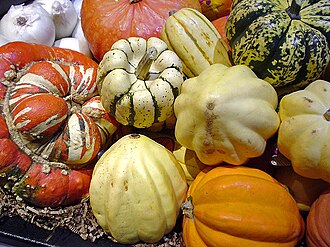
Photo: Wikipedia
Baked winter squash is the sweet, caramelized soul of autumn cooking. The flesh turns tender and velvety when baked, concentrating its natural sugars into a rich, honeyed flavor. At just 37 kcal per 100g, it's a nutrient-dense, low-calorie source of fiber and beta-carotene.
Calorie split: 8% protein · 84% carbs · 7% fat
↓ Full nutrition💚 Why it's loved
People love its natural, comforting sweetness and incredibly versatile texture, which can be silky smooth or pleasantly firm. It's a beloved canvas for both savory spices like cinnamon and nutmeg and for sweet preparations in pies and puddings.
⚠️ Watch-outs & how to enjoy it better
Its high carbohydrate content, including natural sugars, can cause blood sugar spikes if eaten in large portions alone. To counteract this, pair it with a source of protein (like beans, nuts, or cheese) or healthy fat (like olive oil or avocado) to slow sugar absorption. Also, be mindful of added salt in recipes or pre-seasoned varieties.
Key benefits
- Excellent source of beta-carotene, converted to vitamin A for vision and immune health.
- High in fiber, supporting digestive health and satiety.
- Naturally low in calories and fat, making it a weight-management friendly food.
- Provides potassium, which supports healthy blood pressure levels.
- Contains antioxidants like lutein and zeaxanthin.
🍽️ Popular dishes

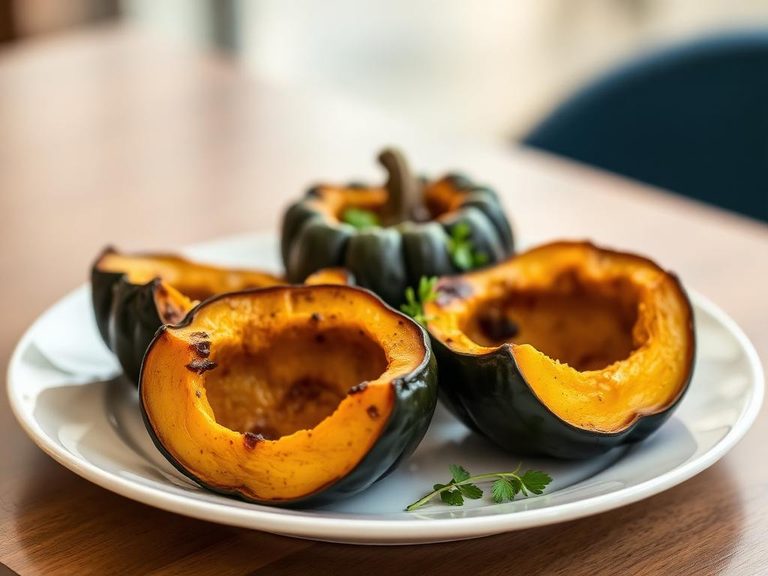
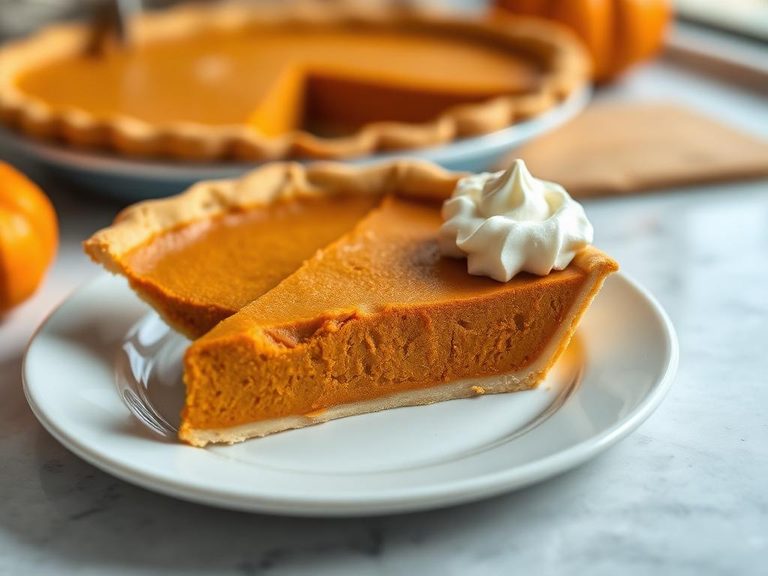
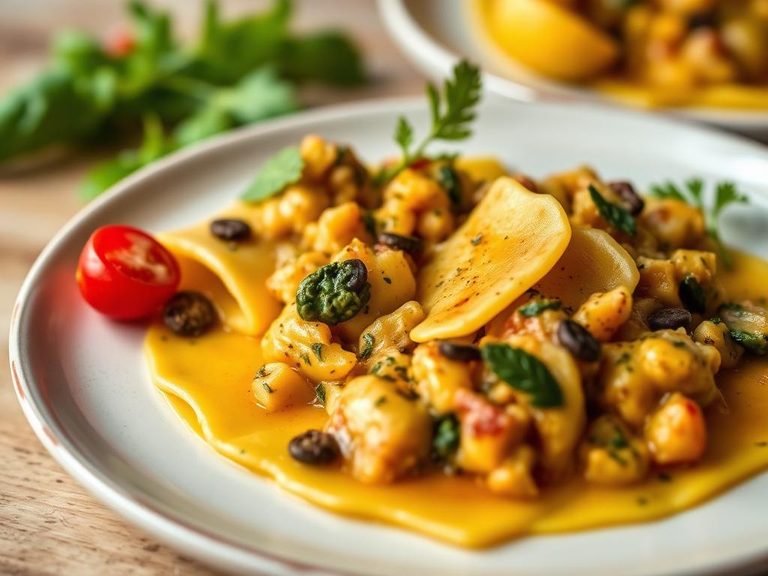
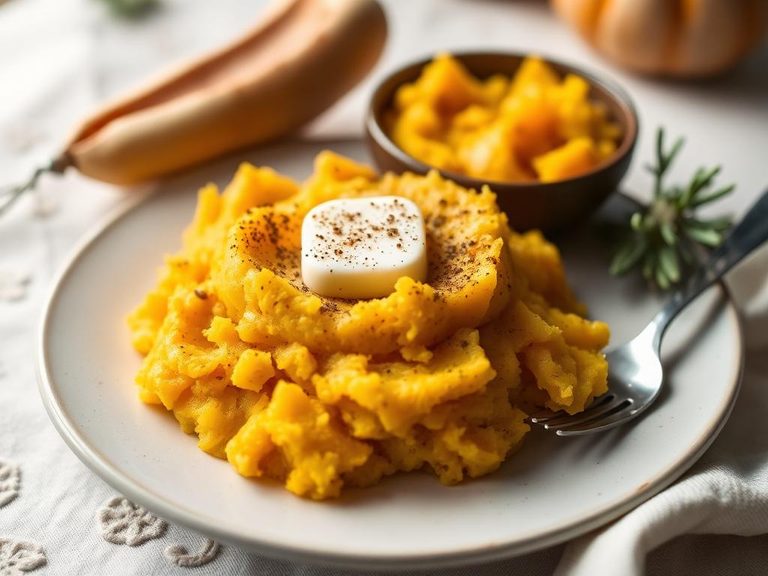
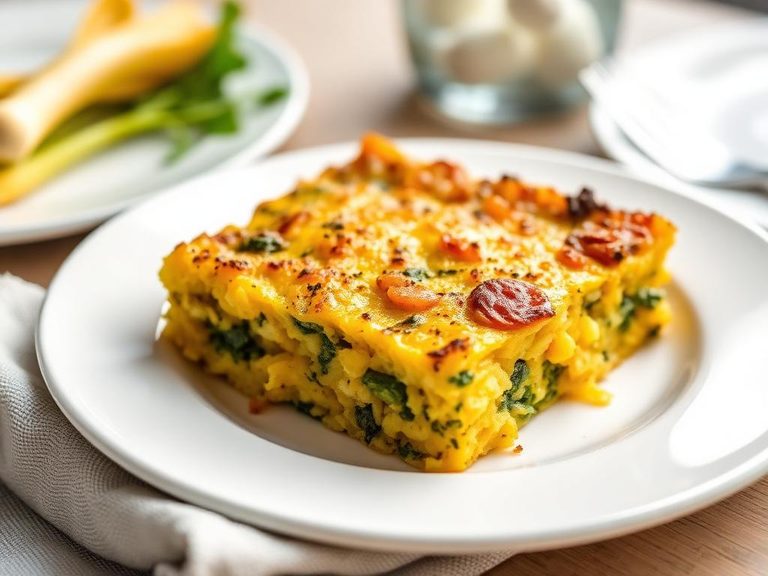
🌍 Where it's eaten
💡 Did you know?
The 'winter' in winter squash doesn't refer to when it's grown, but to its thick, hard rind that allows it to be stored (cured) for several months through the winter, unlike tender summer squash.
Full nutrition (USDA data · scales with serving)
| Water | 89.2 g |
| Energy | 37.0 kcal |
| Energy | 154 kj |
| Protein | 0.89 g |
| Total lipid (fat) | 0.35 g |
| Ash | 0.69 g |
| Carbohydrate, by difference | 8.8 g |
| Fiber, total dietary | 2.8 g |
| Total Sugars | 3.3 g |
| Calcium, Ca | 22.0 mg |
| Iron, Fe | 0.44 mg |
| Magnesium, Mg | 13.0 mg |
| Phosphorus, P | 19.0 mg |
| Potassium, K | 241 mg |
| Sodium, Na | 237 mg |
| Zinc, Zn | 0.22 mg |
| Copper, Cu | 0.08 mg |
| Manganese, Mn | 0.19 mg |
| Selenium, Se | 0.40 ug |
| Vitamin C, total ascorbic acid | 1.8 mg |
| Thiamin | 0.02 mg |
| Riboflavin | 0.07 mg |
| Niacin | 0.49 mg |
| Pantothenic acid | 0.23 mg |
| Vitamin B-6 | 0.16 mg |
| Folate, total | 20.0 ug |
| Folic acid | 0.00 ug |
| Folate, food | 20.0 ug |
| Folate, DFE | 20.0 ug |
| Choline, total | 10.6 mg |
| Betaine | 0.20 mg |
| Vitamin B-12 | 0.00 ug |
| Vitamin B-12, added | 0.00 ug |
| Vitamin A, RAE | 261 ug |
| Retinol | 0.00 ug |
| Carotene, beta | 2793 ug |
| Carotene, alpha | 682 ug |
| Cryptoxanthin, beta | 0.00 ug |
| Vitamin A, IU | 5223 iu |
| Lycopene | 0.00 ug |
| Lutein + zeaxanthin | 1415 ug |
| Vitamin E (alpha-tocopherol) | 0.12 mg |
| Vitamin E, added | 0.00 mg |
| Vitamin D (D2 + D3), International Units | 0.00 iu |
| Vitamin D (D2 + D3) | 0.00 ug |
| Vitamin K (phylloquinone) | 4.4 ug |
| Alcohol, ethyl | 0.00 g |
| Caffeine | 0.00 mg |
| Theobromine | 0.00 mg |
Fat & fatty acid profile (per 100g)
| Fatty acids, total saturated | 0.07 g |
| SFA 4:0 | 0.00 g |
| SFA 6:0 | 0.00 g |
| SFA 8:0 | 0.00 g |
| SFA 10:0 | 0.00 g |
| SFA 12:0 | 0.00 g |
| SFA 14:0 | 0.00 g |
| SFA 16:0 | 0.06 g |
| SFA 18:0 | 0.01 g |
| Fatty acids, total monounsaturated | 0.03 g |
| MUFA 16:1 | 0.00 g |
| MUFA 18:1 | 0.02 g |
| MUFA 20:1 | 0.00 g |
| MUFA 22:1 | 0.00 g |
| Fatty acids, total polyunsaturated | 0.15 g |
| PUFA 18:2 | 0.06 g |
| PUFA 18:3 | 0.09 g |
| PUFA 18:4 | 0.00 g |
| PUFA 20:4 | 0.00 g |
| PUFA 20:5 n-3 (EPA) | 0.00 g |
| PUFA 22:5 n-3 (DPA) | 0.00 g |
| PUFA 22:6 n-3 (DHA) | 0.00 g |
| Fatty acids, total trans | 0.00 g |
| Cholesterol | 0.00 mg |
Amino acid profile (per 100g)
| Tryptophan | 0.01 g |
| Threonine | 0.03 g |
| Isoleucine | 0.04 g |
| Leucine | 0.05 g |
| Lysine | 0.03 g |
| Methionine | 0.01 g |
| Cystine | 0.01 g |
| Phenylalanine | 0.04 g |
| Tyrosine | 0.03 g |
| Valine | 0.04 g |
| Arginine | 0.05 g |
| Histidine | 0.02 g |
| Alanine | 0.04 g |
| Aspartic acid | 0.10 g |
| Glutamic acid | 0.15 g |
| Glycine | 0.03 g |
| Proline | 0.03 g |
| Serine | 0.04 g |
FAQ
Is baked winter squash a starchy vegetable?
Yes, it's considered a starchy vegetable due to its higher carbohydrate content compared to non-starchy vegetables like leafy greens, but it's also packed with fiber and nutrients.
Can I eat the skin of baked winter squash?
It depends on the variety. Delicata and acorn squash skins become tender when baked and are edible. Butternut or pumpkin skins are typically tough and are usually peeled before cooking or discarded after baking.
How does baking affect its nutrition?
Baking concentrates the flavors and natural sugars without adding significant calories (if no fat is added). It makes beta-carotene more bioavailable and is a healthy cooking method that preserves most nutrients.
Nutrient density (calculated · NRF9.3)
Nutrient Rich Foods index: beneficial nutrients (protein, fiber, vitamins, minerals) minus saturated fat, added sugar & sodium, per 100 kcal.
NRF9.3 index — Fulgoni, Keast & Drewnowski, 2009. Computed from USDA nutrients.
Weight-loss friendliness (composite index)
Energy density 0.37 kcal/g · 10% calories from protein · 2.8 g fiber · 3.3 g sugar per 100 g.
Composite of energy density (Rolls et al., 1999), protein & fiber satiety, minus sugar. A calculated heuristic — ranks satiety-per-calorie, not a clinical measure.
Dietary load (calculated from USDA values)
Potential renal acid load. Positive = acid-forming, negative = alkaline-forming.
Sodium-to-potassium ratio: 0.98 (lower is better — aim for ≤ 1)
Sodium:potassium per WHO potassium guidance. Computed from USDA nutrients.