

Pizza, cheese topping, regular crust, frozen, cooked
Whole food · Fast Foods
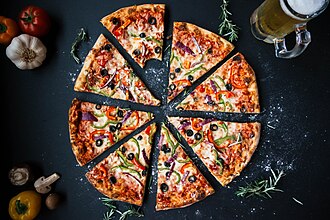
Photo: Wikipedia
This is a classic frozen pizza, transformed by heat into a bubbling, golden disc of melted mozzarella and savory tomato sauce atop a crisp, chewy crust. The experience is a satisfying contrast: the slightly salty, stretchy cheese against the tangy sauce and sturdy base. Nutritionally, it's a dense energy source, packing over 260 calories and a solid 10g of protein per 100g, but also a notable amount of fat and refined carbs.
Calorie split: 15% protein · 43% carbs · 41% fat
↓ Full nutrition💚 Why it's loved
People love it for the ultimate comfort food combination: the umami-rich, gooey cheese, the bright acidity of tomato sauce, and the satisfying chew of the crust. It's a globally recognized, customizable staple that brings people together for casual meals and celebrations.
⚠️ Watch-outs & how to enjoy it better
The high sodium and saturated fat content can be a concern for heart health, and the refined white flour crust can cause rapid blood sugar spikes. To counteract this, pair a smaller slice with a large, leafy green salad dressed with olive oil to slow digestion and add fiber, or choose a whole-wheat crust version if available.
Key benefits
- Provides a quick, convenient source of complete protein and energy.
- Contains calcium from the cheese for bone health.
- Offers lycopene, an antioxidant from the cooked tomato sauce.
- A versatile base for adding nutrient-dense vegetable toppings.
- The regular crust provides some dietary fiber.
🍽️ Popular dishes
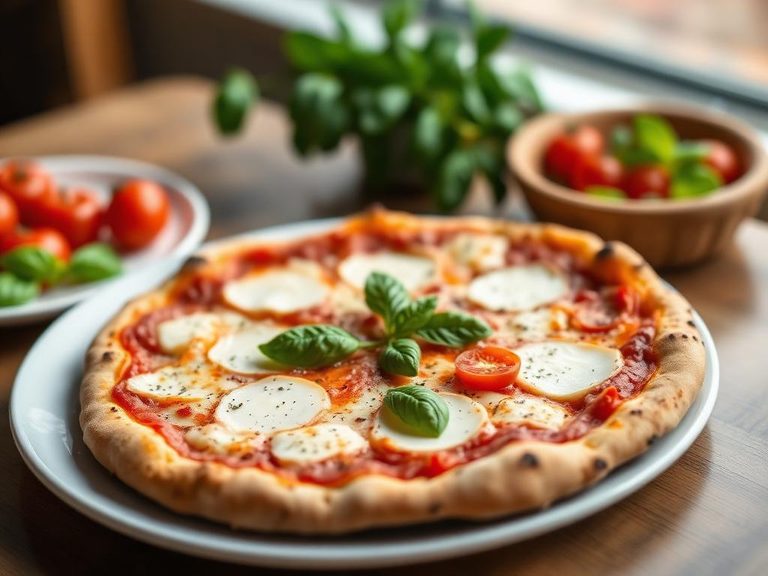
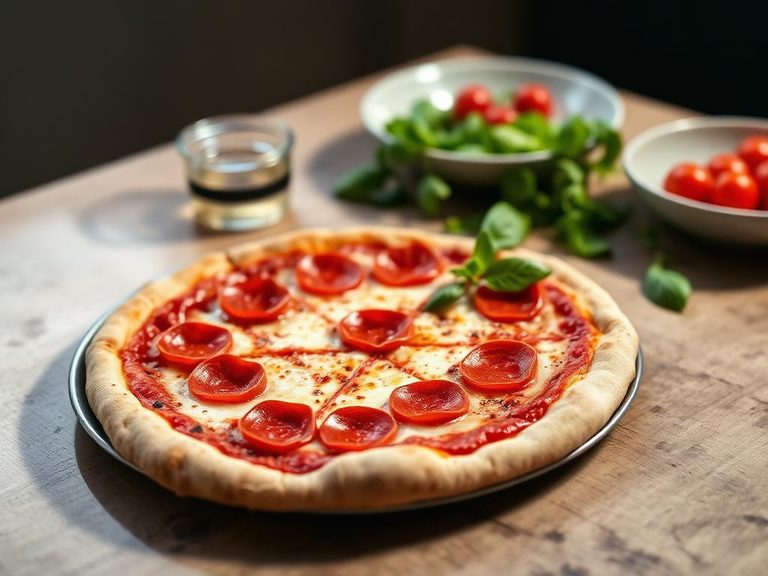

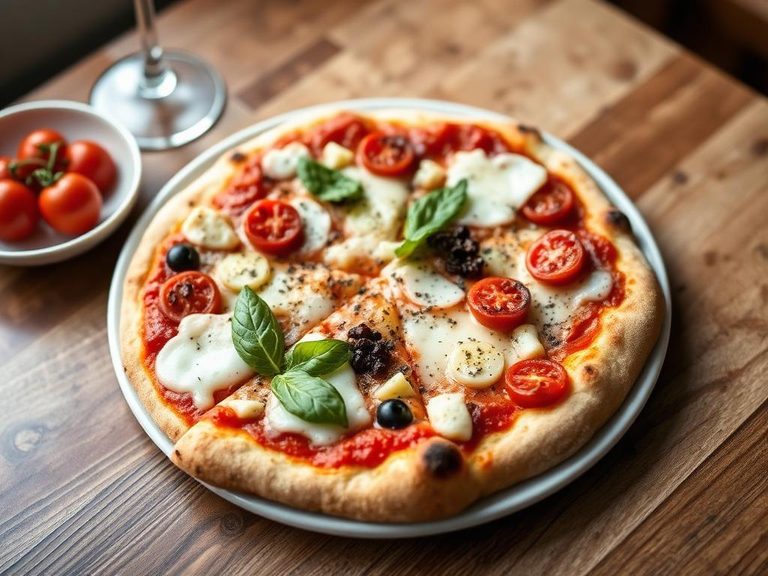
🌍 Where it's eaten
💡 Did you know?
Frozen pizza was first patented in 1950 by Rose Totino, who later sold her company to Pillsbury for $195 million, revolutionizing the frozen food aisle.
Full nutrition (USDA data · scales with serving)
| Water | 46.3 g |
| Energy | 268 kcal |
| Energy | 1121 kj |
| Protein | 10.4 g |
| Total lipid (fat) | 12.3 g |
| Ash | 2.1 g |
| Carbohydrate, by difference | 29.0 g |
| Fiber, total dietary | 2.2 g |
| Total Sugars | 3.6 g |
| Sucrose | 0.31 g |
| Glucose | 0.93 g |
| Fructose | 1.2 g |
| Lactose | 0.39 g |
| Maltose | 0.74 g |
| Starch | 18.7 g |
| Calcium, Ca | 179 mg |
| Iron, Fe | 2.3 mg |
| Magnesium, Mg | 23.0 mg |
| Phosphorus, P | 179 mg |
| Potassium, K | 152 mg |
| Sodium, Na | 447 mg |
| Zinc, Zn | 1.3 mg |
| Copper, Cu | 0.23 mg |
| Manganese, Mn | 0.29 mg |
| Selenium, Se | 21.5 ug |
| Fluoride, F | 31.3 ug |
| Vitamin C, total ascorbic acid | 1.2 mg |
| Thiamin | 0.21 mg |
| Riboflavin | 0.26 mg |
| Niacin | 2.2 mg |
| Pantothenic acid | 0.22 mg |
| Vitamin B-6 | 0.08 mg |
| Folate, total | 38.0 ug |
| Folic acid | 38.0 ug |
| Folate, food | 0.00 ug |
| Folate, DFE | 65.0 ug |
| Choline, total | 14.3 mg |
| Vitamin B-12 | 0.78 ug |
| Vitamin B-12, added | 0.00 ug |
| Vitamin A, RAE | 66.0 ug |
| Retinol | 58.0 ug |
| Carotene, beta | 88.0 ug |
| Carotene, alpha | 0.00 ug |
| Cryptoxanthin, beta | 0.00 ug |
| Vitamin A, IU | 342 iu |
| Lycopene | 1829 ug |
| Lutein + zeaxanthin | 34.0 ug |
| Vitamin E (alpha-tocopherol) | 1.0 mg |
| Vitamin E, added | 0.00 mg |
| Vitamin D (D2 + D3), International Units | 0.00 iu |
| Vitamin D (D2 + D3) | 0.00 ug |
| Vitamin K (phylloquinone) | 6.6 ug |
| Alcohol, ethyl | 0.00 g |
| Caffeine | 0.00 mg |
| Theobromine | 0.00 mg |
Fat & fatty acid profile (per 100g)
| Fatty acids, total saturated | 4.3 g |
| SFA 4:0 | 0.28 g |
| SFA 6:0 | 0.05 g |
| SFA 8:0 | 0.08 g |
| SFA 10:0 | 0.11 g |
| SFA 12:0 | 0.15 g |
| SFA 14:0 | 0.45 g |
| SFA 16:0 | 2.0 g |
| SFA 18:0 | 1.1 g |
| Fatty acids, total monounsaturated | 4.2 g |
| MUFA 16:1 | 0.13 g |
| MUFA 18:1 | 4.1 g |
| MUFA 20:1 | 0.03 g |
| MUFA 22:1 | 0.00 g |
| Fatty acids, total polyunsaturated | 1.9 g |
| PUFA 18:2 | 1.7 g |
| PUFA 18:3 | 0.17 g |
| PUFA 18:4 | 0.04 g |
| PUFA 20:4 | 0.01 g |
| PUFA 20:5 n-3 (EPA) | 0.00 g |
| PUFA 22:5 n-3 (DPA) | 0.00 g |
| PUFA 22:6 n-3 (DHA) | 0.00 g |
| Cholesterol | 14.0 mg |
Amino acid profile (per 100g)
| Tryptophan | 0.17 g |
| Threonine | 0.38 g |
| Isoleucine | 0.47 g |
| Leucine | 0.87 g |
| Lysine | 0.59 g |
| Methionine | 0.18 g |
| Cystine | 0.11 g |
| Phenylalanine | 0.53 g |
| Tyrosine | 0.32 g |
| Valine | 0.60 g |
| Arginine | 0.40 g |
| Histidine | 0.28 g |
| Alanine | 0.33 g |
| Aspartic acid | 0.65 g |
| Glutamic acid | 2.9 g |
| Glycine | 0.27 g |
| Proline | 1.2 g |
| Serine | 0.56 g |
FAQ
How does frozen pizza compare nutritionally to fresh takeaway pizza?
Frozen pizza often has a more controlled, sometimes lower, calorie and fat content per serving due to standardized sizing. However, takeaway pizza can be made with higher-quality, less processed ingredients. Both are typically high in sodium.
Is the cheese on frozen pizza real?
Most quality brands use real mozzarella cheese, though it's often a low-moisture part-skim variety formulated to freeze and reheat well without excessive oil separation. Some budget brands may use cheese blends or analogs.
Can I make a frozen pizza healthier?
Absolutely. Top it with extra vegetables like bell peppers, spinach, or mushrooms before baking. Serve it with a side of vegetables or a salad. You can also blot any excess oil from the cheese after cooking.
Nutrient density (calculated · NRF9.3)
Nutrient Rich Foods index: beneficial nutrients (protein, fiber, vitamins, minerals) minus saturated fat, added sugar & sodium, per 100 kcal.
NRF9.3 index — Fulgoni, Keast & Drewnowski, 2009. Computed from USDA nutrients.
Weight-loss friendliness (composite index)
Energy density 2.68 kcal/g · 15% calories from protein · 2.2 g fiber · 3.6 g sugar per 100 g.
Composite of energy density (Rolls et al., 1999), protein & fiber satiety, minus sugar. A calculated heuristic — ranks satiety-per-calorie, not a clinical measure.
Dietary load (calculated from USDA values)
Potential renal acid load. Positive = acid-forming, negative = alkaline-forming.
Sodium-to-potassium ratio: 2.94 (lower is better — aim for ≤ 1)
Sodium:potassium per WHO potassium guidance. Computed from USDA nutrients.