

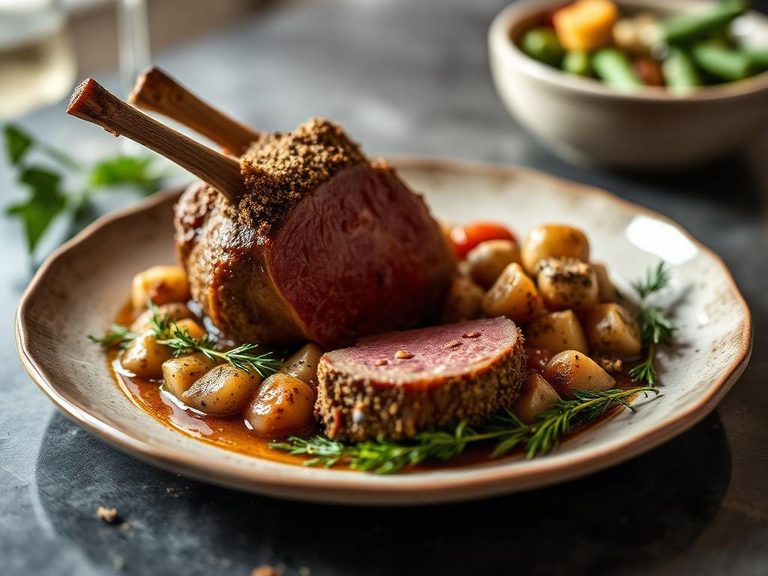
Lamb, New Zealand, imported, fore-shank, separable lean and fat, cooked, braised
Whole food · Lamb, Veal, and Game Products

Photo: Wikipedia
This is a cut from the lower leg of New Zealand lamb, slow-cooked until the tough connective tissue melts into rich gelatin. The result is a deeply savory, fall-apart tender morsel with a robust, meaty flavor and a luxurious, unctuous mouthfeel from the intermingled fat and collagen. Nutritionally, it's a powerhouse of complete protein and iron, with virtually no carbohydrates.
Calorie split: 47% protein · 0% carbs · 53% fat
↓ Full nutrition💚 Why it's loved
People adore braised lamb shank for its profound depth of flavor and the way the meat becomes impossibly tender, pulling cleanly from the bone. It's a centerpiece dish that feels both rustic and elegant, deeply satisfying in cold weather.
⚠️ Watch-outs & how to enjoy it better
The high saturated fat content may be a concern for those managing cholesterol or heart health. The cooking process can be lengthy, and the shank is best enjoyed in moderation. Counteract this by serving it with a large portion of non-starchy vegetables (like roasted broccoli or a bitter green salad) to add fiber and volume, and consider skimming excess fat from the braising liquid before serving.
Key benefits
- Excellent source of complete protein for muscle maintenance.
- Rich in heme iron, which is highly bioavailable.
- Provides zinc, essential for immune function.
- Contains collagen-derived gelatin, beneficial for gut lining.
- A zero-carb, high-satiety food.
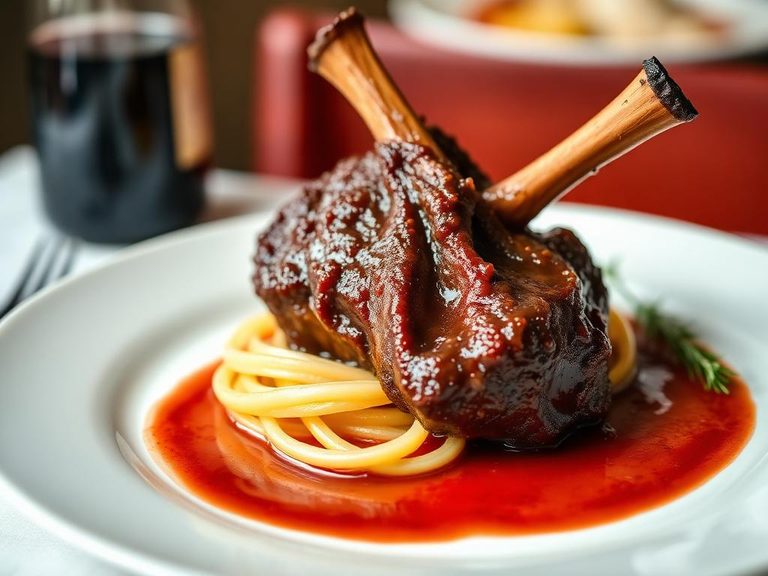
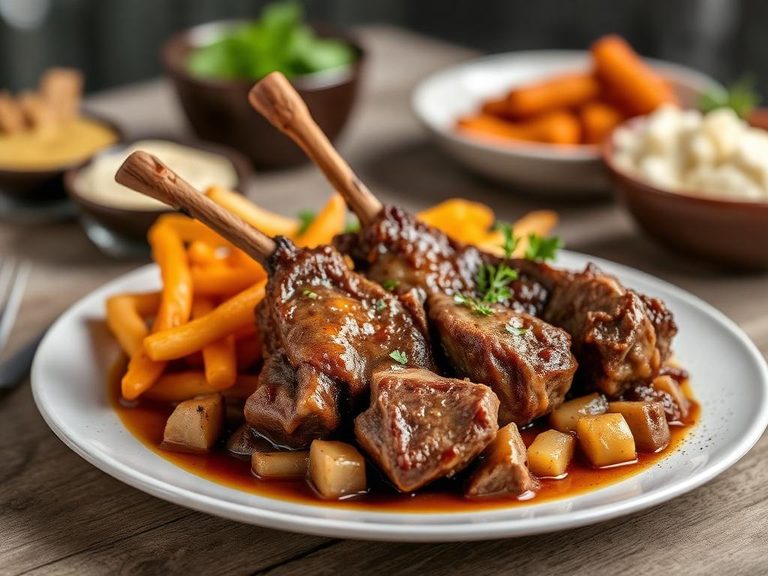
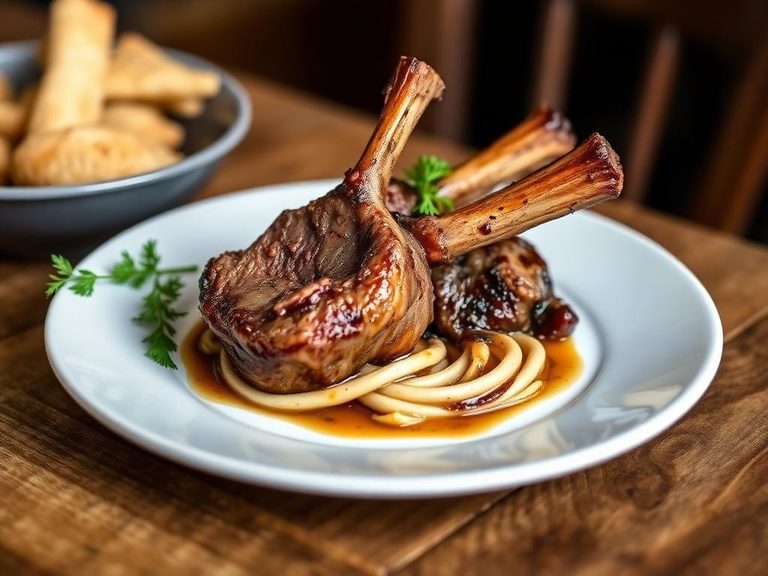
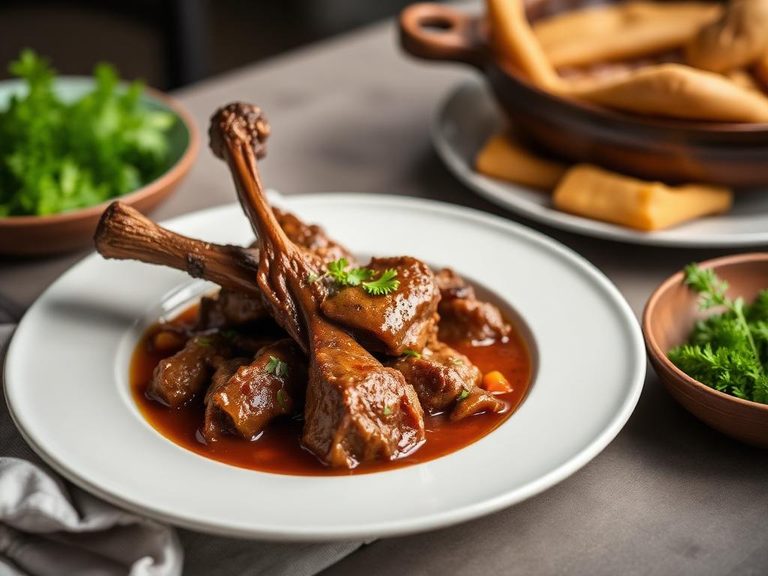
🍽️ Popular dishes
🌍 Where it's eaten
💡 Did you know?
A single lamb shank can weigh over 400 grams raw, making it a generous portion that often serves as a complete meal for one person when paired with sides.
Full nutrition (USDA data · scales with serving)
| Water | 55.6 g |
| Energy | 256 kcal |
| Energy | 1073 kj |
| Protein | 30.4 g |
| Total lipid (fat) | 15.0 g |
| Ash | 0.89 g |
| Carbohydrate, by difference | 0.03 g |
| Fiber, total dietary | 0.00 g |
| Total Sugars | 0.00 g |
| Calcium, Ca | 11.0 mg |
| Iron, Fe | 2.1 mg |
| Magnesium, Mg | 21.0 mg |
| Phosphorus, P | 165 mg |
| Potassium, K | 250 mg |
| Sodium, Na | 74.0 mg |
| Zinc, Zn | 6.5 mg |
| Copper, Cu | 0.13 mg |
| Manganese, Mn | 0.01 mg |
| Selenium, Se | 9.1 ug |
| Vitamin C, total ascorbic acid | 0.00 mg |
| Thiamin | 0.05 mg |
| Riboflavin | 0.14 mg |
| Niacin | 3.8 mg |
| Pantothenic acid | 0.46 mg |
| Vitamin B-6 | 0.07 mg |
| Folic acid | 0.00 ug |
| Vitamin B-12 | 1.3 ug |
| Vitamin A, RAE | 8.0 ug |
| Retinol | 8.0 ug |
| Carotene, beta | 0.00 ug |
| Carotene, alpha | 0.00 ug |
| Cryptoxanthin, beta | 0.00 ug |
| Vitamin A, IU | 27.0 iu |
| Lycopene | 0.00 ug |
| Lutein + zeaxanthin | 0.00 ug |
| Vitamin E (alpha-tocopherol) | 0.49 mg |
| Vitamin D (D2 + D3), International Units | 2.0 iu |
| Vitamin D (D2 + D3) | 0.10 ug |
| Vitamin D3 (cholecalciferol) | 0.10 ug |
| Alcohol, ethyl | 0.00 g |
| Caffeine | 0.00 mg |
| Theobromine | 0.00 mg |
Fat & fatty acid profile (per 100g)
| Fatty acids, total saturated | 5.6 g |
| SFA 4:0 | 0.00 g |
| SFA 6:0 | 0.00 g |
| SFA 8:0 | 0.00 g |
| SFA 10:0 | 0.02 g |
| SFA 12:0 | 0.03 g |
| SFA 14:0 | 0.33 g |
| SFA 16:0 | 2.2 g |
| SFA 17:0 | 0.23 g |
| SFA 18:0 | 2.7 g |
| SFA 20:0 | 0.01 g |
| SFA 22:0 | 0.02 g |
| SFA 24:0 | 0.00 g |
| Fatty acids, total monounsaturated | 4.1 g |
| MUFA 14:1 | 0.01 g |
| MUFA 15:1 | 0.00 g |
| MUFA 16:1 | 0.15 g |
| MUFA 17:1 | 0.00 g |
| MUFA 18:1 | 4.0 g |
| MUFA 20:1 | 0.00 g |
| MUFA 22:1 | 0.00 g |
| MUFA 24:1 c | 0.00 g |
| Fatty acids, total polyunsaturated | 0.70 g |
| PUFA 18:2 | 0.44 g |
| PUFA 18:3 | 0.16 g |
| PUFA 18:4 | 0.00 g |
| PUFA 20:2 n-6 c,c | 0.00 g |
| PUFA 20:3 | 0.00 g |
| PUFA 20:4 | 0.04 g |
| PUFA 20:5 n-3 (EPA) | 0.03 g |
| PUFA 22:5 n-3 (DPA) | 0.03 g |
| PUFA 22:6 n-3 (DHA) | 0.01 g |
| Fatty acids, total trans | 0.64 g |
| Cholesterol | 110 mg |
Amino acid profile (per 100g)
| Tryptophan | 0.34 g |
| Threonine | 1.4 g |
| Isoleucine | 1.4 g |
| Leucine | 2.3 g |
| Lysine | 2.7 g |
| Methionine | 0.99 g |
| Cystine | 0.40 g |
| Phenylalanine | 1.2 g |
| Tyrosine | 1.1 g |
| Valine | 1.5 g |
| Arginine | 2.0 g |
| Histidine | 0.64 g |
| Alanine | 1.5 g |
| Glutamic acid | 4.2 g |
| Glycine | 1.3 g |
| Proline | 0.97 g |
| Serine | 1.0 g |
FAQ
What's the best way to cook lamb shank to make it tender?
The key is low-and-slow moist heat. Braising (searing then simmering in liquid) for 2-3 hours, or using a pressure cooker, breaks down the tough collagen into gelatin, resulting in fork-tender meat.
Is lamb shank a fatty cut?
Yes, it has a significant amount of intramuscular fat and connective tissue, which is what gives it such rich flavor and moisture when cooked properly. The nutrition data reflects this with about 15g of fat per 100g cooked.
Can I use lamb shank in a slow cooker?
Absolutely. It's an ideal slow cooker cut. Sear the shanks first for flavor, then cook on low for 6-8 hours with your braising liquid until the meat is completely tender.
Nutrient density (calculated · NRF9.3)
Nutrient Rich Foods index: beneficial nutrients (protein, fiber, vitamins, minerals) minus saturated fat, added sugar & sodium, per 100 kcal.
NRF9.3 index — Fulgoni, Keast & Drewnowski, 2009. Computed from USDA nutrients.
Weight-loss friendliness (composite index)
Energy density 2.56 kcal/g · 47% calories from protein · 0.0 g fiber · 0.0 g sugar per 100 g.
Composite of energy density (Rolls et al., 1999), protein & fiber satiety, minus sugar. A calculated heuristic — ranks satiety-per-calorie, not a clinical measure.
Dietary load (calculated from USDA values)
Potential renal acid load. Positive = acid-forming, negative = alkaline-forming.
Sodium-to-potassium ratio: 0.30 (lower is better — aim for ≤ 1)
Sodium:potassium per WHO potassium guidance. Computed from USDA nutrients.