

Lamb, leg, whole (shank and sirloin), separable lean and fat, trimmed to 1/4" fat, choice, cooked, roasted
Whole food · Lamb, Veal, and Game Products

Photo: Wikipedia
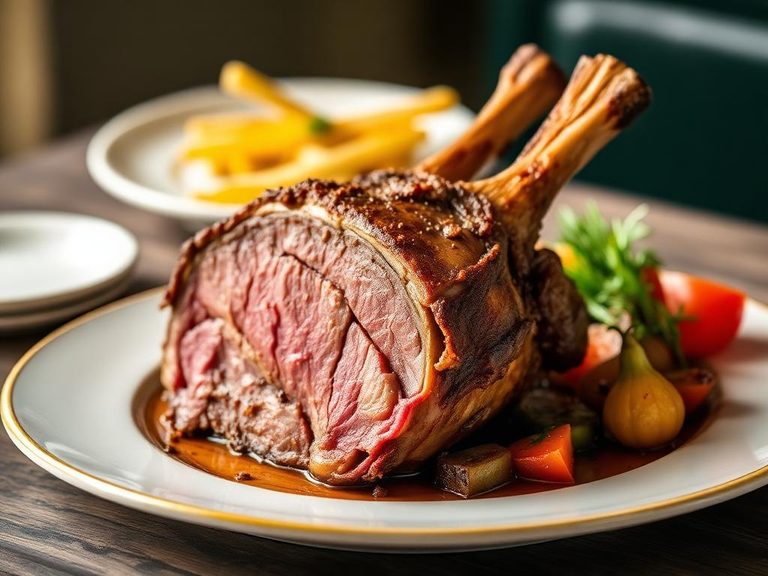
This is a whole leg of lamb, roasted to a deep, savory perfection with a tender, juicy interior and a crisp, flavorful crust. The generous 1/4-inch fat cap bastes the meat during cooking, creating a rich, succulent texture and a robust, slightly gamey flavor that's milder than shoulder. It's a powerhouse of protein, delivering over 25 grams per 100g serving with zero carbohydrates.
Calorie split: 41% protein · 0% carbs · 59% fat
↓ Full nutrition💚 Why it's loved
People cherish this cut for its celebratory nature and deep, savory flavor that anchors a feast. Its versatility allows it to be sliced for elegant roasts, shredded for hearty stews, or grilled for a smoky char.
⚠️ Watch-outs & how to enjoy it better
The visible fat and higher saturated fat content may concern those monitoring heart health or calorie intake. To counteract, trim excess fat before cooking, opt for dry-heat methods like roasting that allow fat to render and drip away, and balance the meal with large portions of non-starchy vegetables.
Key benefits
- Excellent source of complete protein for muscle maintenance.
- Rich in essential minerals like iron, zinc, and selenium.
- Provides B vitamins, especially B12, for energy metabolism.
- Contains conjugated linoleic acid (CLA), a naturally occurring fatty acid.
- Naturally carb-free, fitting low-carb or ketogenic dietary patterns.
🍽️ Popular dishes
🌍 Where it's eaten
💡 Did you know?
The term 'gigot,' commonly used for leg of lamb in French cuisine, comes from the Old French word for 'leg' and is the origin of the English phrase 'leg of mutton.'
Full nutrition (USDA data · scales with serving)
| Water | 57.5 g |
| Energy | 258 kcal |
| Energy | 1079 kj |
| Protein | 25.6 g |
| Total lipid (fat) | 16.5 g |
| Ash | 1.0 g |
| Carbohydrate, by difference | 0.00 g |
| Fiber, total dietary | 0.00 g |
| Total Sugars | 0.00 g |
| Calcium, Ca | 11.0 mg |
| Iron, Fe | 2.0 mg |
| Magnesium, Mg | 24.0 mg |
| Phosphorus, P | 191 mg |
| Potassium, K | 313 mg |
| Sodium, Na | 66.0 mg |
| Zinc, Zn | 4.4 mg |
| Copper, Cu | 0.12 mg |
| Manganese, Mn | 0.02 mg |
| Selenium, Se | 27.2 ug |
| Vitamin C, total ascorbic acid | 0.00 mg |
| Thiamin | 0.10 mg |
| Riboflavin | 0.27 mg |
| Niacin | 6.6 mg |
| Pantothenic acid | 0.68 mg |
| Vitamin B-6 | 0.15 mg |
| Folate, total | 20.0 ug |
| Folic acid | 0.00 ug |
| Folate, food | 20.0 ug |
| Folate, DFE | 20.0 ug |
| Choline, total | 96.3 mg |
| Betaine | 12.7 mg |
| Vitamin B-12 | 2.6 ug |
| Vitamin B-12, added | 0.00 ug |
| Vitamin A, RAE | 0.00 ug |
| Retinol | 0.00 ug |
| Carotene, beta | 0.00 ug |
| Carotene, alpha | 0.00 ug |
| Cryptoxanthin, beta | 0.00 ug |
| Vitamin A, IU | 0.00 iu |
| Lycopene | 0.00 ug |
| Lutein + zeaxanthin | 0.00 ug |
| Vitamin E (alpha-tocopherol) | 0.15 mg |
| Vitamin E, added | 0.00 mg |
| Vitamin D (D2 + D3), International Units | 2.0 iu |
| Vitamin D (D2 + D3) | 0.10 ug |
| Vitamin D3 (cholecalciferol) | 0.10 ug |
| Vitamin K (phylloquinone) | 4.2 ug |
| Vitamin K (Dihydrophylloquinone) | 0.00 ug |
| Alcohol, ethyl | 0.00 g |
| Caffeine | 0.00 mg |
| Theobromine | 0.00 mg |
Fat & fatty acid profile (per 100g)
| Fatty acids, total saturated | 6.9 g |
| SFA 4:0 | 0.00 g |
| SFA 6:0 | 0.00 g |
| SFA 8:0 | 0.00 g |
| SFA 10:0 | 0.04 g |
| SFA 12:0 | 0.07 g |
| SFA 14:0 | 0.64 g |
| SFA 16:0 | 3.5 g |
| SFA 18:0 | 2.2 g |
| Fatty acids, total monounsaturated | 7.0 g |
| MUFA 16:1 | 0.48 g |
| MUFA 18:1 | 6.3 g |
| MUFA 20:1 | 0.00 g |
| MUFA 22:1 | 0.00 g |
| Fatty acids, total polyunsaturated | 1.2 g |
| PUFA 18:2 | 0.90 g |
| PUFA 18:3 | 0.23 g |
| PUFA 18:4 | 0.00 g |
| PUFA 20:4 | 0.06 g |
| PUFA 20:5 n-3 (EPA) | 0.00 g |
| PUFA 22:5 n-3 (DPA) | 0.00 g |
| PUFA 22:6 n-3 (DHA) | 0.00 g |
| Cholesterol | 93.0 mg |
Amino acid profile (per 100g)
| Tryptophan | 0.30 g |
| Threonine | 1.1 g |
| Isoleucine | 1.2 g |
| Leucine | 2.0 g |
| Lysine | 2.3 g |
| Methionine | 0.66 g |
| Cystine | 0.30 g |
| Phenylalanine | 1.0 g |
| Tyrosine | 0.86 g |
| Valine | 1.4 g |
| Arginine | 1.5 g |
| Histidine | 0.81 g |
| Alanine | 1.5 g |
| Aspartic acid | 2.2 g |
| Glutamic acid | 3.7 g |
| Glycine | 1.2 g |
| Proline | 1.1 g |
| Serine | 0.95 g |
FAQ
What's the difference between leg of lamb and lamb shoulder?
Leg of lamb is leaner, more uniform, and best for roasting whole or into steaks. Shoulder has more fat and connective tissue, making it ideal for slow-cooking methods like braising to break it down into tender, pull-apart meat.
How do I prevent my roasted leg of lamb from being tough?
Avoid overcooking. Use a meat thermometer and pull it from the oven at 135°F (57°C) for medium-rare, as it will continue to cook while resting. Always let the meat rest for 15-20 minutes after roasting before carving to allow juices to redistribute.
Is lamb considered red meat?
Yes, lamb is classified as red meat by culinary and nutritional definitions due to its myoglobin content and the fact that it comes from a mammal. Nutritionally, it is a dense source of protein, iron, and B12.
Nutrient density (calculated · NRF9.3)
Nutrient Rich Foods index: beneficial nutrients (protein, fiber, vitamins, minerals) minus saturated fat, added sugar & sodium, per 100 kcal.
NRF9.3 index — Fulgoni, Keast & Drewnowski, 2009. Computed from USDA nutrients.
Weight-loss friendliness (composite index)
Energy density 2.58 kcal/g · 40% calories from protein · 0.0 g fiber · 0.0 g sugar per 100 g.
Composite of energy density (Rolls et al., 1999), protein & fiber satiety, minus sugar. A calculated heuristic — ranks satiety-per-calorie, not a clinical measure.
Dietary load (calculated from USDA values)
Potential renal acid load. Positive = acid-forming, negative = alkaline-forming.
Sodium-to-potassium ratio: 0.21 (lower is better — aim for ≤ 1)
Sodium:potassium per WHO potassium guidance. Computed from USDA nutrients.