

Hummus, home prepared
Whole food · Legumes and Legume Products

Photo: Wikipedia
Hummus is a creamy, savory spread made from cooked, mashed chickpeas blended with tahini, lemon juice, and garlic. It has a rich, nutty flavor with a smooth, thick texture that is both satisfying and versatile. With 177 kcal per 100g, it offers a balanced mix of plant-based protein (4.86g) and healthy fats (8.59g), making it a nutrient-dense choice for snacking or meals.
Calorie split: 11% protein · 45% carbs · 44% fat
↓ Full nutrition💚 Why it's loved
People love hummus for its creamy, tangy flavor that pairs well with almost any food, from vegetables to bread. It’s a staple in Middle Eastern cuisine, celebrated for its simplicity and ability to bring people together around shared meals.
⚠️ Watch-outs & how to enjoy it better
Hummus can be high in sodium and may cause bloating due to chickpeas' fiber content, especially for those with sensitive digestion. To counteract this, pair it with protein-rich foods like grilled chicken or use low-sodium recipes, and soak chickpeas overnight to reduce gas-producing compounds.
Key benefits
- High in plant-based protein for muscle maintenance
- Rich in dietary fiber (4g) to support digestion
- Contains healthy fats from tahini and olive oil
- Low in sugar (0.27g) to avoid blood sugar spikes
- Provides iron and folate from chickpeas
🍽️ Popular dishes
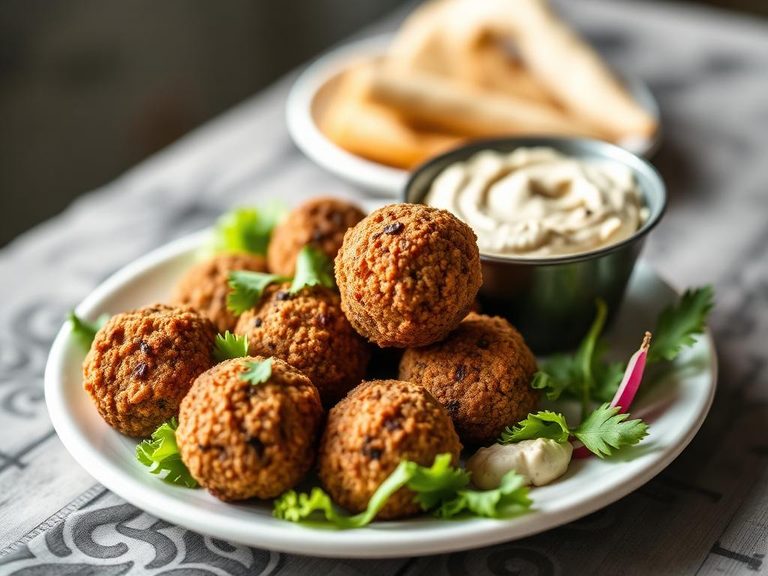
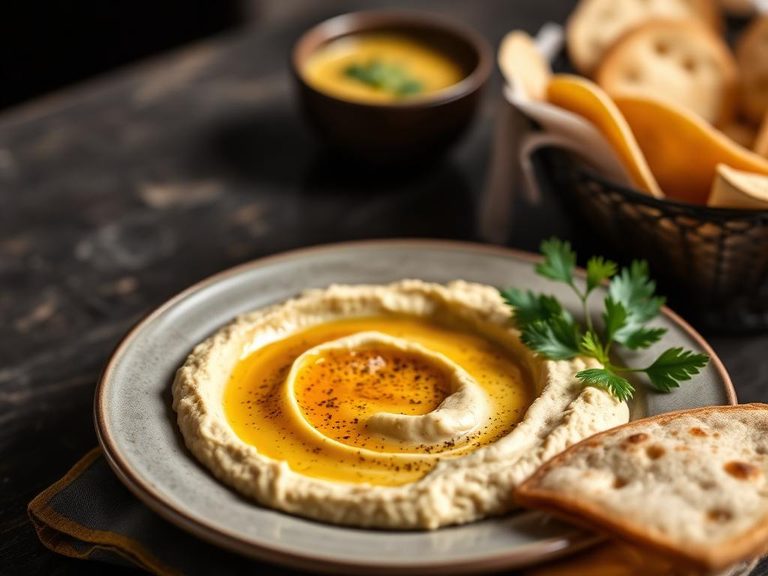
🌍 Where it's eaten
💡 Did you know?
Hummus has been consumed for thousands of years, with evidence of chickpea cultivation dating back to 7,500 BCE in the Middle East, making it one of the oldest known foods.
Full nutrition (USDA data · scales with serving)
| Water | 64.9 g |
| Energy | 177 kcal |
| Energy | 742 kj |
| Protein | 4.9 g |
| Total lipid (fat) | 8.6 g |
| Ash | 1.6 g |
| Carbohydrate, by difference | 20.1 g |
| Fiber, total dietary | 4.0 g |
| Total Sugars | 0.27 g |
| Calcium, Ca | 49.0 mg |
| Iron, Fe | 1.6 mg |
| Magnesium, Mg | 29.0 mg |
| Phosphorus, P | 110 mg |
| Potassium, K | 173 mg |
| Sodium, Na | 242 mg |
| Zinc, Zn | 1.1 mg |
| Copper, Cu | 0.22 mg |
| Manganese, Mn | 0.57 mg |
| Selenium, Se | 2.4 ug |
| Vitamin C, total ascorbic acid | 7.9 mg |
| Thiamin | 0.09 mg |
| Riboflavin | 0.05 mg |
| Niacin | 0.40 mg |
| Pantothenic acid | 0.29 mg |
| Vitamin B-6 | 0.40 mg |
| Folate, total | 59.0 ug |
| Folic acid | 0.00 ug |
| Folate, food | 59.0 ug |
| Folate, DFE | 59.0 ug |
| Choline, total | 27.8 mg |
| Vitamin B-12 | 0.00 ug |
| Vitamin B-12, added | 0.00 ug |
| Vitamin A, RAE | 0.00 ug |
| Retinol | 0.00 ug |
| Carotene, beta | 2.0 ug |
| Carotene, alpha | 0.00 ug |
| Cryptoxanthin, beta | 2.0 ug |
| Vitamin A, IU | 5.0 iu |
| Lycopene | 0.00 ug |
| Lutein + zeaxanthin | 1.0 ug |
| Vitamin E (alpha-tocopherol) | 0.75 mg |
| Vitamin E, added | 0.00 mg |
| Tocopherol, beta | 0.01 mg |
| Tocopherol, gamma | 0.04 mg |
| Tocopherol, delta | 0.00 mg |
| Vitamin D (D2 + D3), International Units | 0.00 iu |
| Vitamin D (D2 + D3) | 0.00 ug |
| Vitamin K (phylloquinone) | 3.0 ug |
| Vitamin K (Dihydrophylloquinone) | 0.00 ug |
| Alcohol, ethyl | 0.00 g |
| Caffeine | 0.00 mg |
| Theobromine | 0.00 mg |
Fat & fatty acid profile (per 100g)
| Fatty acids, total saturated | 1.1 g |
| SFA 4:0 | 0.00 g |
| SFA 6:0 | 0.00 g |
| SFA 8:0 | 0.00 g |
| SFA 10:0 | 0.00 g |
| SFA 12:0 | 0.00 g |
| SFA 14:0 | 0.01 g |
| SFA 16:0 | 0.88 g |
| SFA 17:0 | 0.00 g |
| SFA 18:0 | 0.22 g |
| SFA 20:0 | 0.02 g |
| SFA 22:0 | 0.01 g |
| SFA 24:0 | 0.00 g |
| Fatty acids, total monounsaturated | 4.9 g |
| MUFA 14:1 | 0.00 g |
| MUFA 16:1 | 0.07 g |
| MUFA 17:1 | 0.01 g |
| MUFA 18:1 | 4.8 g |
| MUFA 20:1 | 0.02 g |
| MUFA 22:1 | 0.00 g |
| Fatty acids, total polyunsaturated | 2.1 g |
| PUFA 18:2 | 2.0 g |
| PUFA 18:3 | 0.07 g |
| PUFA 18:4 | 0.00 g |
| PUFA 20:4 | 0.00 g |
| PUFA 20:5 n-3 (EPA) | 0.00 g |
| PUFA 22:5 n-3 (DPA) | 0.00 g |
| PUFA 22:6 n-3 (DHA) | 0.00 g |
| Cholesterol | 0.00 mg |
| Phytosterols | 11.0 mg |
Amino acid profile (per 100g)
| Tryptophan | 0.06 g |
| Threonine | 0.18 g |
| Isoleucine | 0.21 g |
| Leucine | 0.35 g |
| Lysine | 0.29 g |
| Methionine | 0.08 g |
| Cystine | 0.07 g |
| Phenylalanine | 0.26 g |
| Tyrosine | 0.13 g |
| Valine | 0.21 g |
| Arginine | 0.50 g |
| Histidine | 0.13 g |
| Alanine | 0.21 g |
| Aspartic acid | 0.54 g |
| Glutamic acid | 0.88 g |
| Glycine | 0.22 g |
| Proline | 0.20 g |
| Serine | 0.24 g |
FAQ
Is hummus a good source of protein?
Yes, hummus provides about 4.86g of protein per 100g, making it a good plant-based protein source, especially when combined with whole grains like pita bread.
Can hummus be part of a weight-loss diet?
Absolutely, due to its high fiber and protein content, hummus can help you feel full longer, but portion control is key as it is calorie-dense at 177 kcal per 100g.
Is hummus suitable for vegans?
Yes, traditional hummus is vegan as it contains no animal products, but always check labels for added ingredients like dairy or honey in commercial versions.
Nutrient density (calculated · NRF9.3)
Nutrient Rich Foods index: beneficial nutrients (protein, fiber, vitamins, minerals) minus saturated fat, added sugar & sodium, per 100 kcal.
NRF9.3 index — Fulgoni, Keast & Drewnowski, 2009. Computed from USDA nutrients.
Weight-loss friendliness (composite index)
Energy density 1.77 kcal/g · 11% calories from protein · 4.0 g fiber · 0.3 g sugar per 100 g.
Composite of energy density (Rolls et al., 1999), protein & fiber satiety, minus sugar. A calculated heuristic — ranks satiety-per-calorie, not a clinical measure.
Dietary load (calculated from USDA values)
Potential renal acid load. Positive = acid-forming, negative = alkaline-forming.
Sodium-to-potassium ratio: 1.40 (lower is better — aim for ≤ 1)
Sodium:potassium per WHO potassium guidance. Computed from USDA nutrients.