

Grapefruit juice, white, frozen concentrate, unsweetened, diluted with 3 volume water
Whole food · Fruits and Fruit Juices
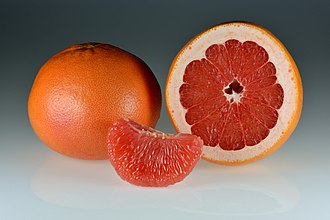
Photo: Wikipedia
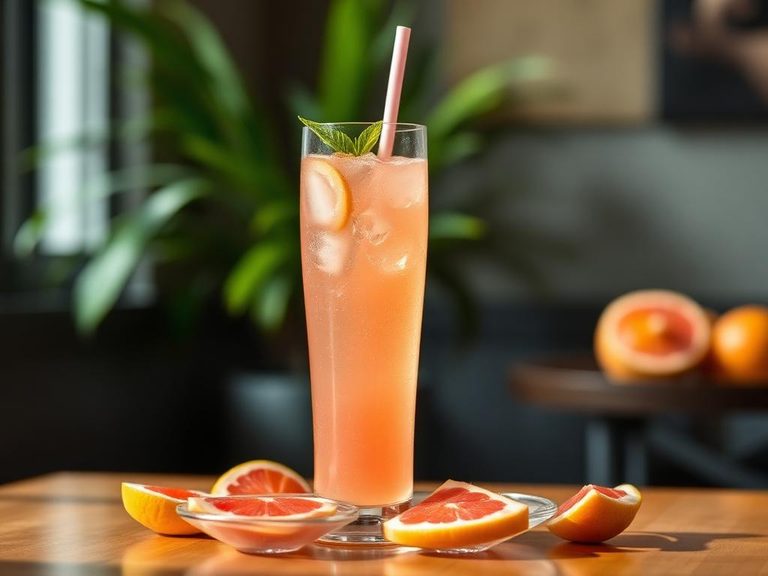
This is the reconstituted version of frozen white grapefruit juice concentrate, made by diluting the frozen block with three parts water. It yields a pale, translucent liquid with a sharp, bracingly tart and slightly bitter citrus flavor, a thin, watery texture, and a clean, refreshing finish. Nutritionally, it's a low-calorie source of vitamin C and simple carbohydrates, primarily from natural fruit sugars.
Calorie split: 5% protein · 92% carbs · 3% fat
↓ Full nutrition💚 Why it's loved
People adore its vibrant, palate-cleansing sourness that cuts through sweetness and richness, making it a classic breakfast staple or cocktail mixer. Its concentrated form offers long-term storage and the ability to adjust the strength to personal taste.
⚠️ Watch-outs & how to enjoy it better
The high natural sugar content can cause rapid blood-sugar spikes, especially for those with insulin resistance or diabetes. The potent acidity and compounds like furanocoumarins can interact with certain medications (e.g., statins) and may aggravate acid reflux or heartburn. To mitigate, always consume it with a meal containing protein or healthy fats (like nuts or yogurt) to slow sugar absorption, and practice strict portion control.
Key benefits
- Excellent source of immune-supporting vitamin C
- Low in calories and fat-free
- Provides quick energy from natural fruit sugars
- Contains beneficial plant compounds like lycopene and naringin
- A convenient way to increase daily fruit intake
🍽️ Popular dishes


🌍 Where it's eaten
💡 Did you know?
The compound naringin, which gives white grapefruit its characteristic bitter taste, is also being studied for its potential anti-inflammatory and antioxidant properties in scientific research.
Full nutrition (USDA data · scales with serving)
| Water | 89.3 g |
| Energy | 41.0 kcal |
| Energy | 172 kj |
| Protein | 0.55 g |
| Total lipid (fat) | 0.13 g |
| Ash | 0.28 g |
| Carbohydrate, by difference | 9.7 g |
| Fiber, total dietary | 0.10 g |
| Total Sugars | 9.6 g |
| Calcium, Ca | 8.0 mg |
| Iron, Fe | 0.14 mg |
| Magnesium, Mg | 11.0 mg |
| Phosphorus, P | 14.0 mg |
| Potassium, K | 136 mg |
| Sodium, Na | 1.0 mg |
| Zinc, Zn | 0.05 mg |
| Copper, Cu | 0.03 mg |
| Manganese, Mn | 0.02 mg |
| Selenium, Se | 0.10 ug |
| Vitamin C, total ascorbic acid | 33.7 mg |
| Thiamin | 0.04 mg |
| Riboflavin | 0.02 mg |
| Niacin | 0.22 mg |
| Pantothenic acid | 0.19 mg |
| Vitamin B-6 | 0.04 mg |
| Folate, total | 4.0 ug |
| Folic acid | 0.00 ug |
| Folate, food | 4.0 ug |
| Folate, DFE | 4.0 ug |
| Choline, total | 7.7 mg |
| Vitamin B-12 | 0.00 ug |
| Vitamin B-12, added | 0.00 ug |
| Vitamin A, RAE | 0.00 ug |
| Retinol | 0.00 ug |
| Carotene, beta | 4.0 ug |
| Carotene, alpha | 2.0 ug |
| Cryptoxanthin, beta | 1.0 ug |
| Vitamin A, IU | 9.0 iu |
| Lycopene | 0.00 ug |
| Lutein + zeaxanthin | 10.0 ug |
| Vitamin E (alpha-tocopherol) | 0.04 mg |
| Vitamin E, added | 0.00 mg |
| Vitamin D (D2 + D3), International Units | 0.00 iu |
| Vitamin D (D2 + D3) | 0.00 ug |
| Vitamin K (phylloquinone) | 0.00 ug |
| Alcohol, ethyl | 0.00 g |
| Caffeine | 0.00 mg |
| Theobromine | 0.00 mg |
Fat & fatty acid profile (per 100g)
| Fatty acids, total saturated | 0.02 g |
| SFA 4:0 | 0.00 g |
| SFA 6:0 | 0.00 g |
| SFA 8:0 | 0.00 g |
| SFA 10:0 | 0.00 g |
| SFA 12:0 | 0.00 g |
| SFA 14:0 | 0.00 g |
| SFA 16:0 | 0.02 g |
| SFA 18:0 | 0.00 g |
| Fatty acids, total monounsaturated | 0.02 g |
| MUFA 16:1 | 0.00 g |
| MUFA 18:1 | 0.02 g |
| MUFA 20:1 | 0.00 g |
| MUFA 22:1 | 0.00 g |
| Fatty acids, total polyunsaturated | 0.03 g |
| PUFA 18:2 | 0.03 g |
| PUFA 18:3 | 0.01 g |
| PUFA 18:4 | 0.00 g |
| PUFA 20:4 | 0.00 g |
| PUFA 20:5 n-3 (EPA) | 0.00 g |
| PUFA 22:5 n-3 (DPA) | 0.00 g |
| PUFA 22:6 n-3 (DHA) | 0.00 g |
| Fatty acids, total trans | 0.00 g |
| Cholesterol | 0.00 mg |
Amino acid profile (per 100g)
Estimated from Grapefruit, sections, canned, juice pack, solids and liquids — USDA does not publish this profile for Grapefruit juice.
| Tryptophan | 0.01 g |
| Threonine | 0.01 g |
| Isoleucine | 0.01 g |
| Leucine | 0.01 g |
| Lysine | 0.02 g |
| Methionine | 0.01 g |
| Cystine | 0.01 g |
| Phenylalanine | 0.04 g |
| Tyrosine | 0.01 g |
| Valine | 0.01 g |
| Arginine | 0.08 g |
| Histidine | 0.01 g |
| Alanine | 0.02 g |
| Aspartic acid | 0.13 g |
| Glutamic acid | 0.18 g |
| Glycine | 0.01 g |
| Proline | 0.06 g |
| Serine | 0.03 g |
FAQ
How is this different from regular grapefruit juice?
This product starts as a frozen concentrate with most water removed. You dilute it at home, which gives you control over the final strength and sweetness. It's often more economical and has a longer shelf life than pre-diluted, refrigerated juice.
Why is it specified as 'white' grapefruit?
White grapefruit has pale yellow flesh and is typically more tart and less sweet than pink or red varieties. The juice is lighter in color and has a sharper, more bitter flavor profile, making it a distinct ingredient.
Can I use this in cooking or baking?
Absolutely. It's excellent for making glazes, reducing into syrups, adding acidity to pan sauces, or in marinades to tenderize meats. Its concentrated flavor shines in both sweet and savory applications.
Nutrient density (calculated · NRF9.3)
Nutrient Rich Foods index: beneficial nutrients (protein, fiber, vitamins, minerals) minus saturated fat, added sugar & sodium, per 100 kcal.
NRF9.3 index — Fulgoni, Keast & Drewnowski, 2009. Computed from USDA nutrients.
Weight-loss friendliness (composite index)
Energy density 0.41 kcal/g · 5% calories from protein · 0.1 g fiber · 9.6 g sugar per 100 g.
Composite of energy density (Rolls et al., 1999), protein & fiber satiety, minus sugar. A calculated heuristic — ranks satiety-per-calorie, not a clinical measure.
Dietary load (calculated from USDA values)
Potential renal acid load. Positive = acid-forming, negative = alkaline-forming.
Sodium-to-potassium ratio: 0.01 (lower is better — aim for ≤ 1)
Sodium:potassium per WHO potassium guidance. Computed from USDA nutrients.