

DIGIORNO Pizza, cheese topping, thin crispy crust, frozen, baked
Whole food · Fast Foods
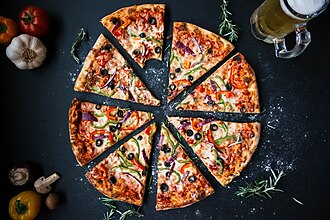
Photo: Wikipedia
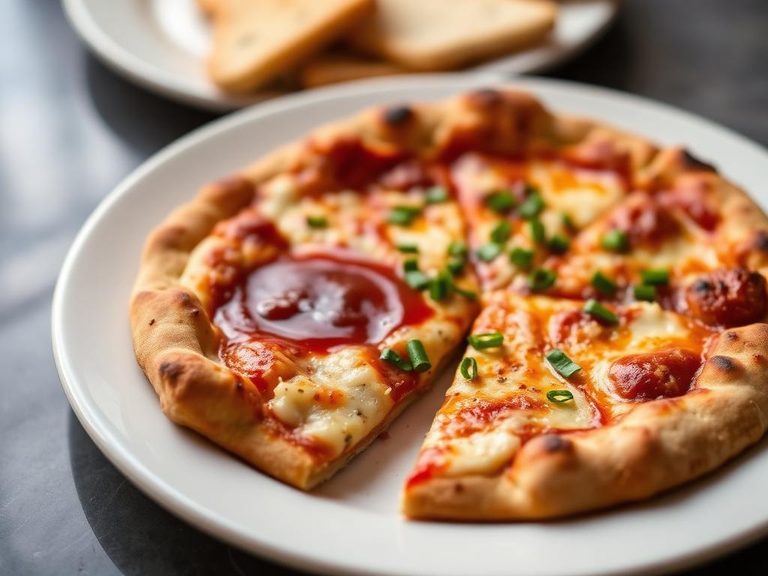
DiGiorno Thin & Crispy Cheese Pizza is a frozen, oven-baked pie that delivers a satisfying crunch from its cracker-like crust, topped with a savory tomato sauce and a generous layer of melted mozzarella and cheddar cheese. It offers a convenient, restaurant-style experience at home, with a nutrition profile that provides a solid protein boost (12.96g per 100g) alongside its carbohydrate and fat content.
Calorie split: 21% protein · 43% carbs · 36% fat
↓ Full nutrition💚 Why it's loved
People love it for the reliable, crispy crust that holds up to the toppings without becoming soggy, and the familiar, comforting blend of tangy sauce and melted cheese that satisfies classic pizza cravings. Its versatility makes it a go-to for quick lunches, casual dinners, or a late-night snack.
⚠️ Watch-outs & how to enjoy it better
The thin crust, while crispy, can lead to faster consumption and potential overeating of the calorie-dense toppings. Those monitoring sodium or saturated fat intake should be cautious, as frozen pizzas can be high in both. To counteract, pair a slice with a large side salad or steamed vegetables to increase volume and fiber, promoting fullness with fewer total calories.
Key benefits
- Good source of protein for muscle maintenance
- Provides dietary fiber (3g per 100g)
- Convenient, quick meal solution
- Offers a satisfying, crunchy texture
- Contains calcium from cheese
🍽️ Popular dishes
🌍 Where it's eaten
💡 Did you know?
The DiGiorno brand's signature 'rising crust' was invented in 1991, but their thin & crispy line was developed later to mimic the cracker-like texture of Stouffer's pizzas, which were a top competitor.
Full nutrition (USDA data · scales with serving)
| Water | 48.1 g |
| Energy | 247 kcal |
| Energy | 1033 kj |
| Protein | 13.0 g |
| Total lipid (fat) | 9.9 g |
| Ash | 2.5 g |
| Carbohydrate, by difference | 26.5 g |
| Fiber, total dietary | 3.0 g |
| Sucrose | 0.00 g |
| Glucose | 1.2 g |
| Fructose | 1.4 g |
| Lactose | 0.00 g |
| Starch | 20.0 g |
| Calcium, Ca | 275 mg |
| Iron, Fe | 0.68 mg |
| Magnesium, Mg | 27.0 mg |
| Phosphorus, P | 236 mg |
| Potassium, K | 233 mg |
| Sodium, Na | 506 mg |
| Zinc, Zn | 1.8 mg |
| Copper, Cu | 0.10 mg |
| Manganese, Mn | 0.23 mg |
| Selenium, Se | 21.4 ug |
| Vitamin C, total ascorbic acid | 0.10 mg |
| Thiamin | 0.10 mg |
| Riboflavin | 0.13 mg |
| Niacin | 1.3 mg |
| Pantothenic acid | 0.50 mg |
| Vitamin B-6 | 0.13 mg |
| Vitamin B-12 | 0.62 ug |
| Vitamin A, RAE | 64.0 ug |
| Retinol | 64.0 ug |
| Vitamin A, IU | 212 iu |
| Vitamin E (alpha-tocopherol) | 0.74 mg |
| Tocopherol, beta | 0.05 mg |
| Tocopherol, gamma | 1.1 mg |
| Tocopherol, delta | 0.30 mg |
| Tocotrienol, alpha | 0.00 mg |
| Tocotrienol, beta | 0.00 mg |
| Tocotrienol, gamma | 0.01 mg |
| Tocotrienol, delta | 0.00 mg |
| Vitamin K (phylloquinone) | 4.2 ug |
| Vitamin K (Dihydrophylloquinone) | 2.8 ug |
| Vitamin K (Menaquinone-4) | 1.9 ug |
Fat & fatty acid profile (per 100g)
| Fatty acids, total saturated | 4.6 g |
| SFA 4:0 | 0.08 g |
| SFA 6:0 | 0.09 g |
| SFA 8:0 | 0.06 g |
| SFA 10:0 | 0.16 g |
| SFA 12:0 | 0.20 g |
| SFA 14:0 | 0.69 g |
| SFA 15:0 | 0.07 g |
| SFA 16:0 | 2.2 g |
| SFA 17:0 | 0.05 g |
| SFA 18:0 | 0.98 g |
| SFA 20:0 | 0.01 g |
| SFA 22:0 | 0.01 g |
| SFA 24:0 | 0.01 g |
| Fatty acids, total monounsaturated | 2.7 g |
| MUFA 14:1 | 0.05 g |
| MUFA 15:1 | 0.00 g |
| MUFA 16:1 | 0.13 g |
| MUFA 16:1 c | 0.11 g |
| MUFA 17:1 | 0.00 g |
| MUFA 18:1 | 2.5 g |
| MUFA 18:1 c | 2.1 g |
| MUFA 20:1 | 0.02 g |
| MUFA 22:1 | 0.00 g |
| MUFA 22:1 c | 0.00 g |
| MUFA 24:1 c | 0.00 g |
| Fatty acids, total polyunsaturated | 1.2 g |
| PUFA 18:2 | 1.0 g |
| PUFA 18:2 n-6 c,c | 0.92 g |
| PUFA 18:2 CLAs | 0.04 g |
| PUFA 18:3 | 0.11 g |
| PUFA 18:3 n-3 c,c,c (ALA) | 0.11 g |
| PUFA 18:3 n-6 c,c,c | 0.00 g |
| PUFA 18:4 | 0.00 g |
| PUFA 20:2 n-6 c,c | 0.00 g |
| PUFA 20:3 | 0.01 g |
| PUFA 20:3 n-3 | 0.00 g |
| PUFA 20:3 n-6 | 0.01 g |
| PUFA 20:4 | 0.01 g |
| PUFA 20:5 n-3 (EPA) | 0.00 g |
| PUFA 22:4 | 0.01 g |
| PUFA 22:5 n-3 (DPA) | 0.01 g |
| PUFA 22:6 n-3 (DHA) | 0.00 g |
| Fatty acids, total trans | 0.49 g |
| Fatty acids, total trans-monoenoic | 0.43 g |
| TFA 16:1 t | 0.02 g |
| TFA 18:1 t | 0.41 g |
| TFA 22:1 t | 0.00 g |
| TFA 18:2 t not further defined | 0.06 g |
| Fatty acids, total trans-polyenoic | 0.06 g |
| Cholesterol | 21.0 mg |
FAQ
How does the nutrition compare to a regular crust pizza?
The thin crispy crust typically has fewer calories and carbohydrates per slice than a traditional or rising crust, as there is less dough. However, the topping density (cheese and sauce) remains similar, so fat and protein content can be comparable.
Is this a good option for a high-protein meal?
With nearly 13g of protein per 100g, it provides a respectable amount, especially from the cheese. To make it a more complete high-protein meal, consider adding a side of grilled chicken or a bean salad.
Why is the crust so crispy?
The crust is par-baked and designed with a specific flour blend and low moisture content to achieve a cracker-like texture that crisps up quickly in a home oven without becoming chewy.
Nutrient density (calculated · NRF9.3)
Nutrient Rich Foods index: beneficial nutrients (protein, fiber, vitamins, minerals) minus saturated fat, added sugar & sodium, per 100 kcal.
NRF9.3 index — Fulgoni, Keast & Drewnowski, 2009. Computed from USDA nutrients.
Weight-loss friendliness (composite index)
Energy density 2.47 kcal/g · 21% calories from protein · 3.0 g fiber · 0.0 g sugar per 100 g.
Composite of energy density (Rolls et al., 1999), protein & fiber satiety, minus sugar. A calculated heuristic — ranks satiety-per-calorie, not a clinical measure.
Dietary load (calculated from USDA values)
Potential renal acid load. Positive = acid-forming, negative = alkaline-forming.
Sodium-to-potassium ratio: 2.17 (lower is better — aim for ≤ 1)
Sodium:potassium per WHO potassium guidance. Computed from USDA nutrients.