

Crackers, whole grain, sandwich-type, with peanut butter filling
Whole food · Baked Products
This is the classic, nostalgic snack of two crisp whole-grain crackers sandwiching a smooth, savory-sweet peanut butter filling. It delivers a satisfying crunch followed by a rich, nutty, and slightly sweet taste, with a texture that's both crumbly and creamy. Nutritionally, it's a dense energy source, packing over 460 calories and a solid 14 grams of plant-based protein per 100 grams.
Calorie split: 12% protein · 47% carbs · 41% fat
↓ Full nutrition💚 Why it's loved
People love it for its perfect balance of salty, sweet, and savory flavors, and the iconic textural contrast between the dry, snappy cracker and the smooth filling. It's a beloved childhood staple and a go-to for quick energy, deeply embedded in lunchbox culture and on-the-go snacking.
⚠️ Watch-outs & how to enjoy it better
The high calorie density and added sugars can contribute to blood sugar spikes if eaten in large quantities. It's also a common allergen (peanuts, wheat) and can be high in sodium. To counteract this, practice strict portion control (stick to 2-3 crackers), pair it with a piece of fruit for added fiber, or choose low-sodium, reduced-sugar varieties.
Key benefits
- High in plant-based protein for satiety and muscle support.
- Good source of dietary fiber from whole grains.
- Provides quick and sustained energy from carbs and fats.
- Contains heart-healthy monounsaturated fats from peanuts.
- Convenient, shelf-stable, no-prep snack.
🍽️ Popular dishes

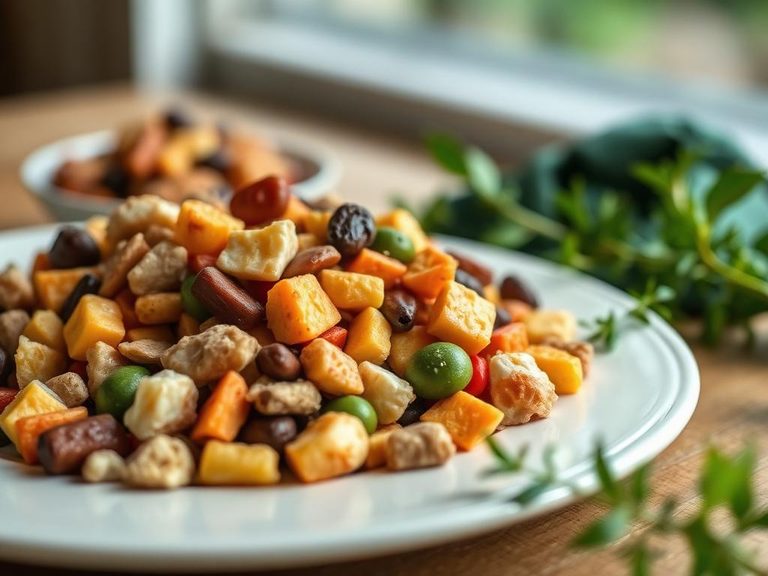

🌍 Where it's eaten
💡 Did you know?
The iconic sandwich cracker format was popularized in the early 20th century by brands like Austin and Nabisco, designed to be a shelf-stable, non-messy evolution of the classic peanut butter and jelly sandwich.
Full nutrition (USDA data · scales with serving)
| Water | 7.3 g |
| Energy | 465 kcal |
| Energy | 1947 kj |
| Protein | 14.1 g |
| Total lipid (fat) | 21.2 g |
| Ash | 2.8 g |
| Carbohydrate, by difference | 54.6 g |
| Fiber, total dietary | 9.4 g |
| Total Sugars | 9.4 g |
| Calcium, Ca | 33.0 mg |
| Iron, Fe | 3.1 mg |
| Magnesium, Mg | 107 mg |
| Phosphorus, P | 256 mg |
| Potassium, K | 330 mg |
| Sodium, Na | 635 mg |
| Zinc, Zn | 2.0 mg |
| Copper, Cu | 0.31 mg |
| Selenium, Se | 18.7 ug |
| Vitamin C, total ascorbic acid | 0.00 mg |
| Thiamin | 0.33 mg |
| Riboflavin | 0.23 mg |
| Niacin | 6.3 mg |
| Vitamin B-6 | 0.22 mg |
| Folate, total | 74.0 ug |
| Folic acid | 34.0 ug |
| Folate, food | 40.0 ug |
| Folate, DFE | 97.0 ug |
| Choline, total | 29.7 mg |
| Vitamin B-12 | 0.00 ug |
| Vitamin B-12, added | 0.00 ug |
| Vitamin A, RAE | 0.00 ug |
| Retinol | 0.00 ug |
| Carotene, beta | 2.0 ug |
| Carotene, alpha | 0.00 ug |
| Cryptoxanthin, beta | 0.00 ug |
| Vitamin A, IU | 3.0 iu |
| Lycopene | 0.00 ug |
| Lutein + zeaxanthin | 79.0 ug |
| Vitamin E (alpha-tocopherol) | 2.6 mg |
| Vitamin E, added | 0.00 mg |
| Vitamin D (D2 + D3), International Units | 0.00 iu |
| Vitamin D (D2 + D3) | 0.00 ug |
| Vitamin K (phylloquinone) | 4.5 ug |
| Alcohol, ethyl | 0.00 g |
| Caffeine | 0.00 mg |
| Theobromine | 0.00 mg |
Fat & fatty acid profile (per 100g)
| Fatty acids, total saturated | 4.5 g |
| SFA 4:0 | 0.00 g |
| SFA 6:0 | 0.00 g |
| SFA 8:0 | 0.00 g |
| SFA 10:0 | 0.00 g |
| SFA 12:0 | 0.00 g |
| SFA 14:0 | 0.01 g |
| SFA 15:0 | 0.00 g |
| SFA 16:0 | 2.6 g |
| SFA 17:0 | 0.02 g |
| SFA 18:0 | 0.80 g |
| SFA 20:0 | 0.32 g |
| SFA 22:0 | 0.52 g |
| SFA 24:0 | 0.27 g |
| Fatty acids, total monounsaturated | 9.8 g |
| MUFA 14:1 | 0.00 g |
| MUFA 15:1 | 0.00 g |
| MUFA 16:1 | 0.02 g |
| MUFA 17:1 | 0.01 g |
| MUFA 18:1 | 9.5 g |
| MUFA 20:1 | 0.21 g |
| MUFA 22:1 | 0.01 g |
| MUFA 24:1 c | 0.00 g |
| Fatty acids, total polyunsaturated | 4.5 g |
| PUFA 18:2 | 4.0 g |
| PUFA 18:3 | 0.48 g |
| PUFA 18:4 | 0.00 g |
| PUFA 20:2 n-6 c,c | 0.00 g |
| PUFA 20:3 | 0.00 g |
| PUFA 20:4 | 0.00 g |
| PUFA 20:5 n-3 (EPA) | 0.00 g |
| PUFA 22:4 | 0.00 g |
| PUFA 22:5 n-3 (DPA) | 0.00 g |
| PUFA 22:6 n-3 (DHA) | 0.00 g |
| Fatty acids, total trans | 0.00 g |
| Cholesterol | 0.00 mg |
Amino acid profile (per 100g)
Estimated from Crackers, cheese, sandwich-type with cheese filling — USDA does not publish this profile for Crackers.
| Tryptophan | 0.11 g |
| Threonine | 0.33 g |
| Isoleucine | 0.36 g |
| Leucine | 0.64 g |
| Lysine | 0.39 g |
| Methionine | 0.15 g |
| Cystine | 0.15 g |
| Phenylalanine | 0.35 g |
| Tyrosine | 0.25 g |
| Valine | 0.38 g |
| Arginine | 0.29 g |
| Histidine | 0.17 g |
| Alanine | 0.30 g |
| Aspartic acid | 0.52 g |
| Glutamic acid | 2.2 g |
| Glycine | 0.24 g |
| Proline | 0.77 g |
| Serine | 0.40 g |
FAQ
Are whole grain sandwich crackers healthier than regular ones?
Yes, the whole grain crackers provide more fiber, vitamins, and minerals compared to refined white flour crackers, which can help with digestion and sustained energy release.
Why are they so high in calories?
The combination of calorie-dense peanut butter (fat and protein) and dry crackers (carbohydrates) creates a energy-dense food. The low water content means calories are concentrated.
Can I eat these on a gluten-free diet?
Most standard varieties contain wheat and are not gluten-free. However, some brands now offer gluten-free versions using alternative flours like rice or almond flour. Always check the label.
Nutrient density (calculated · NRF9.3)
Nutrient Rich Foods index: beneficial nutrients (protein, fiber, vitamins, minerals) minus saturated fat, added sugar & sodium, per 100 kcal.
NRF9.3 index — Fulgoni, Keast & Drewnowski, 2009. Computed from USDA nutrients.
Weight-loss friendliness (composite index)
Energy density 4.65 kcal/g · 12% calories from protein · 9.4 g fiber · 9.4 g sugar per 100 g.
Composite of energy density (Rolls et al., 1999), protein & fiber satiety, minus sugar. A calculated heuristic — ranks satiety-per-calorie, not a clinical measure.
Dietary load (calculated from USDA values)
Potential renal acid load. Positive = acid-forming, negative = alkaline-forming.
Sodium-to-potassium ratio: 1.92 (lower is better — aim for ≤ 1)
Sodium:potassium per WHO potassium guidance. Computed from USDA nutrients.