

Chicken, broilers or fryers, meat only, cooked, roasted
Whole food · Poultry Products
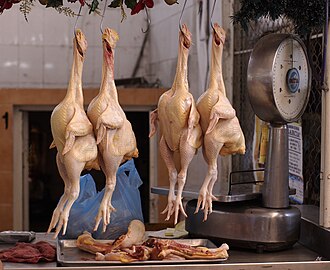
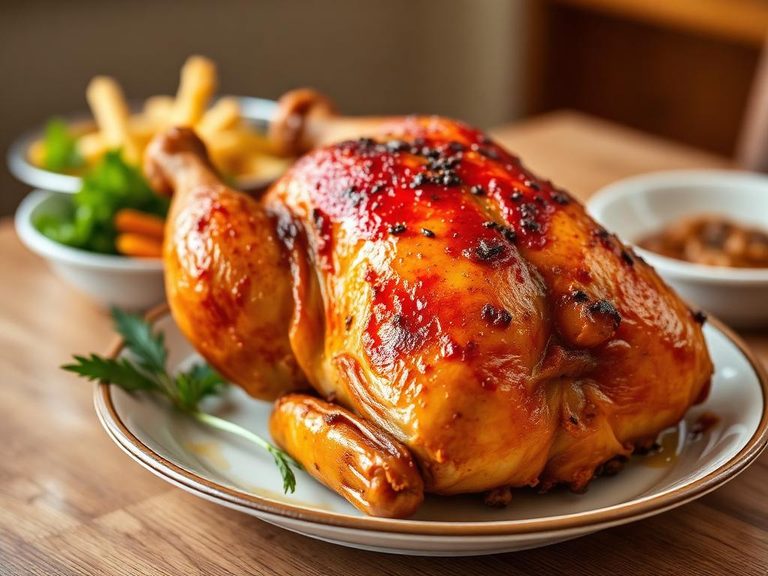
Photo: Wikipedia
This is lean, roasted chicken breast—the workhorse of kitchens worldwide. Its texture is firm yet tender, with a clean, savory flavor that acts as a blank canvas for countless seasonings and sauces. Nutritionally, it's a powerhouse, delivering a massive 29 grams of high-quality protein per 100 grams with virtually no fat or carbohydrates.
Calorie split: 63% protein · 0% carbs · 37% fat
↓ Full nutrition💚 Why it's loved
People love it for its incredible adaptability—it readily absorbs marinades, spices, and sauces, making it a reliable foundation for everything from a simple weeknight meal to a gourmet dish. It's also a cultural staple, featured in iconic comfort foods across the globe.
⚠️ Watch-outs & how to enjoy it better
Its very leanness means it can easily become dry and bland if overcooked, which is a common pitfall. To counteract this, marinate before cooking, use a meat thermometer to pull it at 165°F (74°C), and always let it rest before slicing to retain juices.
Key benefits
- Excellent source of complete, lean protein for muscle maintenance and satiety.
- Very low in carbohydrates and sugars, making it suitable for low-carb diets.
- Provides essential nutrients like niacin, vitamin B6, and selenium.
- A versatile, mild base for a wide variety of global cuisines and dietary plans.
🍽️ Popular dishes

🌍 Where it's eaten
💡 Did you know?
The specific cut 'broiler or fryer' refers to a young chicken (under 13 weeks old) raised specifically for its tender, juicy meat, as opposed to an older 'roaster' or an egg-laying 'layer' hen.
Full nutrition (USDA data · scales with serving)
| Water | 63.8 g |
| Energy | 190 kcal |
| Energy | 795 kj |
| Protein | 28.9 g |
| Total lipid (fat) | 7.4 g |
| Ash | 1.0 g |
| Carbohydrate, by difference | 0.00 g |
| Fiber, total dietary | 0.00 g |
| Total Sugars | 0.00 g |
| Calcium, Ca | 15.0 mg |
| Iron, Fe | 1.2 mg |
| Magnesium, Mg | 25.0 mg |
| Phosphorus, P | 195 mg |
| Potassium, K | 243 mg |
| Sodium, Na | 86.0 mg |
| Zinc, Zn | 2.1 mg |
| Copper, Cu | 0.07 mg |
| Manganese, Mn | 0.02 mg |
| Selenium, Se | 22.0 ug |
| Vitamin C, total ascorbic acid | 0.00 mg |
| Thiamin | 0.07 mg |
| Riboflavin | 0.18 mg |
| Niacin | 9.2 mg |
| Pantothenic acid | 1.1 mg |
| Vitamin B-6 | 0.47 mg |
| Folate, total | 6.0 ug |
| Folic acid | 0.00 ug |
| Folate, food | 6.0 ug |
| Folate, DFE | 6.0 ug |
| Choline, total | 78.8 mg |
| Betaine | 5.7 mg |
| Vitamin B-12 | 0.33 ug |
| Vitamin B-12, added | 0.00 ug |
| Vitamin A, RAE | 16.0 ug |
| Retinol | 16.0 ug |
| Carotene, beta | 0.00 ug |
| Carotene, alpha | 0.00 ug |
| Cryptoxanthin, beta | 0.00 ug |
| Vitamin A, IU | 53.0 iu |
| Lycopene | 0.00 ug |
| Lutein + zeaxanthin | 0.00 ug |
| Vitamin E (alpha-tocopherol) | 0.27 mg |
| Vitamin E, added | 0.00 mg |
| Vitamin D (D2 + D3), International Units | 5.0 iu |
| Vitamin D (D2 + D3) | 0.10 ug |
| Vitamin D3 (cholecalciferol) | 0.10 ug |
| Vitamin K (phylloquinone) | 2.4 ug |
| Vitamin K (Dihydrophylloquinone) | 0.00 ug |
| Alcohol, ethyl | 0.00 g |
| Caffeine | 0.00 mg |
| Theobromine | 0.00 mg |
Fat & fatty acid profile (per 100g)
| Fatty acids, total saturated | 2.0 g |
| SFA 4:0 | 0.00 g |
| SFA 6:0 | 0.00 g |
| SFA 8:0 | 0.00 g |
| SFA 10:0 | 0.00 g |
| SFA 12:0 | 0.02 g |
| SFA 14:0 | 0.06 g |
| SFA 16:0 | 1.4 g |
| SFA 18:0 | 0.49 g |
| Fatty acids, total monounsaturated | 2.7 g |
| MUFA 16:1 | 0.35 g |
| MUFA 18:1 | 2.2 g |
| MUFA 20:1 | 0.04 g |
| MUFA 22:1 | 0.00 g |
| Fatty acids, total polyunsaturated | 1.7 g |
| PUFA 18:2 | 1.4 g |
| PUFA 18:3 | 0.07 g |
| PUFA 18:4 | 0.00 g |
| PUFA 20:4 | 0.11 g |
| PUFA 20:5 n-3 (EPA) | 0.01 g |
| PUFA 22:5 n-3 (DPA) | 0.02 g |
| PUFA 22:6 n-3 (DHA) | 0.04 g |
| Cholesterol | 89.0 mg |
Amino acid profile (per 100g)
| Tryptophan | 0.34 g |
| Threonine | 1.2 g |
| Isoleucine | 1.5 g |
| Leucine | 2.2 g |
| Lysine | 2.5 g |
| Methionine | 0.80 g |
| Cystine | 0.37 g |
| Phenylalanine | 1.1 g |
| Tyrosine | 0.98 g |
| Valine | 1.4 g |
| Arginine | 1.7 g |
| Histidine | 0.90 g |
| Alanine | 1.6 g |
| Aspartic acid | 2.6 g |
| Glutamic acid | 4.3 g |
| Glycine | 1.4 g |
| Proline | 1.2 g |
| Serine | 0.99 g |
FAQ
How do I keep roasted chicken breast from drying out?
The key is avoiding overcooking. Use a meat thermometer and remove the chicken when the thickest part reaches 165°F (74°C). Letting it rest for 5-10 minutes after cooking allows the juices to redistribute throughout the meat.
Is this the same as 'chicken breast' at the store?
Yes, this is the standard, skinless, boneless chicken breast you find at the supermarket, prepared by roasting. The nutritional data reflects the cooked meat without added fats.
Why is the protein content so high?
Chicken breast is almost entirely lean muscle tissue. When cooked, water is lost, concentrating the nutrients. This results in an exceptionally high protein-to-weight ratio, making it one of the most efficient whole-food protein sources.
Nutrient density (calculated · NRF9.3)
Nutrient Rich Foods index: beneficial nutrients (protein, fiber, vitamins, minerals) minus saturated fat, added sugar & sodium, per 100 kcal.
NRF9.3 index — Fulgoni, Keast & Drewnowski, 2009. Computed from USDA nutrients.
Weight-loss friendliness (composite index)
Energy density 1.90 kcal/g · 61% calories from protein · 0.0 g fiber · 0.0 g sugar per 100 g.
Composite of energy density (Rolls et al., 1999), protein & fiber satiety, minus sugar. A calculated heuristic — ranks satiety-per-calorie, not a clinical measure.
Dietary load (calculated from USDA values)
Potential renal acid load. Positive = acid-forming, negative = alkaline-forming.
Sodium-to-potassium ratio: 0.35 (lower is better — aim for ≤ 1)
Sodium:potassium per WHO potassium guidance. Computed from USDA nutrients.