

Candies, fudge, vanilla, prepared-from-recipe
Whole food · Sweets

Photo: Wikipedia
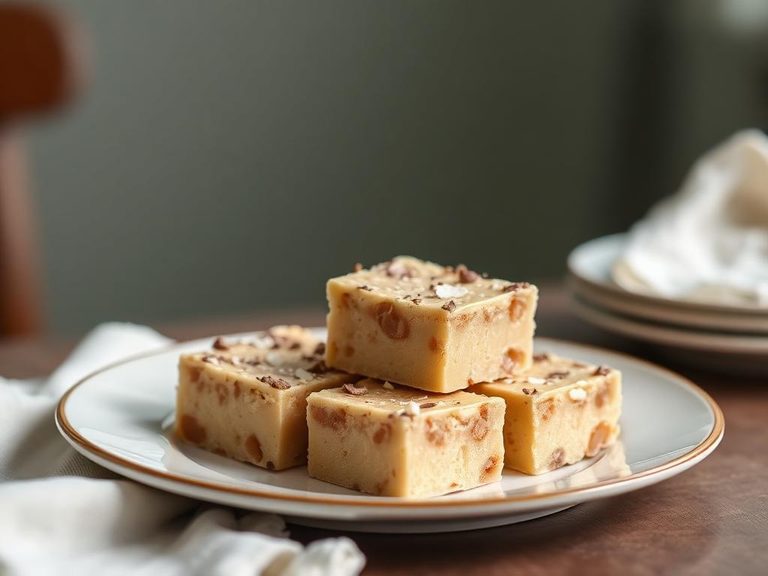
A dense, creamy confection made by cooking sugar, milk, and butter to the soft-ball stage, vanilla fudge offers a melt-in-your-mouth texture that is simultaneously smooth and slightly crumbly. Its flavor profile is intensely sweet and buttery, with a pure vanilla note that cuts through the richness. Nutritionally, it is a concentrated source of energy, with over 80% of its weight coming from carbohydrates, primarily as sugar.
Calorie split: 1% protein · 86% carbs · 13% fat
↓ Full nutrition💚 Why it's loved
People adore vanilla fudge for its nostalgic, comforting sweetness and its luxuriously smooth, creamy texture that dissolves on the tongue. Its simple, pure flavor makes it a beloved classic that pairs well with coffee or tea and is often a cherished holiday or gift item.
⚠️ Watch-outs & how to enjoy it better
Its extremely high sugar content (nearly 80g per 100g) can cause rapid blood-sugar spikes, making it unsuitable for those managing diabetes or insulin resistance. To mitigate this, consume a very small portion (e.g., a 1-inch square) and pair it with a source of protein or healthy fat (like a handful of nuts or a piece of cheese) to slow sugar absorption. It is also calorie-dense, so mindful portion control is essential.
Key benefits
- Quick source of energy due to high carbohydrate content
- Provides a small amount of calcium from milk or cream
- Can be a morale-boosting treat in moderation
- Versatile base for flavor variations (e.g., chocolate, nuts)
- Traditional comfort food with cultural significance
🍽️ Popular dishes


🌍 Where it's eaten
💡 Did you know?
The soft-ball stage, crucial for fudge's texture, is reached when sugar syrup is heated to 112-116°C (234-241°F), a precise temperature that determines if the fudge will set properly or become grainy.
Full nutrition (USDA data · scales with serving)
| Water | 10.8 g |
| Energy | 383 kcal |
| Energy | 1602 kj |
| Protein | 1.1 g |
| Total lipid (fat) | 5.5 g |
| Ash | 0.34 g |
| Carbohydrate, by difference | 82.2 g |
| Fiber, total dietary | 0.00 g |
| Total Sugars | 79.8 g |
| Calcium, Ca | 38.0 mg |
| Iron, Fe | 0.02 mg |
| Magnesium, Mg | 3.0 mg |
| Phosphorus, P | 30.0 mg |
| Potassium, K | 49.0 mg |
| Sodium, Na | 47.0 mg |
| Zinc, Zn | 0.15 mg |
| Copper, Cu | 0.00 mg |
| Manganese, Mn | 0.00 mg |
| Selenium, Se | 1.7 ug |
| Vitamin C, total ascorbic acid | 0.00 mg |
| Thiamin | 0.01 mg |
| Riboflavin | 0.07 mg |
| Niacin | 0.04 mg |
| Pantothenic acid | 0.12 mg |
| Vitamin B-6 | 0.01 mg |
| Folate, total | 1.0 ug |
| Folic acid | 0.00 ug |
| Folate, food | 1.0 ug |
| Folate, DFE | 1.0 ug |
| Choline, total | 5.3 mg |
| Vitamin B-12 | 0.08 ug |
| Vitamin B-12, added | 0.00 ug |
| Vitamin A, RAE | 46.0 ug |
| Retinol | 45.0 ug |
| Carotene, beta | 10.0 ug |
| Carotene, alpha | 0.00 ug |
| Cryptoxanthin, beta | 0.00 ug |
| Vitamin A, IU | 168 iu |
| Lycopene | 0.00 ug |
| Lutein + zeaxanthin | 0.00 ug |
| Vitamin E (alpha-tocopherol) | 0.14 mg |
| Vitamin E, added | 0.00 mg |
| Vitamin D (D2 + D3), International Units | 0.00 iu |
| Vitamin D (D2 + D3) | 0.00 ug |
| Vitamin K (phylloquinone) | 0.50 ug |
| Alcohol, ethyl | 0.00 g |
| Caffeine | 0.00 mg |
| Theobromine | 0.00 mg |
Fat & fatty acid profile (per 100g)
| Fatty acids, total saturated | 3.4 g |
| SFA 4:0 | 0.20 g |
| SFA 6:0 | 0.13 g |
| SFA 8:0 | 0.09 g |
| SFA 10:0 | 0.16 g |
| SFA 12:0 | 0.17 g |
| SFA 13:0 | 0.00 g |
| SFA 14:0 | 0.50 g |
| SFA 15:0 | 0.00 g |
| SFA 16:0 | 1.4 g |
| SFA 17:0 | 0.03 g |
| SFA 18:0 | 0.66 g |
| SFA 20:0 | 0.01 g |
| SFA 22:0 | 0.00 g |
| SFA 24:0 | 0.00 g |
| Fatty acids, total monounsaturated | 1.4 g |
| MUFA 14:1 | 0.00 g |
| MUFA 16:1 | 0.05 g |
| MUFA 18:1 | 1.3 g |
| MUFA 20:1 | 0.01 g |
| MUFA 22:1 | 0.00 g |
| Fatty acids, total polyunsaturated | 0.23 g |
| PUFA 18:2 | 0.19 g |
| PUFA 18:3 | 0.04 g |
| PUFA 18:4 | 0.00 g |
| PUFA 20:4 | 0.00 g |
| PUFA 20:5 n-3 (EPA) | 0.00 g |
| PUFA 22:5 n-3 (DPA) | 0.00 g |
| PUFA 22:6 n-3 (DHA) | 0.00 g |
| Fatty acids, total trans | 0.18 g |
| Cholesterol | 15.0 mg |
Amino acid profile (per 100g)
Estimated from Candies, honey-combed, with peanut butter — USDA does not publish this profile for Candies.
| Tryptophan | 0.09 g |
| Threonine | 0.21 g |
| Isoleucine | 0.24 g |
| Leucine | 0.61 g |
| Lysine | 0.27 g |
| Methionine | 0.10 g |
| Cystine | 0.09 g |
| Phenylalanine | 0.47 g |
| Tyrosine | 0.33 g |
| Valine | 0.31 g |
| Arginine | 1.1 g |
| Histidine | 0.22 g |
| Alanine | 0.36 g |
| Aspartic acid | 1.2 g |
| Glutamic acid | 2.0 g |
| Glycine | 0.56 g |
| Proline | 0.55 g |
| Serine | 0.58 g |
FAQ
What makes fudge different from other candies?
Fudge is defined by its crystalline sugar structure, achieved by carefully controlling the cooling and stirring process, which gives it a smooth, creamy, yet slightly grainy texture unlike hard candies or caramels.
Can I make fudge without a candy thermometer?
Yes, but it's risky. You can use the cold-water test: drop a small amount of syrup into cold water; if it forms a soft, pliable ball (soft-ball stage), it's ready. However, a thermometer is more reliable for consistent results.
Why does my homemade fudge sometimes turn grainy?
Graininess is usually caused by sugar crystals forming prematurely. This can happen if the mixture isn't stirred enough during cooling, or if it's cooled too quickly. Using a clean pan and avoiding stirring once it reaches the soft-ball stage helps prevent this.
Nutrient density (calculated · NRF9.3)
Nutrient Rich Foods index: beneficial nutrients (protein, fiber, vitamins, minerals) minus saturated fat, added sugar & sodium, per 100 kcal.
NRF9.3 index — Fulgoni, Keast & Drewnowski, 2009. Computed from USDA nutrients.
Weight-loss friendliness (composite index)
Energy density 3.83 kcal/g · 1% calories from protein · 0.0 g fiber · 79.8 g sugar per 100 g.
Composite of energy density (Rolls et al., 1999), protein & fiber satiety, minus sugar. A calculated heuristic — ranks satiety-per-calorie, not a clinical measure.
Dietary load (calculated from USDA values)
Potential renal acid load. Positive = acid-forming, negative = alkaline-forming.
Sodium-to-potassium ratio: 0.96 (lower is better — aim for ≤ 1)
Sodium:potassium per WHO potassium guidance. Computed from USDA nutrients.