

Beef, brisket, flat half, separable lean and fat, trimmed to 0" fat, select, cooked, braised
Whole food · Beef Products

Photo: Wikipedia
This is the lean, rectangular flat half of a beef brisket, trimmed of excess fat and slow-braised until fork-tender. It delivers a deep, beefy flavor with a firm yet succulent texture that holds up beautifully to slicing. With a robust 33.59g of protein per 100g and zero carbohydrates, it is a powerhouse of lean nutrition.
Calorie split: 69% protein · 0% carbs · 31% fat
↓ Full nutrition💚 Why it's loved
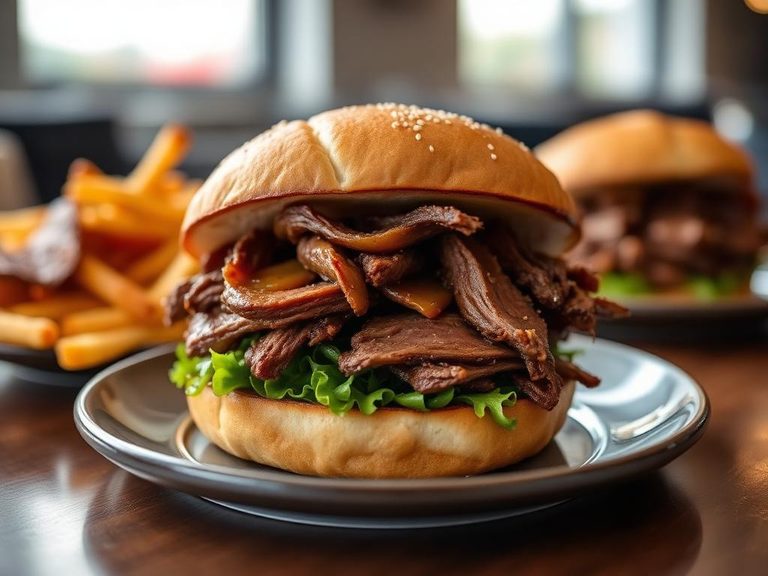
People love this cut for its deep, savory beefiness and the melt-in-your-mouth tenderness achieved through slow braising. Its versatility makes it a centerpiece for everything from hearty sandwiches to elegant plated dinners.
⚠️ Watch-outs & how to enjoy it better
The primary downside is its high sodium content, especially if braised with salty broths or marinades, which can be a concern for those monitoring blood pressure. To counteract this, use low-sodium broths and rinse the meat after cooking, or pair it with potassium-rich vegetables like potatoes or spinach to help balance electrolytes.
Key benefits
- Exceptionally high in protein for muscle maintenance and satiety
- Contains zero carbohydrates and sugar, ideal for low-carb diets
- Rich in B vitamins, particularly B12, for energy metabolism
- Provides essential minerals like zinc and iron
- Low in fat relative to other brisket cuts when trimmed
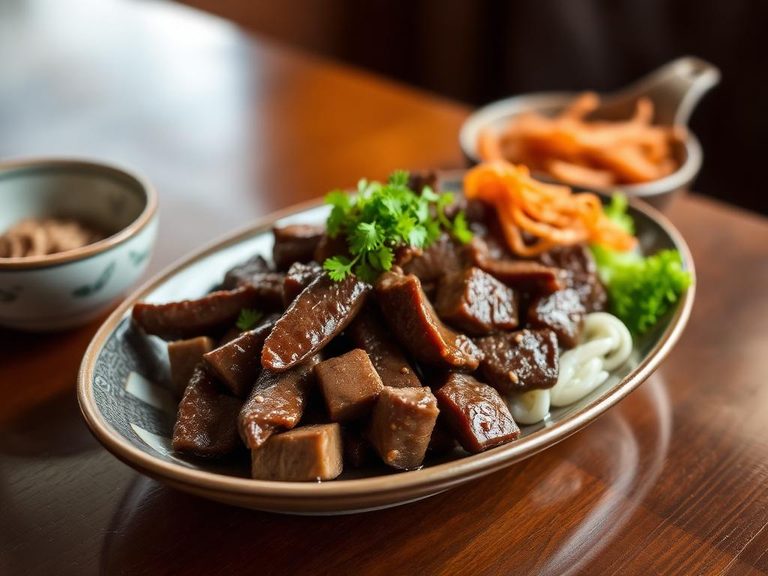
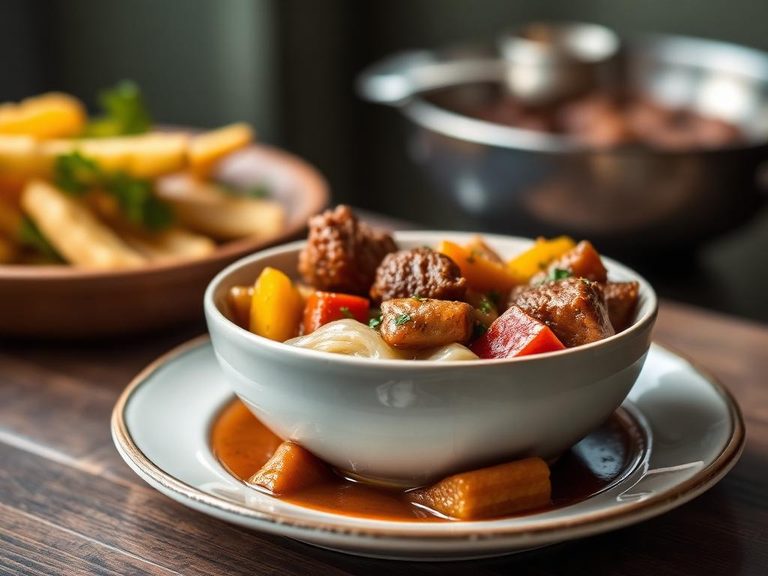
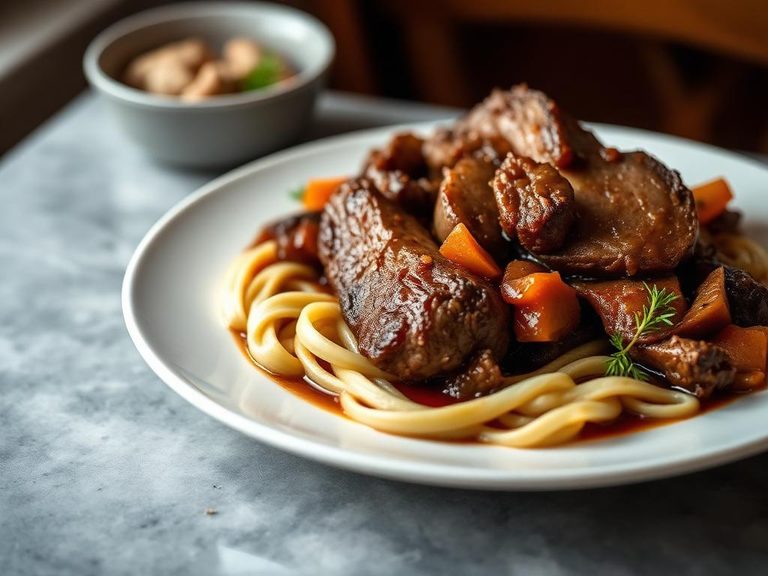
🍽️ Popular dishes


🌍 Where it's eaten
💡 Did you know?
The brisket comes from the breast or lower chest of the cow, a muscle group that gets a rigorous workout, which is why it requires long, slow cooking to break down the tough connective tissue into gelatin.
Full nutrition (USDA data · scales with serving)
| Water | 59.4 g |
| Energy | 205 kcal |
| Energy | 856 kj |
| Protein | 33.6 g |
| Total lipid (fat) | 6.8 g |
| Ash | 0.98 g |
| Carbohydrate, by difference | 0.00 g |
| Fiber, total dietary | 0.00 g |
| Total Sugars | 0.00 g |
| Calcium, Ca | 20.0 mg |
| Iron, Fe | 2.8 mg |
| Magnesium, Mg | 22.0 mg |
| Phosphorus, P | 208 mg |
| Potassium, K | 275 mg |
| Sodium, Na | 57.0 mg |
| Zinc, Zn | 8.0 mg |
| Copper, Cu | 0.10 mg |
| Manganese, Mn | 0.01 mg |
| Selenium, Se | 32.5 ug |
| Vitamin C, total ascorbic acid | 0.00 mg |
| Thiamin | 0.06 mg |
| Riboflavin | 0.16 mg |
| Niacin | 4.2 mg |
| Pantothenic acid | 0.57 mg |
| Vitamin B-6 | 0.28 mg |
| Folate, total | 9.0 ug |
| Folic acid | 0.00 ug |
| Folate, food | 9.0 ug |
| Folate, DFE | 9.0 ug |
| Choline, total | 128 mg |
| Betaine | 16.8 mg |
| Vitamin B-12 | 1.9 ug |
| Vitamin B-12, added | 0.00 ug |
| Vitamin A, RAE | 0.00 ug |
| Retinol | 0.00 ug |
| Carotene, beta | 0.00 ug |
| Carotene, alpha | 0.00 ug |
| Cryptoxanthin, beta | 0.00 ug |
| Vitamin A, IU | 0.00 iu |
| Lycopene | 0.00 ug |
| Lutein + zeaxanthin | 0.00 ug |
| Vitamin E (alpha-tocopherol) | 0.43 mg |
| Vitamin E, added | 0.00 mg |
| Tocopherol, beta | 0.00 mg |
| Tocopherol, gamma | 0.00 mg |
| Tocopherol, delta | 0.00 mg |
| Vitamin K (phylloquinone) | 1.5 ug |
| Alcohol, ethyl | 0.00 g |
| Caffeine | 0.00 mg |
| Theobromine | 0.00 mg |
Fat & fatty acid profile (per 100g)
| Fatty acids, total saturated | 2.7 g |
| SFA 4:0 | 0.00 g |
| SFA 6:0 | 0.00 g |
| SFA 8:0 | 0.00 g |
| SFA 10:0 | 0.02 g |
| SFA 12:0 | 0.01 g |
| SFA 14:0 | 0.21 g |
| SFA 16:0 | 1.6 g |
| SFA 18:0 | 0.80 g |
| Fatty acids, total monounsaturated | 2.9 g |
| MUFA 16:1 | 0.28 g |
| MUFA 18:1 | 2.6 g |
| MUFA 20:1 | 0.01 g |
| MUFA 22:1 | 0.00 g |
| Fatty acids, total polyunsaturated | 0.25 g |
| PUFA 18:2 | 0.17 g |
| PUFA 18:3 | 0.07 g |
| PUFA 18:4 | 0.00 g |
| PUFA 20:4 | 0.01 g |
| PUFA 20:5 n-3 (EPA) | 0.00 g |
| PUFA 22:5 n-3 (DPA) | 0.00 g |
| PUFA 22:6 n-3 (DHA) | 0.00 g |
| Cholesterol | 93.0 mg |
Amino acid profile (per 100g)
| Tryptophan | 0.22 g |
| Threonine | 1.3 g |
| Isoleucine | 1.5 g |
| Leucine | 2.7 g |
| Lysine | 2.8 g |
| Methionine | 0.88 g |
| Cystine | 0.43 g |
| Phenylalanine | 1.3 g |
| Tyrosine | 1.1 g |
| Valine | 1.7 g |
| Arginine | 2.2 g |
| Histidine | 1.1 g |
| Alanine | 2.0 g |
| Aspartic acid | 3.1 g |
| Glutamic acid | 5.0 g |
| Glycine | 2.0 g |
| Proline | 1.6 g |
| Serine | 1.3 g |
| Hydroxyproline | 0.35 g |
FAQ
What is the difference between the flat and point of brisket?
The flat half is the leaner, more uniform rectangular portion, while the point is the fattier, more marbled end. The flat is often preferred for slicing and sandwiches due to its shape and lower fat content.
How do I prevent braised brisket from drying out?
Ensure you cook it low and slow (around 300°F/150°C) with enough liquid to create steam, and cover the pot tightly. Letting it rest for at least 15 minutes after cooking allows the juices to redistribute.
Is this cut suitable for grilling?
While brisket is traditionally braised or smoked, the flat half can be grilled if sliced against the grain and marinated well. However, it is best suited for moist-heat methods like braising to achieve optimal tenderness.
Nutrient density (calculated · NRF9.3)
Nutrient Rich Foods index: beneficial nutrients (protein, fiber, vitamins, minerals) minus saturated fat, added sugar & sodium, per 100 kcal.
NRF9.3 index — Fulgoni, Keast & Drewnowski, 2009. Computed from USDA nutrients.
Weight-loss friendliness (composite index)
Energy density 2.05 kcal/g · 66% calories from protein · 0.0 g fiber · 0.0 g sugar per 100 g.
Composite of energy density (Rolls et al., 1999), protein & fiber satiety, minus sugar. A calculated heuristic — ranks satiety-per-calorie, not a clinical measure.
Dietary load (calculated from USDA values)
Potential renal acid load. Positive = acid-forming, negative = alkaline-forming.
Sodium-to-potassium ratio: 0.21 (lower is better — aim for ≤ 1)
Sodium:potassium per WHO potassium guidance. Computed from USDA nutrients.