

Spinach, canned, regular pack, drained solids
Whole food · Vegetables and Vegetable Products

Photo: Wikipedia
This is spinach that has been cooked, canned, and then drained of its liquid, resulting in a soft, tender, and deeply savory vegetable with a concentrated earthy flavor. Nutritionally, it's a powerhouse of protein and fiber for very few calories, making it an efficient way to boost the nutrient density of a meal.
Calorie split: 38% protein · 46% carbs · 15% fat
↓ Full nutrition💚 Why it's loved
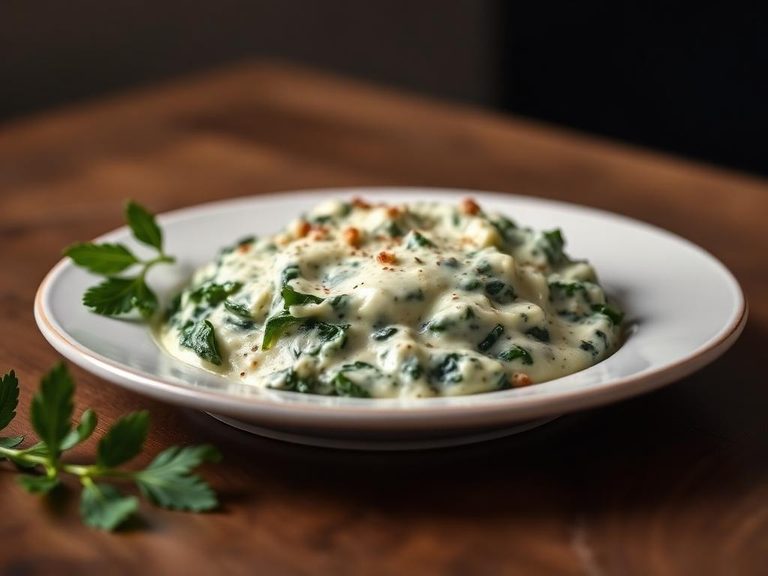
People love it for its deep, savory umami flavor that enriches soups, stews, and casseroles without adding heaviness. Its soft texture blends seamlessly into dishes like spanakopita or spinach dip, and it's a staple for quick, nutritious weeknight cooking.
⚠️ Watch-outs & how to enjoy it better
The canning process can lead to a softer, sometimes mushy texture and a more pronounced 'cooked' flavor compared to fresh. It may also contain added sodium for preservation; look for 'no salt added' versions or rinse the solids to reduce sodium content. The oxalates in spinach can bind to minerals like calcium and iron, but pairing it with a source of vitamin C (like lemon juice) can enhance iron absorption.
Key benefits
- Excellent source of plant-based protein for its calorie count.
- High in dietary fiber, supporting digestive health.
- Very low in calories and fat, suitable for calorie-conscious diets.
- Provides iron, vitamin K, and vitamin A (from beta-carotene).
- Convenient and shelf-stable with a long pantry life.
🍽️ Popular dishes


🌍 Where it's eaten
💡 Did you know?
Canned spinach was a staple on early 20th-century naval ships, including the USS Olympia, where it was valued for its long shelf life and high iron content to prevent scurvy and anemia among sailors.
Full nutrition (USDA data · scales with serving)
| Water | 91.8 g |
| Energy | 23.0 kcal |
| Energy | 96.0 kj |
| Protein | 2.8 g |
| Total lipid (fat) | 0.50 g |
| Ash | 1.5 g |
| Carbohydrate, by difference | 3.4 g |
| Fiber, total dietary | 2.4 g |
| Total Sugars | 0.40 g |
| Calcium, Ca | 127 mg |
| Iron, Fe | 2.3 mg |
| Magnesium, Mg | 76.0 mg |
| Phosphorus, P | 44.0 mg |
| Potassium, K | 346 mg |
| Sodium, Na | 322 mg |
| Zinc, Zn | 0.46 mg |
| Copper, Cu | 0.18 mg |
| Manganese, Mn | 0.60 mg |
| Selenium, Se | 1.4 ug |
| Vitamin C, total ascorbic acid | 14.3 mg |
| Thiamin | 0.02 mg |
| Riboflavin | 0.14 mg |
| Niacin | 0.39 mg |
| Pantothenic acid | 0.05 mg |
| Vitamin B-6 | 0.10 mg |
| Folate, total | 98.0 ug |
| Folic acid | 0.00 ug |
| Folate, food | 98.0 ug |
| Folate, DFE | 98.0 ug |
| Choline, total | 18.4 mg |
| Betaine | 83.2 mg |
| Vitamin B-12 | 0.00 ug |
| Vitamin B-12, added | 0.00 ug |
| Vitamin A, RAE | 490 ug |
| Retinol | 0.00 ug |
| Carotene, beta | 5881 ug |
| Carotene, alpha | 0.00 ug |
| Cryptoxanthin, beta | 0.00 ug |
| Vitamin A, IU | 9801 iu |
| Lycopene | 0.00 ug |
| Lutein + zeaxanthin | 10575 ug |
| Vitamin E (alpha-tocopherol) | 1.9 mg |
| Vitamin E, added | 0.00 mg |
| Vitamin D (D2 + D3), International Units | 0.00 iu |
| Vitamin D (D2 + D3) | 0.00 ug |
| Vitamin K (phylloquinone) | 462 ug |
| Alcohol, ethyl | 0.00 g |
| Caffeine | 0.00 mg |
| Theobromine | 0.00 mg |
Fat & fatty acid profile (per 100g)
| Fatty acids, total saturated | 0.08 g |
| SFA 4:0 | 0.00 g |
| SFA 6:0 | 0.00 g |
| SFA 8:0 | 0.00 g |
| SFA 10:0 | 0.00 g |
| SFA 12:0 | 0.00 g |
| SFA 14:0 | 0.01 g |
| SFA 16:0 | 0.06 g |
| SFA 18:0 | 0.01 g |
| Fatty acids, total monounsaturated | 0.01 g |
| MUFA 16:1 | 0.01 g |
| MUFA 18:1 | 0.01 g |
| MUFA 20:1 | 0.00 g |
| MUFA 22:1 | 0.00 g |
| Fatty acids, total polyunsaturated | 0.21 g |
| PUFA 18:2 | 0.03 g |
| PUFA 18:3 | 0.18 g |
| PUFA 18:4 | 0.00 g |
| PUFA 20:4 | 0.00 g |
| PUFA 20:5 n-3 (EPA) | 0.00 g |
| PUFA 22:5 n-3 (DPA) | 0.00 g |
| PUFA 22:6 n-3 (DHA) | 0.00 g |
| Fatty acids, total trans | 0.00 g |
| Cholesterol | 0.00 mg |
Amino acid profile (per 100g)
| Tryptophan | 0.04 g |
| Threonine | 0.12 g |
| Isoleucine | 0.14 g |
| Leucine | 0.22 g |
| Lysine | 0.17 g |
| Methionine | 0.05 g |
| Cystine | 0.03 g |
| Phenylalanine | 0.13 g |
| Tyrosine | 0.11 g |
| Valine | 0.16 g |
| Arginine | 0.16 g |
| Histidine | 0.06 g |
| Alanine | 0.14 g |
| Aspartic acid | 0.24 g |
| Glutamic acid | 0.34 g |
| Glycine | 0.13 g |
| Proline | 0.11 g |
| Serine | 0.10 g |
FAQ
Is canned spinach as nutritious as fresh?
Canning can reduce some heat-sensitive nutrients like vitamin C, but it often makes other nutrients like beta-carotene and lycopene more bioavailable. Canned spinach remains a very good source of fiber, protein, vitamin K, and iron.
How do I reduce the metallic taste from the can?
Rinse the drained spinach thoroughly under cold water. For cooked dishes, sautéing it briefly with garlic and a little oil before adding other ingredients can also improve its flavor profile.
Can I use the liquid from the can?
The liquid, or 'pot liquor,' is flavorful and nutritious but often high in sodium if the spinach was canned with salt. You can use it to add depth to soups, stews, or rice, but be mindful of the overall salt content in your recipe.
Nutrient density (calculated · NRF9.3)
Nutrient Rich Foods index: beneficial nutrients (protein, fiber, vitamins, minerals) minus saturated fat, added sugar & sodium, per 100 kcal.
NRF9.3 index — Fulgoni, Keast & Drewnowski, 2009. Computed from USDA nutrients.
Weight-loss friendliness (composite index)
Energy density 0.23 kcal/g · 49% calories from protein · 2.4 g fiber · 0.4 g sugar per 100 g.
Composite of energy density (Rolls et al., 1999), protein & fiber satiety, minus sugar. A calculated heuristic — ranks satiety-per-calorie, not a clinical measure.
Dietary load (calculated from USDA values)
Potential renal acid load. Positive = acid-forming, negative = alkaline-forming.
Sodium-to-potassium ratio: 0.93 (lower is better — aim for ≤ 1)
Sodium:potassium per WHO potassium guidance. Computed from USDA nutrients.