

Pork, fresh, leg (ham), whole, separable lean and fat, cooked, roasted
Whole food · Pork Products

Photo: Wikipedia
This is a succulent cut from the hind leg of the pig, roasted to a beautiful golden-brown. The texture is a perfect balance of tender, lean meat and a flavorful, slightly crispy fat cap. It's a protein powerhouse, packing nearly 27 grams per 100g with zero carbohydrates.
Calorie split: 40% protein · 0% carbs · 60% fat
↓ Full nutrition💚 Why it's loved
People adore the deep, savory flavor that intensifies with roasting, and the textural contrast between the juicy meat and crisp fat. Its versatility makes it a centerpiece for both everyday family dinners and festive holiday feasts across many cultures.
⚠️ Watch-outs & how to enjoy it better
The high fat content, particularly saturated fat, can be a concern for heart health if consumed in excess. To enjoy it healthily, practice portion control (aim for a 3-4 oz serving), trim visible fat before or after cooking, and pair it with fiber-rich vegetables like roasted Brussels sprouts or a fresh salad to balance the meal.
Key benefits
- Excellent source of high-quality protein for muscle maintenance.
- Rich in B vitamins, especially thiamine (B1) and niacin (B3).
- Provides essential minerals like selenium, zinc, and phosphorus.
- A complete protein source containing all essential amino acids.
🍽️ Popular dishes
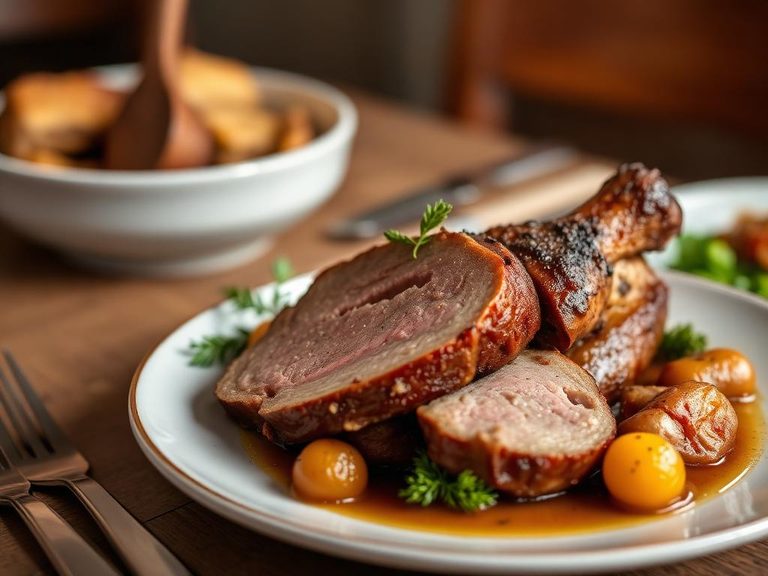

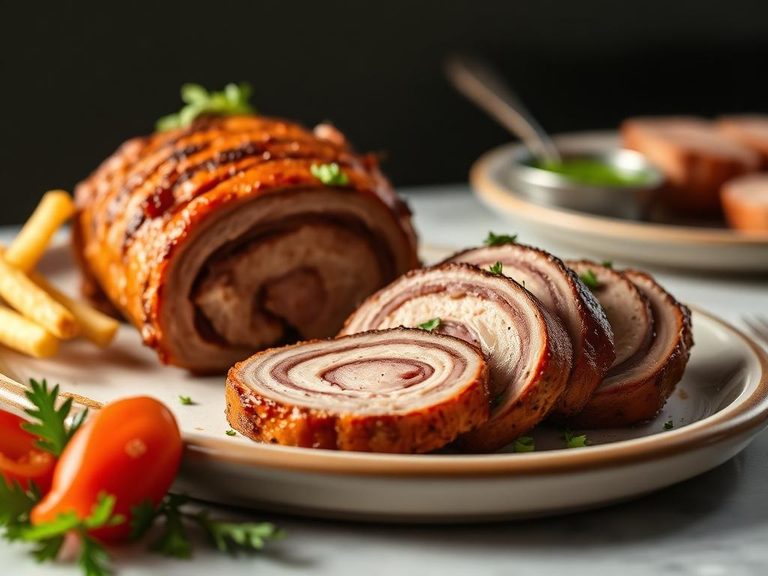
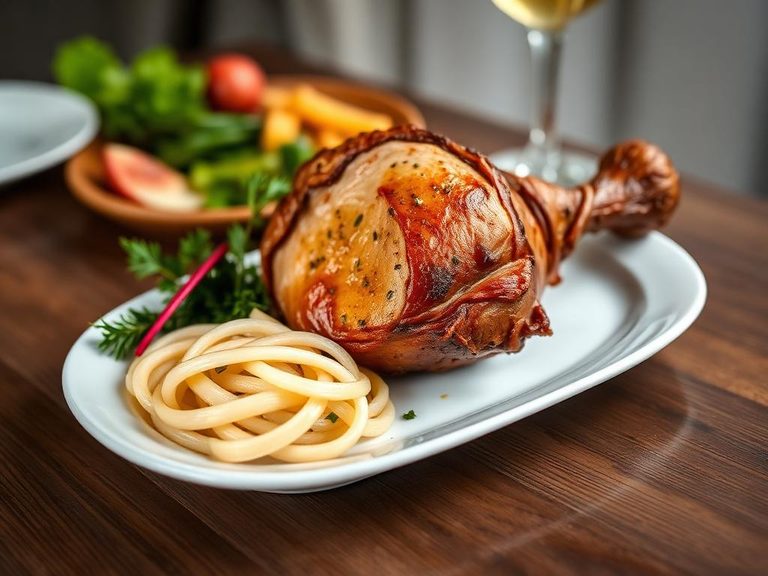
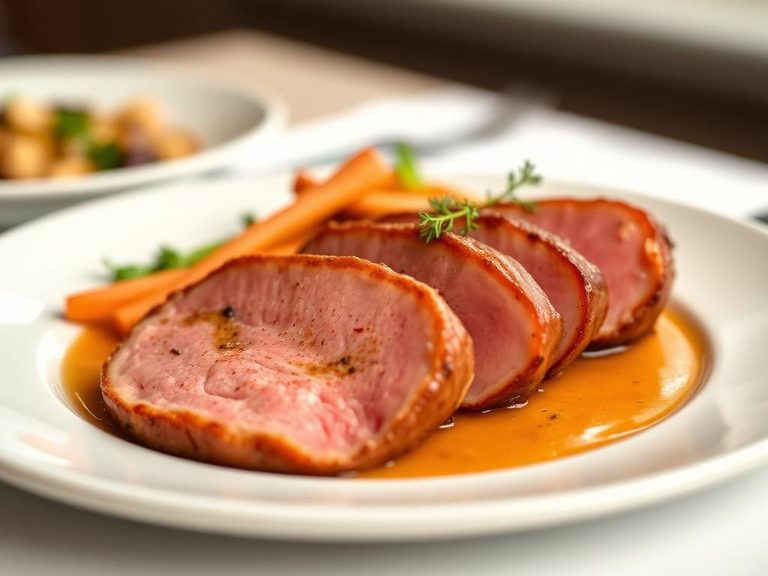

🌍 Where it's eaten
💡 Did you know?
The ham's distinctive pink color in cured versions comes from the reaction of myoglobin with nitrites, a preservation method dating back centuries.
Full nutrition (USDA data · scales with serving)
| Water | 55.0 g |
| Energy | 273 kcal |
| Energy | 1142 kj |
| Protein | 26.8 g |
| Total lipid (fat) | 17.6 g |
| Ash | 1.1 g |
| Carbohydrate, by difference | 0.00 g |
| Fiber, total dietary | 0.00 g |
| Total Sugars | 0.00 g |
| Calcium, Ca | 14.0 mg |
| Iron, Fe | 1.0 mg |
| Magnesium, Mg | 22.0 mg |
| Phosphorus, P | 263 mg |
| Potassium, K | 352 mg |
| Sodium, Na | 60.0 mg |
| Zinc, Zn | 3.0 mg |
| Copper, Cu | 0.10 mg |
| Manganese, Mn | 0.03 mg |
| Selenium, Se | 45.3 ug |
| Vitamin C, total ascorbic acid | 0.30 mg |
| Thiamin | 0.64 mg |
| Riboflavin | 0.31 mg |
| Niacin | 4.6 mg |
| Pantothenic acid | 0.62 mg |
| Vitamin B-6 | 0.40 mg |
| Folate, total | 10.0 ug |
| Folic acid | 0.00 ug |
| Folate, food | 10.0 ug |
| Folate, DFE | 10.0 ug |
| Choline, total | 92.2 mg |
| Betaine | 3.6 mg |
| Vitamin B-12 | 0.68 ug |
| Vitamin B-12, added | 0.00 ug |
| Vitamin A, RAE | 3.0 ug |
| Retinol | 3.0 ug |
| Carotene, beta | 0.00 ug |
| Carotene, alpha | 0.00 ug |
| Cryptoxanthin, beta | 0.00 ug |
| Vitamin A, IU | 10.0 iu |
| Lycopene | 0.00 ug |
| Lutein + zeaxanthin | 0.00 ug |
| Vitamin E (alpha-tocopherol) | 0.22 mg |
| Vitamin E, added | 0.00 mg |
| Vitamin D (D2 + D3), International Units | 33.0 iu |
| Vitamin D (D2 + D3) | 0.80 ug |
| Vitamin D3 (cholecalciferol) | 0.80 ug |
| Vitamin K (phylloquinone) | 0.00 ug |
| Vitamin K (Dihydrophylloquinone) | 0.00 ug |
| Alcohol, ethyl | 0.00 g |
| Caffeine | 0.00 mg |
| Theobromine | 0.00 mg |
Fat & fatty acid profile (per 100g)
| Fatty acids, total saturated | 6.5 g |
| SFA 4:0 | 0.00 g |
| SFA 6:0 | 0.00 g |
| SFA 8:0 | 0.00 g |
| SFA 10:0 | 0.02 g |
| SFA 12:0 | 0.01 g |
| SFA 14:0 | 0.22 g |
| SFA 16:0 | 4.0 g |
| SFA 18:0 | 2.1 g |
| Fatty acids, total monounsaturated | 7.9 g |
| MUFA 16:1 | 0.50 g |
| MUFA 18:1 | 7.2 g |
| MUFA 20:1 | 0.12 g |
| MUFA 22:1 | 0.00 g |
| Fatty acids, total polyunsaturated | 1.7 g |
| PUFA 18:2 | 1.5 g |
| PUFA 18:3 | 0.05 g |
| PUFA 18:4 | 0.00 g |
| PUFA 20:4 | 0.07 g |
| PUFA 20:5 n-3 (EPA) | 0.00 g |
| PUFA 22:5 n-3 (DPA) | 0.00 g |
| PUFA 22:6 n-3 (DHA) | 0.00 g |
| Cholesterol | 94.0 mg |
Amino acid profile (per 100g)
| Tryptophan | 0.32 g |
| Threonine | 1.2 g |
| Isoleucine | 1.2 g |
| Leucine | 2.1 g |
| Lysine | 2.4 g |
| Methionine | 0.69 g |
| Cystine | 0.33 g |
| Phenylalanine | 1.1 g |
| Tyrosine | 0.90 g |
| Valine | 1.4 g |
| Arginine | 1.7 g |
| Histidine | 1.0 g |
| Alanine | 1.6 g |
| Aspartic acid | 2.4 g |
| Glutamic acid | 4.1 g |
| Glycine | 1.5 g |
| Proline | 1.2 g |
| Serine | 1.1 g |
FAQ
What's the best way to keep roasted pork leg from drying out?
Let the meat rest for at least 10-15 minutes after roasting before carving. This allows the juices to redistribute throughout the meat, resulting in a moister slice.
Is the fat on roasted pork leg edible?
Yes, the rendered fat is flavorful and can be enjoyed in moderation. For a leaner meal, you can trim the fat cap before cooking or simply remove it from the slices on your plate.
How does roasted pork leg compare nutritionally to other meats?
It is leaner than many beef cuts but has more fat than skinless chicken breast. Its protein content is comparable to other roasted meats, making it a solid protein source.
Nutrient density (calculated · NRF9.3)
Nutrient Rich Foods index: beneficial nutrients (protein, fiber, vitamins, minerals) minus saturated fat, added sugar & sodium, per 100 kcal.
NRF9.3 index — Fulgoni, Keast & Drewnowski, 2009. Computed from USDA nutrients.
Weight-loss friendliness (composite index)
Energy density 2.73 kcal/g · 39% calories from protein · 0.0 g fiber · 0.0 g sugar per 100 g.
Composite of energy density (Rolls et al., 1999), protein & fiber satiety, minus sugar. A calculated heuristic — ranks satiety-per-calorie, not a clinical measure.
Dietary load (calculated from USDA values)
Potential renal acid load. Positive = acid-forming, negative = alkaline-forming.
Sodium-to-potassium ratio: 0.17 (lower is better — aim for ≤ 1)
Sodium:potassium per WHO potassium guidance. Computed from USDA nutrients.