

Ice cream, bar or stick, chocolate covered
Whole food · Dairy and Egg Products
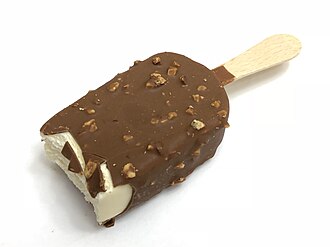
Photo: Wikipedia
A classic handheld ice cream treat, featuring a core of creamy vanilla or other flavor enrobed in a hard, cracking chocolate shell. The textural contrast between the smooth, cold interior and the crisp, snappy coating is its signature appeal. Nutritionally, it's a calorie-dense indulgence, with most of its energy coming from fat and sugar.
Calorie split: 5% protein · 30% carbs · 65% fat
↓ Full nutrition💚 Why it's loved
People adore the satisfying snap of the chocolate shell giving way to the cold, creamy interior. It's a nostalgic, portable summer staple that combines two beloved desserts—ice cream and chocolate—into one convenient, mess-minimizing format.
⚠️ Watch-outs & how to enjoy it better
The high sugar content (18.3g per 100g) can cause rapid blood-sugar spikes, and the saturated fat from the coating and dairy is significant. To mitigate this, enjoy it occasionally and mindfully, perhaps after a balanced meal containing protein and fiber to slow sugar absorption. Those with lactose intolerance or milk allergies should avoid it or seek specific alternatives.
Key benefits
- Quick source of energy from carbohydrates and fats
- Provides a small amount of calcium from dairy
- Offers a psychological mood boost as a treat
- Convenient, pre-portioned format for on-the-go consumption
🍽️ Popular dishes


🌍 Where it's eaten
💡 Did you know?
The hard chocolate shell on many ice cream bars is achieved by dipping the frozen ice cream into a liquid coating that contains cocoa butter, which solidifies instantly upon contact with the cold surface, creating the signature 'crack'.
Full nutrition (USDA data · scales with serving)
| Water | 46.3 g |
| Energy | 331 kcal |
| Energy | 1386 kj |
| Protein | 4.1 g |
| Total lipid (fat) | 24.1 g |
| Ash | 1.0 g |
| Carbohydrate, by difference | 24.5 g |
| Fiber, total dietary | 0.80 g |
| Total Sugars | 18.3 g |
| Calcium, Ca | 119 mg |
| Iron, Fe | 0.29 mg |
| Magnesium, Mg | 28.0 mg |
| Phosphorus, P | 173 mg |
| Potassium, K | 305 mg |
| Sodium, Na | 68.0 mg |
| Zinc, Zn | 0.82 mg |
| Copper, Cu | 0.08 mg |
| Manganese, Mn | 0.08 mg |
| Selenium, Se | 2.4 ug |
| Vitamin C, total ascorbic acid | 0.00 mg |
| Thiamin | 0.06 mg |
| Riboflavin | 0.26 mg |
| Niacin | 0.17 mg |
| Pantothenic acid | 0.48 mg |
| Vitamin B-6 | 0.04 mg |
| Folate, total | 7.0 ug |
| Folic acid | 0.00 ug |
| Folate, food | 7.0 ug |
| Folate, DFE | 7.0 ug |
| Choline, total | 29.7 mg |
| Vitamin B-12 | 0.49 ug |
| Vitamin B-12, added | 0.00 ug |
| Vitamin A, RAE | 19.0 ug |
| Retinol | 15.0 ug |
| Carotene, beta | 44.0 ug |
| Carotene, alpha | 0.00 ug |
| Cryptoxanthin, beta | 0.00 ug |
| Vitamin A, IU | 123 iu |
| Lycopene | 0.00 ug |
| Lutein + zeaxanthin | 0.00 ug |
| Vitamin E (alpha-tocopherol) | 0.42 mg |
| Vitamin E, added | 0.00 mg |
| Vitamin D (D2 + D3), International Units | 7.0 iu |
| Vitamin D (D2 + D3) | 0.20 ug |
| Vitamin D3 (cholecalciferol) | 0.20 ug |
| Vitamin K (phylloquinone) | 1.3 ug |
| Alcohol, ethyl | 0.00 g |
| Caffeine | 3.0 mg |
| Theobromine | 32.0 mg |
Fat & fatty acid profile (per 100g)
| Fatty acids, total saturated | 13.2 g |
| SFA 4:0 | 0.18 g |
| SFA 6:0 | 0.15 g |
| SFA 8:0 | 0.62 g |
| SFA 10:0 | 0.59 g |
| SFA 12:0 | 3.5 g |
| SFA 14:0 | 1.8 g |
| SFA 16:0 | 3.8 g |
| SFA 18:0 | 2.5 g |
| SFA 20:0 | 0.08 g |
| Fatty acids, total monounsaturated | 6.4 g |
| MUFA 16:1 | 0.16 g |
| MUFA 18:1 | 6.2 g |
| MUFA 20:1 | 0.00 g |
| MUFA 22:1 | 0.00 g |
| Fatty acids, total polyunsaturated | 3.3 g |
| PUFA 18:2 | 3.0 g |
| PUFA 18:3 | 0.28 g |
| PUFA 18:4 | 0.00 g |
| PUFA 20:4 | 0.00 g |
| PUFA 20:5 n-3 (EPA) | 0.00 g |
| PUFA 22:5 n-3 (DPA) | 0.00 g |
| PUFA 22:6 n-3 (DHA) | 0.00 g |
| Cholesterol | 28.0 mg |
Amino acid profile (per 100g)
Estimated from Ice cream sundae cone — USDA does not publish this profile for Ice cream.
| Tryptophan | 0.01 g |
| Threonine | 0.02 g |
| Isoleucine | 0.03 g |
| Leucine | 0.06 g |
| Lysine | 0.02 g |
| Methionine | 0.01 g |
| Cystine | 0.02 g |
| Phenylalanine | 0.04 g |
| Tyrosine | 0.02 g |
| Valine | 0.04 g |
| Arginine | 0.03 g |
| Histidine | 0.02 g |
| Alanine | 0.03 g |
| Aspartic acid | 0.03 g |
| Glutamic acid | 0.29 g |
| Glycine | 0.03 g |
| Proline | 0.10 g |
| Serine | 0.04 g |
FAQ
Why does the chocolate shell crack so perfectly?
The coating is a special formulation, often a 'compound coating' or a mixture high in cocoa butter, designed to harden rapidly when it touches the frozen ice cream. This rapid solidification creates a smooth, brittle layer that fractures cleanly.
Is the ice cream inside different from regular tub ice cream?
Often, yes. The ice cream used for enrobing is formulated to be slightly denser and have a lower overrun (less air) so it maintains its structure and doesn't melt too quickly during the dipping and packaging process.
Can I make these at home?
Yes! You can dip scoops or logs of homemade ice cream into a melted chocolate mixture (often with a little coconut oil for smoothness) and freeze them. The homemade version may not have the same uniform, ultra-hard shell as commercial ones but is delicious.
Nutrient density (calculated · NRF9.3)
Nutrient Rich Foods index: beneficial nutrients (protein, fiber, vitamins, minerals) minus saturated fat, added sugar & sodium, per 100 kcal.
NRF9.3 index — Fulgoni, Keast & Drewnowski, 2009. Computed from USDA nutrients.
Weight-loss friendliness (composite index)
Energy density 3.31 kcal/g · 5% calories from protein · 0.8 g fiber · 18.3 g sugar per 100 g.
Composite of energy density (Rolls et al., 1999), protein & fiber satiety, minus sugar. A calculated heuristic — ranks satiety-per-calorie, not a clinical measure.
Dietary load (calculated from USDA values)
Potential renal acid load. Positive = acid-forming, negative = alkaline-forming.
Sodium-to-potassium ratio: 0.22 (lower is better — aim for ≤ 1)
Sodium:potassium per WHO potassium guidance. Computed from USDA nutrients.