

HUNGRY MAN, Salisbury Steak With Gravy, frozen, unprepared
Whole food · Meals, Entrees, and Side Dishes

Photo: Wikipedia
Hungry-Man Salisbury Steak is a hearty, pre-formed beef patty smothered in a rich, savory brown gravy, designed for a satisfying, no-fuss meal. The texture is tender and uniformly ground, with the gravy adding a glossy, umami depth. Nutritionally, it's a calorie-dense protein source, with over 8 grams of fat per 100g contributing to its signature richness.
Calorie split: 23% protein · 20% carbs · 56% fat
↓ Full nutrition💚 Why it's loved
People love it for its comforting, nostalgic flavor that evokes classic American diner food and home-style cooking. It's a go-to for a filling, savory meal that requires minimal effort, perfect for a busy weeknight.
⚠️ Watch-outs & how to enjoy it better
The meal can be high in sodium and saturated fat, which may be a concern for those monitoring heart health or blood pressure. To mitigate this, pair it with a large side of steamed or roasted vegetables to add fiber and volume, and consider draining some of the gravy to reduce sodium and fat intake.
Key benefits
- High protein content (7.96g per 100g) supports muscle maintenance.
- Convenient, single-serving frozen meal for quick preparation.
- Provides a quick source of energy from fats and carbohydrates.
- Shelf-stable and reduces food waste with portion control.
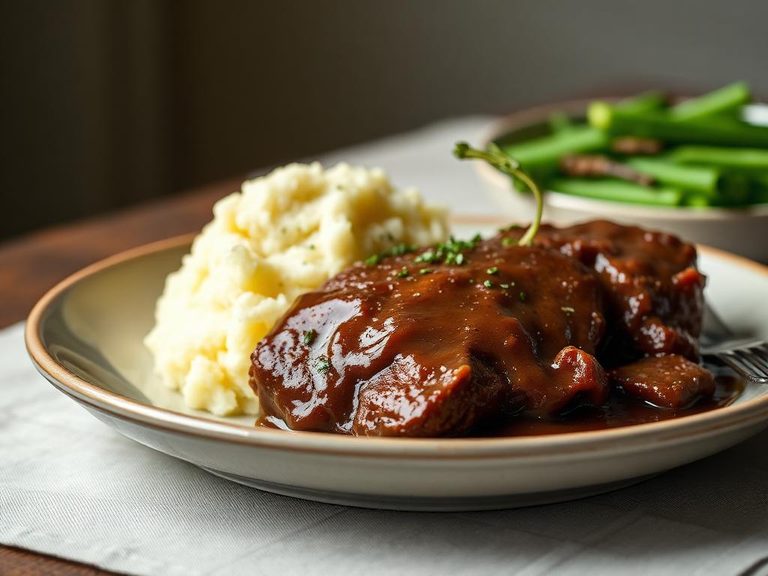
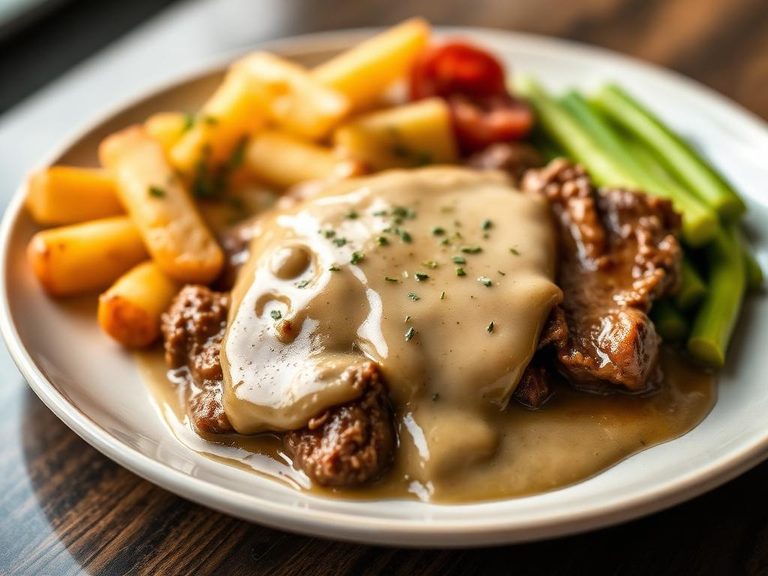
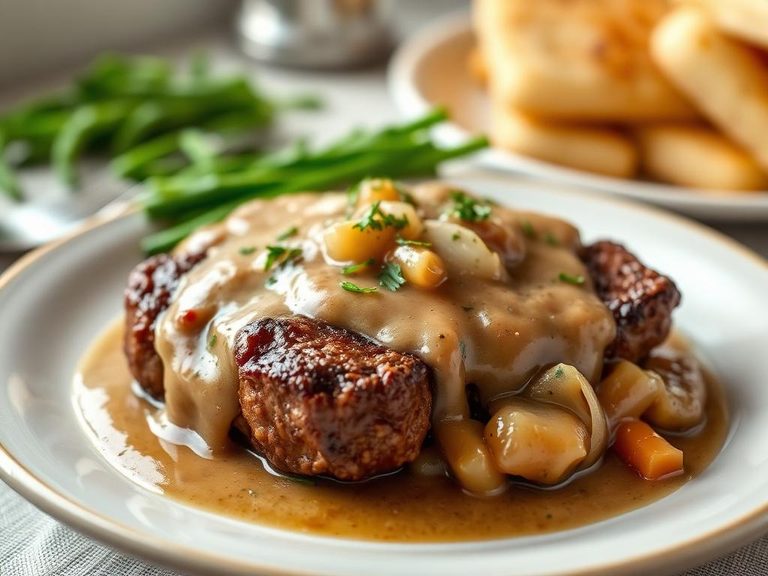
🍽️ Popular dishes


🌍 Where it's eaten
💡 Did you know?
Despite its name, Salisbury steak was not invented in Salisbury, England, but is named after Dr. James Salisbury, a 19th-century American physician who promoted a diet of ground beef patties for health.
Full nutrition (USDA data · scales with serving)
| Water | 75.2 g |
| Energy | 136 kcal |
| Energy | 571 kj |
| Protein | 8.0 g |
| Total lipid (fat) | 8.5 g |
| Ash | 1.4 g |
| Carbohydrate, by difference | 7.0 g |
| Fiber, total dietary | 1.3 g |
| Total Sugars | 0.18 g |
| Sucrose | 0.00 g |
| Glucose | 0.18 g |
| Fructose | 0.00 g |
| Lactose | 0.00 g |
| Maltose | 0.00 g |
| Galactose | 0.00 g |
| Starch | 2.2 g |
| Calcium, Ca | 29.0 mg |
| Iron, Fe | 1.0 mg |
| Magnesium, Mg | 19.0 mg |
| Phosphorus, P | 106 mg |
| Potassium, K | 195 mg |
| Sodium, Na | 379 mg |
| Zinc, Zn | 1.1 mg |
| Copper, Cu | 0.08 mg |
| Manganese, Mn | 0.20 mg |
| Selenium, Se | 8.1 ug |
| Thiamin | 0.08 mg |
| Riboflavin | 0.13 mg |
| Niacin | 1.4 mg |
| Pantothenic acid | 0.22 mg |
| Vitamin B-6 | 0.11 mg |
| Vitamin B-12 | 0.77 ug |
| Vitamin E (alpha-tocopherol) | 0.10 mg |
| Tocopherol, beta | 0.00 mg |
| Tocopherol, gamma | 0.00 mg |
| Tocopherol, delta | 0.00 mg |
| Tocotrienol, alpha | 0.00 mg |
| Tocotrienol, beta | 0.00 mg |
| Tocotrienol, gamma | 0.00 mg |
| Tocotrienol, delta | 0.00 mg |
Fat & fatty acid profile (per 100g)
| Fatty acids, total saturated | 3.4 g |
| SFA 4:0 | 0.00 g |
| SFA 6:0 | 0.00 g |
| SFA 8:0 | 0.00 g |
| SFA 10:0 | 0.00 g |
| SFA 12:0 | 0.00 g |
| SFA 14:0 | 0.24 g |
| SFA 15:0 | 0.03 g |
| SFA 16:0 | 2.0 g |
| SFA 17:0 | 0.08 g |
| SFA 18:0 | 1.1 g |
| SFA 20:0 | 0.00 g |
| SFA 22:0 | 0.00 g |
| SFA 24:0 | 0.00 g |
| Fatty acids, total monounsaturated | 3.9 g |
| MUFA 14:1 | 0.06 g |
| MUFA 15:1 | 0.00 g |
| MUFA 16:1 | 0.32 g |
| MUFA 16:1 c | 0.30 g |
| MUFA 17:1 | 0.05 g |
| MUFA 18:1 | 3.5 g |
| MUFA 18:1 c | 3.2 g |
| MUFA 20:1 | 0.03 g |
| MUFA 22:1 | 0.00 g |
| MUFA 22:1 c | 0.00 g |
| MUFA 24:1 c | 0.00 g |
| Fatty acids, total polyunsaturated | 0.53 g |
| PUFA 18:2 | 0.48 g |
| PUFA 18:2 n-6 c,c | 0.43 g |
| PUFA 18:2 CLAs | 0.04 g |
| PUFA 18:3 | 0.02 g |
| PUFA 18:3 n-3 c,c,c (ALA) | 0.02 g |
| PUFA 18:3 n-6 c,c,c | 0.00 g |
| PUFA 18:3i | 0.00 g |
| PUFA 18:4 | 0.00 g |
| PUFA 20:2 n-6 c,c | 0.01 g |
| PUFA 20:3 | 0.01 g |
| PUFA 20:3 n-3 | 0.00 g |
| PUFA 20:3 n-6 | 0.00 g |
| PUFA 20:4 | 0.01 g |
| PUFA 20:5 n-3 (EPA) | 0.00 g |
| PUFA 22:4 | 0.00 g |
| PUFA 22:5 n-3 (DPA) | 0.00 g |
| PUFA 22:6 n-3 (DHA) | 0.00 g |
| Fatty acids, total trans | 0.35 g |
| Fatty acids, total trans-monoenoic | 0.33 g |
| TFA 16:1 t | 0.02 g |
| TFA 18:1 t | 0.31 g |
| TFA 22:1 t | 0.00 g |
| TFA 18:2 t not further defined | 0.02 g |
| Fatty acids, total trans-polyenoic | 0.02 g |
| Cholesterol | 26.0 mg |
FAQ
Is Salisbury steak made from real steak?
No, it's a ground beef patty, not a cut of steak. The name refers to its formation into a steak-like shape.
How is it different from a hamburger?
Salisbury steak is typically seasoned, formed into an oval, and served with gravy, whereas a hamburger is a round patty served on a bun.
Can I cook it from frozen?
Yes, it's designed to be cooked from frozen in a microwave or conventional oven, following the package instructions for food safety.
Nutrient density (calculated · NRF9.3)
Nutrient Rich Foods index: beneficial nutrients (protein, fiber, vitamins, minerals) minus saturated fat, added sugar & sodium, per 100 kcal.
NRF9.3 index — Fulgoni, Keast & Drewnowski, 2009. Computed from USDA nutrients.
Weight-loss friendliness (composite index)
Energy density 1.36 kcal/g · 23% calories from protein · 1.3 g fiber · 0.2 g sugar per 100 g.
Composite of energy density (Rolls et al., 1999), protein & fiber satiety, minus sugar. A calculated heuristic — ranks satiety-per-calorie, not a clinical measure.
Dietary load (calculated from USDA values)
Potential renal acid load. Positive = acid-forming, negative = alkaline-forming.
Sodium-to-potassium ratio: 1.94 (lower is better — aim for ≤ 1)
Sodium:potassium per WHO potassium guidance. Computed from USDA nutrients.