

Collards, frozen, chopped, cooked, boiled, drained, without salt
Whole food · Vegetables and Vegetable Products

Photo: Wikipedia
Frozen chopped collard greens, boiled and drained, offer a tender, slightly silky texture with a deep, earthy, and mildly cabbage-like flavor. This simple preparation highlights the vegetable's natural savory notes, while its nutritional profile is a standout, packing a significant amount of fiber and protein for very few calories.
Calorie split: 27% protein · 65% carbs · 8% fat
↓ Full nutrition💚 Why it's loved
People love collard greens for their hearty, robust flavor that stands up to long cooking and rich seasonings. They are a versatile canvas, beloved in soul food for absorbing smoky meats and in healthy cooking as a nutrient-dense base.
⚠️ Watch-outs & how to enjoy it better
The natural bitterness and sulfurous notes from boiling can be off-putting to some. To counteract this, cook with a smoked meat or a splash of vinegar, or sauté with garlic and onion after boiling to build a more complex, mellow flavor.
Key benefits
- Excellent source of dietary fiber (2.8g per 100g).
- High in protein for a leafy green (2.97g per 100g).
- Very low in calories (36 kcal per 100g).
- Naturally low in fat and sugar.
- Provides a good base for adding other flavors and nutrients.
🍽️ Popular dishes
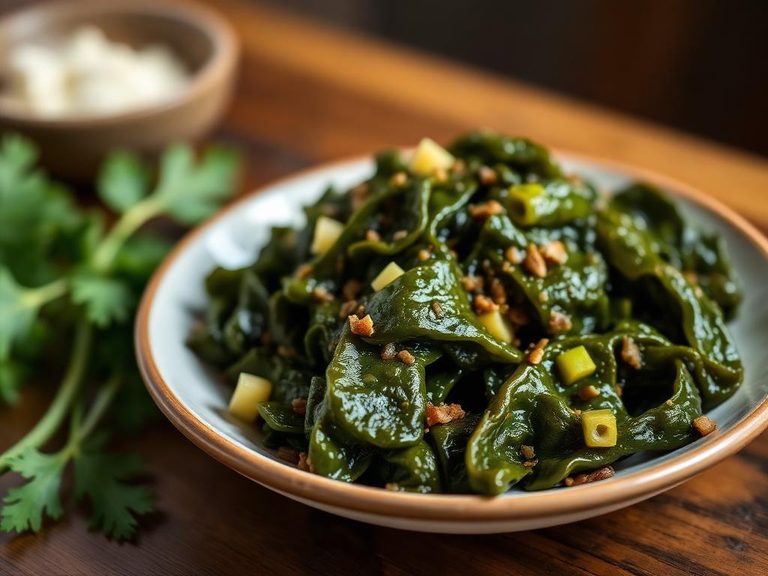
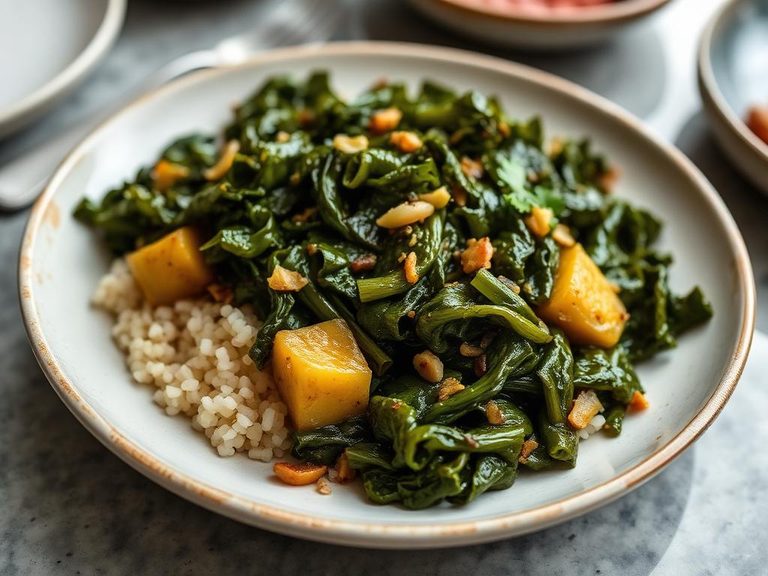
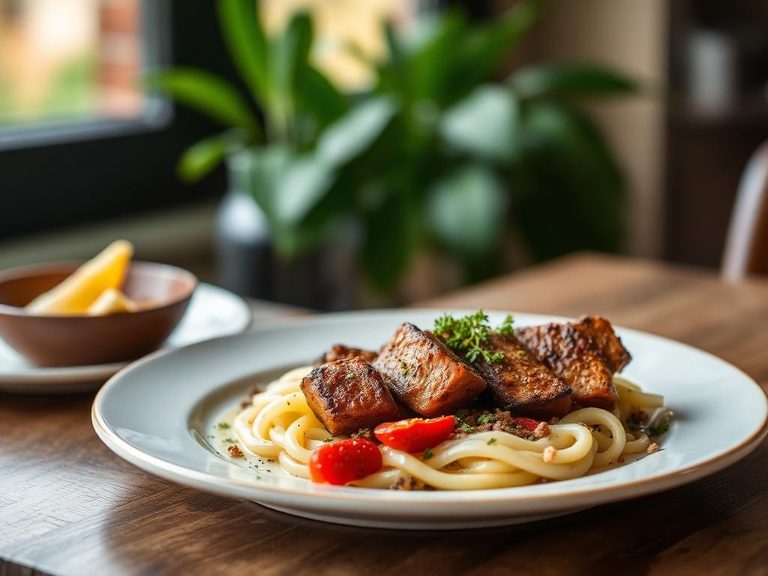
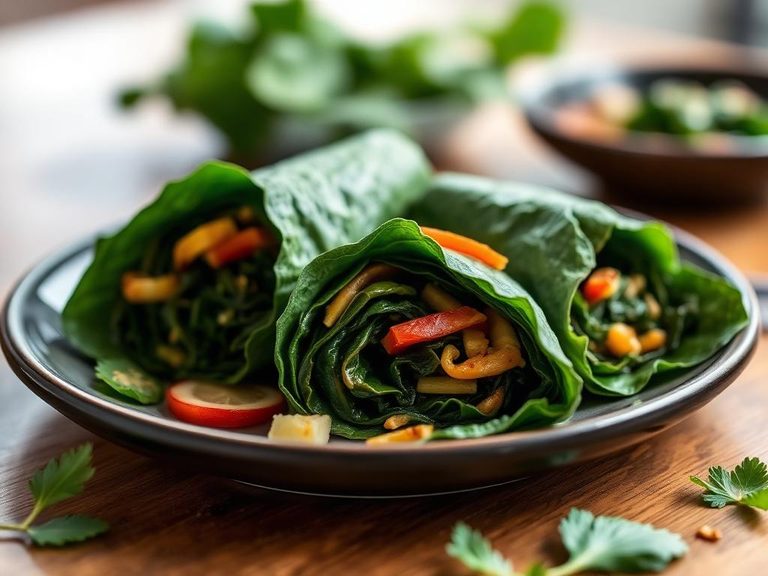
🌍 Where it's eaten
💡 Did you know?
Collard greens are one of the oldest members of the cabbage family, with records of their cultivation dating back to ancient Greece and Rome.
Full nutrition (USDA data · scales with serving)
| Water | 88.5 g |
| Energy | 36.0 kcal |
| Energy | 151 kj |
| Protein | 3.0 g |
| Total lipid (fat) | 0.41 g |
| Ash | 1.1 g |
| Carbohydrate, by difference | 7.1 g |
| Fiber, total dietary | 2.8 g |
| Total Sugars | 0.57 g |
| Calcium, Ca | 210 mg |
| Iron, Fe | 1.1 mg |
| Magnesium, Mg | 30.0 mg |
| Phosphorus, P | 27.0 mg |
| Potassium, K | 251 mg |
| Sodium, Na | 50.0 mg |
| Zinc, Zn | 0.27 mg |
| Copper, Cu | 0.06 mg |
| Manganese, Mn | 0.66 mg |
| Selenium, Se | 1.5 ug |
| Vitamin C, total ascorbic acid | 26.4 mg |
| Thiamin | 0.05 mg |
| Riboflavin | 0.12 mg |
| Niacin | 0.64 mg |
| Pantothenic acid | 0.12 mg |
| Vitamin B-6 | 0.11 mg |
| Folate, total | 76.0 ug |
| Folic acid | 0.00 ug |
| Folate, food | 76.0 ug |
| Folate, DFE | 76.0 ug |
| Choline, total | 45.1 mg |
| Betaine | 0.20 mg |
| Vitamin B-12 | 0.00 ug |
| Vitamin B-12, added | 0.00 ug |
| Vitamin A, RAE | 575 ug |
| Retinol | 0.00 ug |
| Carotene, beta | 6818 ug |
| Carotene, alpha | 127 ug |
| Cryptoxanthin, beta | 28.0 ug |
| Vitamin A, IU | 11493 iu |
| Lycopene | 0.00 ug |
| Lutein + zeaxanthin | 10898 ug |
| Vitamin E (alpha-tocopherol) | 1.3 mg |
| Vitamin E, added | 0.00 mg |
| Vitamin D (D2 + D3), International Units | 0.00 iu |
| Vitamin D (D2 + D3) | 0.00 ug |
| Vitamin K (phylloquinone) | 623 ug |
| Alcohol, ethyl | 0.00 g |
| Caffeine | 0.00 mg |
| Theobromine | 0.00 mg |
Fat & fatty acid profile (per 100g)
| Fatty acids, total saturated | 0.06 g |
| SFA 4:0 | 0.00 g |
| SFA 6:0 | 0.00 g |
| SFA 8:0 | 0.00 g |
| SFA 10:0 | 0.00 g |
| SFA 12:0 | 0.00 g |
| SFA 14:0 | 0.00 g |
| SFA 16:0 | 0.05 g |
| SFA 18:0 | 0.01 g |
| Fatty acids, total monounsaturated | 0.02 g |
| MUFA 16:1 | 0.01 g |
| MUFA 18:1 | 0.01 g |
| MUFA 20:1 | 0.00 g |
| MUFA 22:1 | 0.00 g |
| Fatty acids, total polyunsaturated | 0.21 g |
| PUFA 18:2 | 0.06 g |
| PUFA 18:3 | 0.13 g |
| PUFA 18:4 | 0.00 g |
| PUFA 20:4 | 0.00 g |
| PUFA 20:5 n-3 (EPA) | 0.00 g |
| PUFA 22:5 n-3 (DPA) | 0.00 g |
| PUFA 22:6 n-3 (DHA) | 0.00 g |
| Fatty acids, total trans | 0.00 g |
| Cholesterol | 0.00 mg |
Amino acid profile (per 100g)
| Tryptophan | 0.04 g |
| Threonine | 0.10 g |
| Isoleucine | 0.12 g |
| Leucine | 0.18 g |
| Lysine | 0.14 g |
| Methionine | 0.04 g |
| Cystine | 0.03 g |
| Phenylalanine | 0.10 g |
| Tyrosine | 0.08 g |
| Valine | 0.14 g |
| Arginine | 0.15 g |
| Histidine | 0.06 g |
| Alanine | 0.13 g |
| Aspartic acid | 0.23 g |
| Glutamic acid | 0.25 g |
| Glycine | 0.11 g |
| Proline | 0.13 g |
| Serine | 0.10 g |
FAQ
Why are my boiled collard greens bitter?
Bitterness comes from compounds like glucosinolates. To reduce it, ensure you use fresh, young leaves, discard tough stems, and cook them with a flavor-balancing agent like smoked turkey, a ham hock, or a tablespoon of apple cider vinegar or lemon juice.
Are frozen collard greens as nutritious as fresh?
Yes, often more so. Flash-freezing locks in nutrients at peak freshness. The boiling step for frozen greens can cause some loss of water-soluble vitamins (like vitamin C), but the minerals and fiber remain largely intact.
How do I keep boiled collard greens from getting mushy?
Avoid overcooking. For frozen, chopped greens, boiling for just 5-7 minutes until tender-crisp is usually sufficient. Immediately draining and rinsing with cold water (shocking) stops the cooking process.
Nutrient density (calculated · NRF9.3)
Nutrient Rich Foods index: beneficial nutrients (protein, fiber, vitamins, minerals) minus saturated fat, added sugar & sodium, per 100 kcal.
NRF9.3 index — Fulgoni, Keast & Drewnowski, 2009. Computed from USDA nutrients.
Weight-loss friendliness (composite index)
Energy density 0.36 kcal/g · 33% calories from protein · 2.8 g fiber · 0.6 g sugar per 100 g.
Composite of energy density (Rolls et al., 1999), protein & fiber satiety, minus sugar. A calculated heuristic — ranks satiety-per-calorie, not a clinical measure.
Dietary load (calculated from USDA values)
Potential renal acid load. Positive = acid-forming, negative = alkaline-forming.
Sodium-to-potassium ratio: 0.20 (lower is better — aim for ≤ 1)
Sodium:potassium per WHO potassium guidance. Computed from USDA nutrients.