

Candies, coconut bar, not chocolate covered
Whole food · Sweets

Photo: Wikipedia
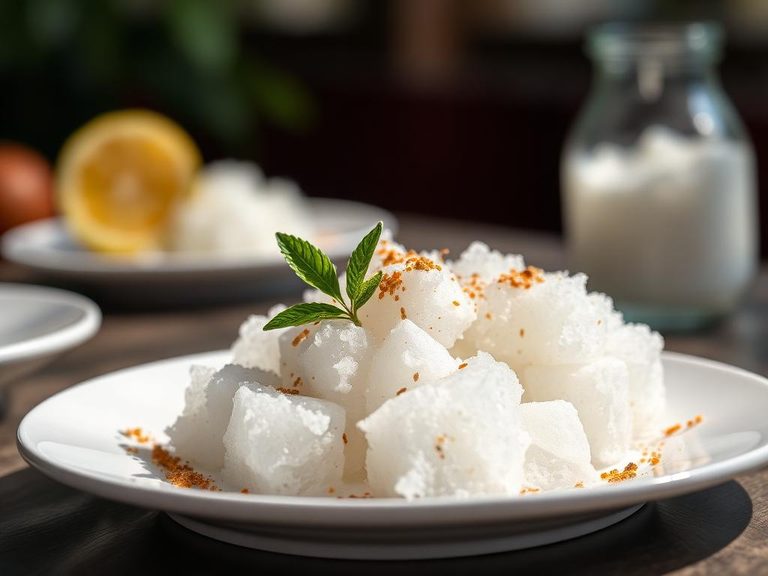
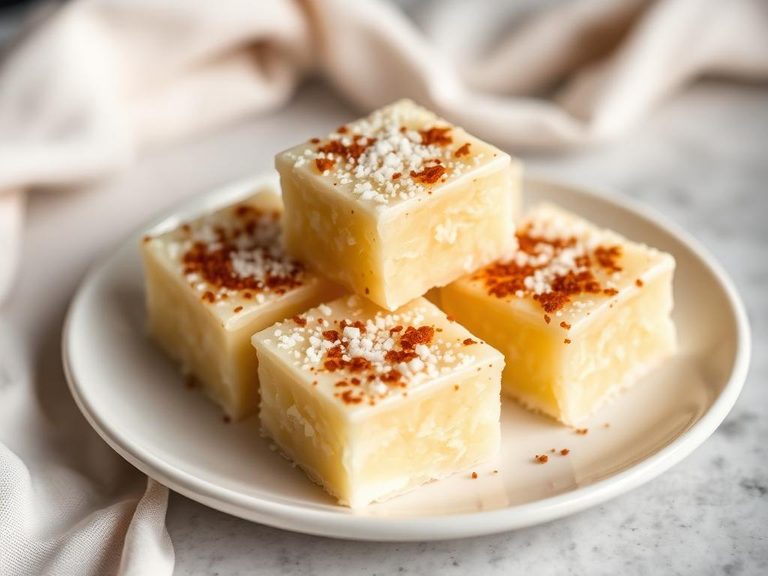
A dense, chewy bar made primarily from shredded coconut bound with sugar and often a fat like palm oil or butter. It offers a sweet, tropical coconut flavor with a satisfying, fibrous texture that can range from soft and fudgy to slightly crunchy. Nutritionally, it's a high-energy, high-fat, high-sugar treat with minimal protein.
Calorie split: 2% protein · 46% carbs · 52% fat
↓ Full nutrition💚 Why it's loved
People adore the intense, sweet coconut flavor and the uniquely satisfying chewy texture. It's a beloved nostalgic treat in many cultures and a versatile ingredient for no-bake desserts.
⚠️ Watch-outs & how to enjoy it better
Its high sugar and saturated fat content can contribute to blood-sugar spikes and is not ideal for frequent consumption. For those monitoring sugar intake, pair a small piece with a protein-rich food like nuts or enjoy it as an occasional dessert rather than a snack.
Key benefits
- Provides quick energy from carbohydrates
- Source of dietary fiber from coconut
- Contains medium-chain triglycerides (MCTs) from coconut
- Offers a convenient, portable sweet snack
- Can be a source of iron and manganese in small amounts
🍽️ Popular dishes
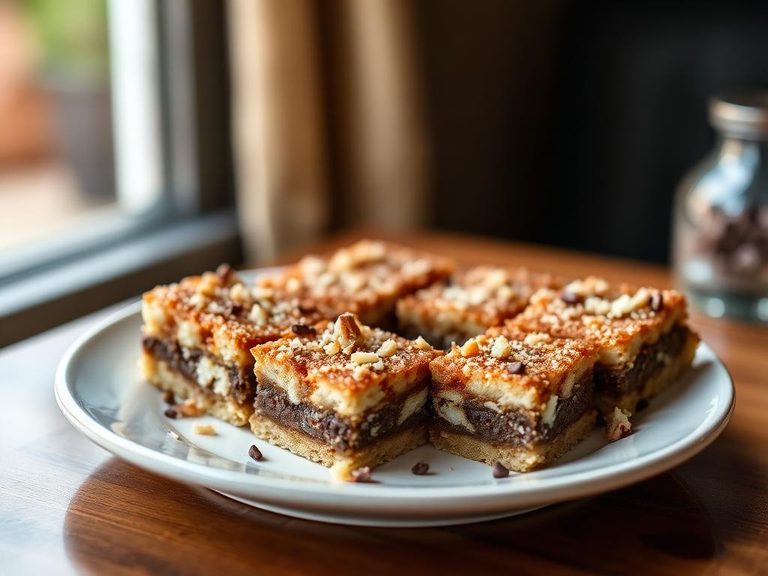
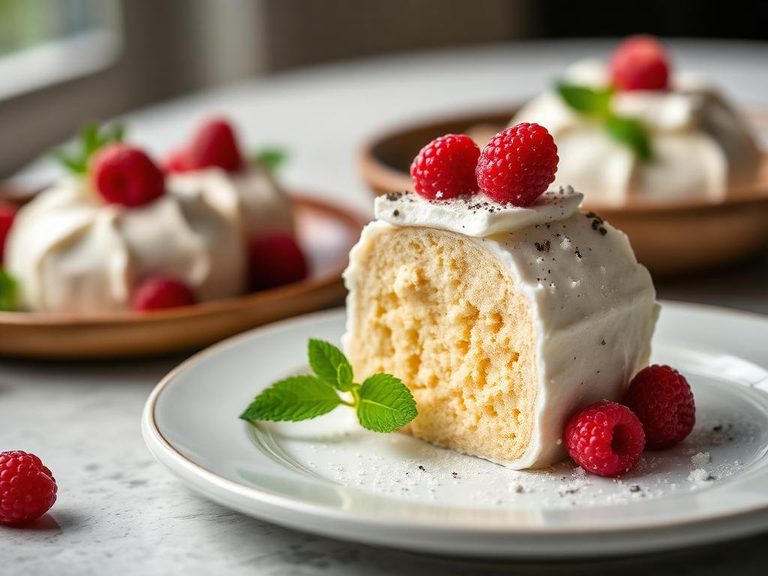
🌍 Where it's eaten
💡 Did you know?
The classic UK 'Coconut Ice' is traditionally a no-bake confection made by simply mixing desiccated coconut with condensed sugar syrup, setting it in a tray, and cutting it into squares.
Full nutrition (USDA data · scales with serving)
| Water | 13.3 g |
| Energy | 481 kcal |
| Energy | 2012 kj |
| Protein | 2.1 g |
| Total lipid (fat) | 27.6 g |
| Ash | 1.1 g |
| Carbohydrate, by difference | 55.9 g |
| Fiber, total dietary | 6.4 g |
| Total Sugars | 36.2 g |
| Calcium, Ca | 43.0 mg |
| Iron, Fe | 0.77 mg |
| Magnesium, Mg | 27.0 mg |
| Phosphorus, P | 93.0 mg |
| Potassium, K | 294 mg |
| Sodium, Na | 128 mg |
| Zinc, Zn | 1.0 mg |
| Copper, Cu | 0.36 mg |
| Manganese, Mn | 1.2 mg |
| Selenium, Se | 8.6 ug |
| Fluoride, F | 0.00 ug |
| Vitamin C, total ascorbic acid | 2.7 mg |
| Thiamin | 0.07 mg |
| Riboflavin | 0.02 mg |
| Niacin | 0.45 mg |
| Pantothenic acid | 0.25 mg |
| Vitamin B-6 | 0.04 mg |
| Folate, total | 22.0 ug |
| Folic acid | 0.00 ug |
| Folate, food | 22.0 ug |
| Folate, DFE | 22.0 ug |
| Choline, total | 10.0 mg |
| Betaine | 0.70 mg |
| Vitamin B-12 | 0.00 ug |
| Vitamin B-12, added | 0.00 ug |
| Vitamin A, RAE | 0.00 ug |
| Retinol | 0.00 ug |
| Carotene, beta | 0.00 ug |
| Carotene, alpha | 0.00 ug |
| Cryptoxanthin, beta | 0.00 ug |
| Vitamin A, IU | 0.00 iu |
| Lycopene | 0.00 ug |
| Lutein + zeaxanthin | 0.00 ug |
| Vitamin E (alpha-tocopherol) | 0.20 mg |
| Vitamin E, added | 0.00 mg |
| Tocopherol, beta | 0.00 mg |
| Tocopherol, gamma | 0.44 mg |
| Tocopherol, delta | 0.00 mg |
| Tocotrienol, alpha | 1.2 mg |
| Tocotrienol, beta | 0.00 mg |
| Vitamin D (D2 + D3), International Units | 0.00 iu |
| Vitamin D (D2 + D3) | 0.00 ug |
| Vitamin K (phylloquinone) | 0.10 ug |
| Alcohol, ethyl | 0.00 g |
| Caffeine | 0.00 mg |
| Theobromine | 0.00 mg |
Fat & fatty acid profile (per 100g)
| Fatty acids, total saturated | 25.5 g |
| SFA 4:0 | 0.00 g |
| SFA 6:0 | 0.16 g |
| SFA 8:0 | 2.0 g |
| SFA 10:0 | 1.6 g |
| SFA 12:0 | 12.8 g |
| SFA 14:0 | 5.0 g |
| SFA 16:0 | 2.4 g |
| SFA 18:0 | 1.5 g |
| Fatty acids, total monounsaturated | 0.33 g |
| MUFA 16:1 | 0.00 g |
| MUFA 18:1 | 0.33 g |
| MUFA 20:1 | 0.00 g |
| MUFA 22:1 | 0.00 g |
| Fatty acids, total polyunsaturated | 0.08 g |
| PUFA 18:2 | 0.08 g |
| PUFA 18:3 | 0.00 g |
| PUFA 18:4 | 0.00 g |
| PUFA 20:4 | 0.00 g |
| PUFA 20:5 n-3 (EPA) | 0.00 g |
| PUFA 22:5 n-3 (DPA) | 0.00 g |
| PUFA 22:6 n-3 (DHA) | 0.00 g |
| Cholesterol | 0.00 mg |
| Phytosterols | 39.0 mg |
Amino acid profile (per 100g)
Estimated from Candies, honey-combed, with peanut butter — USDA does not publish this profile for Candies.
| Tryptophan | 0.09 g |
| Threonine | 0.21 g |
| Isoleucine | 0.24 g |
| Leucine | 0.61 g |
| Lysine | 0.27 g |
| Methionine | 0.10 g |
| Cystine | 0.09 g |
| Phenylalanine | 0.47 g |
| Tyrosine | 0.33 g |
| Valine | 0.31 g |
| Arginine | 1.1 g |
| Histidine | 0.22 g |
| Alanine | 0.36 g |
| Aspartic acid | 1.2 g |
| Glutamic acid | 2.0 g |
| Glycine | 0.56 g |
| Proline | 0.55 g |
| Serine | 0.58 g |
FAQ
Is a coconut bar the same as a coconut macaroon?
No. A coconut bar is a dense, sweet confection made primarily of coconut and sugar. A coconut macaroon is a baked cookie or biscuit, often made with egg whites and sometimes flour, resulting in a lighter, crumbly texture.
Can I use this as an ingredient in other recipes?
Absolutely. It can be chopped and used as a topping for ice cream or yogurt, crumbled into cheesecake bases, or melted down (gently) to create a binding agent for homemade energy bites.
Why is the fat content so high?
Coconut itself is high in saturated fat, primarily lauric acid. The bar's recipe often includes additional fats like palm oil, butter, or coconut oil to achieve the desired rich, chewy texture.
Nutrient density (calculated · NRF9.3)
Nutrient Rich Foods index: beneficial nutrients (protein, fiber, vitamins, minerals) minus saturated fat, added sugar & sodium, per 100 kcal.
NRF9.3 index — Fulgoni, Keast & Drewnowski, 2009. Computed from USDA nutrients.
Weight-loss friendliness (composite index)
Energy density 4.81 kcal/g · 2% calories from protein · 6.4 g fiber · 36.2 g sugar per 100 g.
Composite of energy density (Rolls et al., 1999), protein & fiber satiety, minus sugar. A calculated heuristic — ranks satiety-per-calorie, not a clinical measure.
Dietary load (calculated from USDA values)
Potential renal acid load. Positive = acid-forming, negative = alkaline-forming.
Sodium-to-potassium ratio: 0.44 (lower is better — aim for ≤ 1)
Sodium:potassium per WHO potassium guidance. Computed from USDA nutrients.