

Beverages, tea, green, ready-to-drink, citrus, diet, fortified with vitamin C
Whole food · Beverages

Photo: Wikipedia
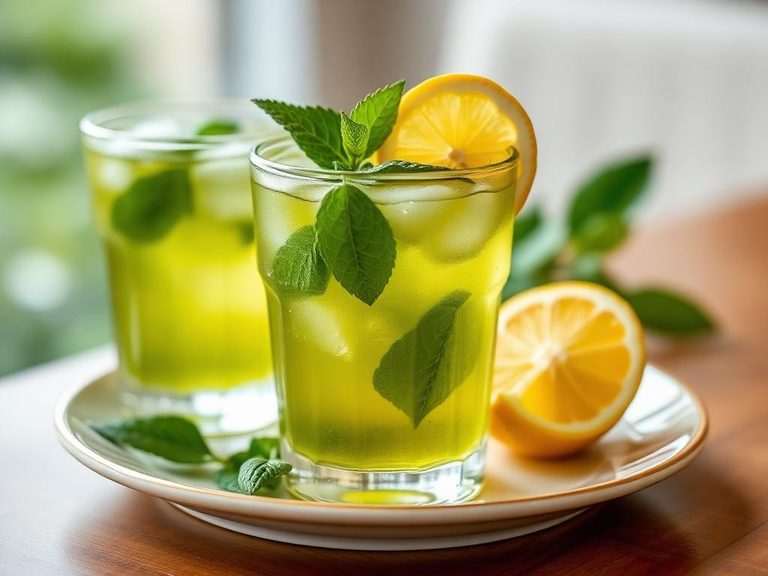
This is a crisp, zero-calorie ready-to-drink green tea, infused with bright citrus notes and fortified with vitamin C. It delivers a refreshing, slightly astringent tea flavor balanced by zesty lemon or orange, with a clean, watery texture. Its standout nutritional feature is being a near-zero calorie beverage that contributes to daily vitamin C intake.
Calorie split: 0% protein · 100% carbs · 0% fat
↓ Full nutrition💚 Why it's loved
People love it for its convenient, thirst-quenching blend of earthy green tea and bright citrus, making it a popular, healthier pick-me-up. It fits seamlessly into busy lifestyles as a portable, flavorful hydration option.
⚠️ Watch-outs & how to enjoy it better
The citric acid can be harsh on tooth enamel over time; rinsing your mouth with water after drinking can help mitigate this. Some versions may contain added sweeteners or sodium, so checking labels is wise for those monitoring intake.
Key benefits
- Virtually calorie-free, aiding weight management.
- Provides a source of antioxidant vitamin C.
- Offers hydration with functional flavor.
- Contains catechins from green tea.
- A convenient, no-prep alternative to sugary sodas.
🍽️ Popular dishes

🌍 Where it's eaten
💡 Did you know?
The 'ready-to-drink' category was pioneered in Japan in the 1980s, revolutionizing how tea was consumed globally by making it a chilled, grab-and-go commodity.
Full nutrition (USDA data · scales with serving)
| Water | 99.6 g |
| Energy | 1.0 kcal |
| Energy | 5.0 kj |
| Protein | 0.00 g |
| Total lipid (fat) | 0.00 g |
| Ash | 0.08 g |
| Carbohydrate, by difference | 0.31 g |
| Fiber, total dietary | 0.00 g |
| Total Sugars | 0.00 g |
| Sucrose | 0.00 g |
| Glucose | 0.00 g |
| Fructose | 0.00 g |
| Lactose | 0.00 g |
| Maltose | 0.00 g |
| Galactose | 0.00 g |
| Calcium, Ca | 1.0 mg |
| Iron, Fe | 0.00 mg |
| Magnesium, Mg | 0.00 mg |
| Phosphorus, P | 36.0 mg |
| Potassium, K | 13.0 mg |
| Sodium, Na | 26.0 mg |
| Zinc, Zn | 0.00 mg |
| Copper, Cu | 0.01 mg |
| Manganese, Mn | 0.08 mg |
| Selenium, Se | 0.00 ug |
| Vitamin C, total ascorbic acid | 39.3 mg |
| Thiamin | 0.00 mg |
| Riboflavin | 0.00 mg |
| Niacin | 0.00 mg |
| Vitamin B-6 | 0.00 mg |
| Folate, total | 0.00 ug |
| Folic acid | 0.00 ug |
| Folate, food | 0.00 ug |
| Folate, DFE | 0.00 ug |
| Choline, total | 0.00 mg |
| Vitamin B-12 | 0.00 ug |
| Vitamin B-12, added | 0.00 ug |
| Vitamin A, RAE | 0.00 ug |
| Retinol | 0.00 ug |
| Carotene, beta | 0.00 ug |
| Carotene, alpha | 0.00 ug |
| Cryptoxanthin, beta | 0.00 ug |
| Vitamin A, IU | 0.00 iu |
| Lycopene | 0.00 ug |
| Lutein + zeaxanthin | 0.00 ug |
| Vitamin E (alpha-tocopherol) | 0.00 mg |
| Vitamin E, added | 0.00 mg |
| Vitamin D (D2 + D3), International Units | 0.00 iu |
| Vitamin D (D2 + D3) | 0.00 ug |
| Vitamin K (phylloquinone) | 0.00 ug |
| Alcohol, ethyl | 0.00 g |
| Caffeine | 5.0 mg |
| Theobromine | 0.00 mg |
Fat & fatty acid profile (per 100g)
| Fatty acids, total saturated | 0.00 g |
| SFA 4:0 | 0.00 g |
| SFA 6:0 | 0.00 g |
| SFA 8:0 | 0.00 g |
| SFA 10:0 | 0.00 g |
| SFA 12:0 | 0.00 g |
| SFA 14:0 | 0.00 g |
| SFA 16:0 | 0.00 g |
| SFA 18:0 | 0.00 g |
| Fatty acids, total monounsaturated | 0.00 g |
| MUFA 16:1 | 0.00 g |
| MUFA 18:1 | 0.00 g |
| MUFA 20:1 | 0.00 g |
| MUFA 22:1 | 0.00 g |
| Fatty acids, total polyunsaturated | 0.00 g |
| PUFA 18:2 | 0.00 g |
| PUFA 18:3 | 0.00 g |
| PUFA 18:4 | 0.00 g |
| PUFA 20:4 | 0.00 g |
| PUFA 20:5 n-3 (EPA) | 0.00 g |
| PUFA 22:5 n-3 (DPA) | 0.00 g |
| PUFA 22:6 n-3 (DHA) | 0.00 g |
| Cholesterol | 0.00 mg |
Amino acid profile (per 100g)
Estimated from Beverages, carbonated, tonic water — USDA does not publish this profile for Beverages.
| Tryptophan | 0.00 g |
| Threonine | 0.00 g |
| Isoleucine | 0.00 g |
| Leucine | 0.00 g |
| Lysine | 0.00 g |
| Methionine | 0.00 g |
| Cystine | 0.00 g |
| Phenylalanine | 0.00 g |
| Tyrosine | 0.00 g |
| Valine | 0.00 g |
| Arginine | 0.00 g |
| Histidine | 0.00 g |
| Alanine | 0.00 g |
| Aspartic acid | 0.00 g |
| Glutamic acid | 0.00 g |
| Glycine | 0.00 g |
| Proline | 0.00 g |
| Serine | 0.00 g |
FAQ
Is this the same as brewed green tea?
Not exactly. RTD versions are brewed, then often filtered, pasteurized, and may have additives like citric acid and preservatives for shelf stability and flavor consistency.
Does the vitamin C change the taste?
Yes, it adds a tart, acidic note that brightens the tea's flavor profile and helps prevent the drink from developing a stale taste over time.
Can I use this in cooking?
Absolutely. It works well as a light poaching liquid for fish, a base for dressings, or to add a subtle tea-citrus note to sorbets and marinades.
Nutrient density (calculated · NRF9.3)
Nutrient Rich Foods index: beneficial nutrients (protein, fiber, vitamins, minerals) minus saturated fat, added sugar & sodium, per 100 kcal.
NRF9.3 index — Fulgoni, Keast & Drewnowski, 2009. Computed from USDA nutrients.
Weight-loss friendliness (composite index)
Energy density 0.01 kcal/g · 0% calories from protein · 0.0 g fiber · 0.0 g sugar per 100 g.
Composite of energy density (Rolls et al., 1999), protein & fiber satiety, minus sugar. A calculated heuristic — ranks satiety-per-calorie, not a clinical measure.
Dietary load (calculated from USDA values)
Potential renal acid load. Positive = acid-forming, negative = alkaline-forming.
Sodium-to-potassium ratio: 2.00 (lower is better — aim for ≤ 1)
Sodium:potassium per WHO potassium guidance. Computed from USDA nutrients.