

Beef, brisket, flat half, separable lean only, trimmed to 1/8" fat, choice, cooked, braised
Whole food · Beef Products

Photo: Wikipedia
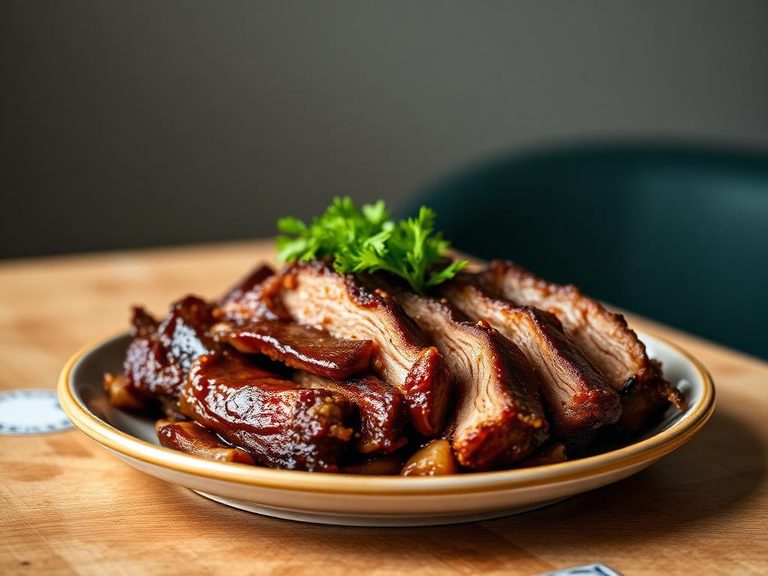
Braised beef brisket flat half is a lean, deeply savory cut that transforms from tough to tender through slow, moist cooking. Its texture is fine-grained and succulent, with a rich, beefy flavor that's mellowed by the braising liquid. Nutritionally, it's a powerhouse of protein with virtually no carbohydrates, making it a staple for high-protein diets.
Calorie split: 68% protein · 0% carbs · 32% fat
↓ Full nutrition💚 Why it's loved
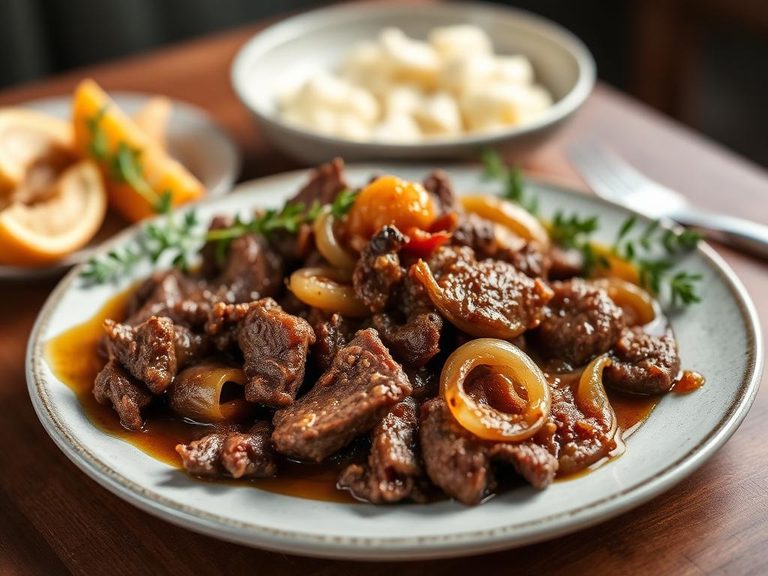
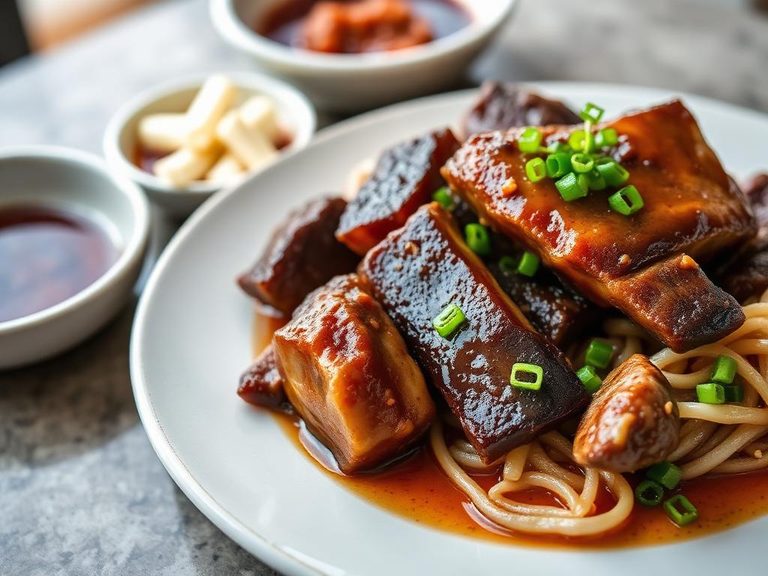
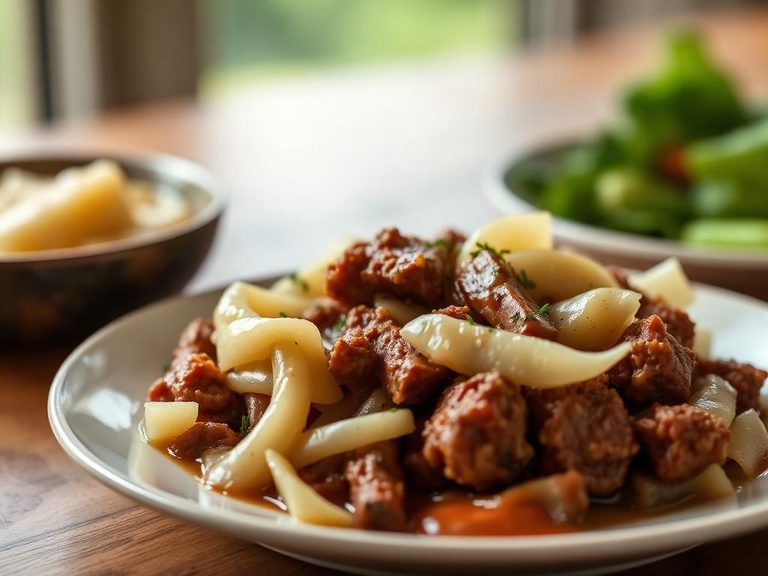
People love braised brisket for its melt-in-your-mouth tenderness and deep, savory flavor that develops over hours of cooking. It's a cultural centerpiece in many cuisines, symbolizing comfort and celebration, and its versatility allows it to be served sliced, shredded, or cubed in countless dishes.
⚠️ Watch-outs & how to enjoy it better
While lean, it can still be high in cholesterol and sodium depending on the braising liquid, which may concern those with heart health issues. To counteract, use low-sodium broths, limit added salt, and pair with fiber-rich vegetables to balance the meal. Also, ensure proper cooking to avoid toughness, as undercooked brisket can be chewy.
Key benefits
- Excellent source of high-quality protein for muscle maintenance.
- Very low in carbohydrates and sugars, suitable for keto and low-carb diets.
- Provides essential minerals like iron and zinc from red meat.
- Lean cut with minimal saturated fat when trimmed to 1/8 inch.
- Slow braising breaks down connective tissue, making it easy to digest.
🍽️ Popular dishes
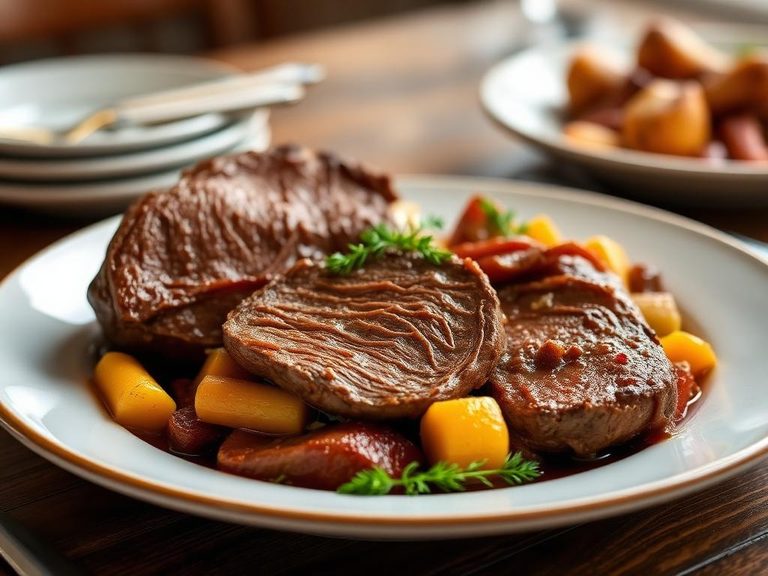
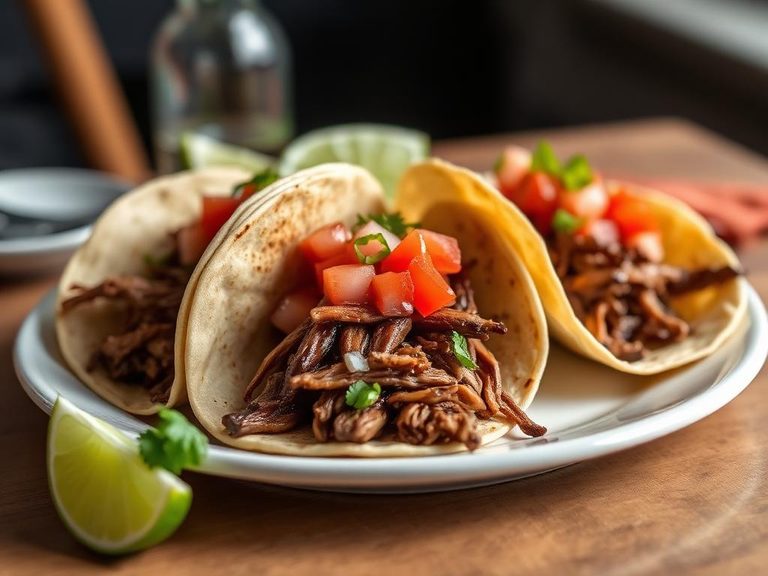
🌍 Where it's eaten
💡 Did you know?
Brisket is the cut of beef used to make pastrami, which is first brined, then smoked, and finally steamed to achieve its iconic texture and flavor.
Full nutrition (USDA data · scales with serving)
| Water | 59.8 g |
| Energy | 203 kcal |
| Energy | 848 kj |
| Protein | 33.1 g |
| Total lipid (fat) | 6.8 g |
| Ash | 1.1 g |
| Carbohydrate, by difference | 0.00 g |
| Fiber, total dietary | 0.00 g |
| Total Sugars | 0.00 g |
| Calcium, Ca | 14.0 mg |
| Iron, Fe | 2.9 mg |
| Magnesium, Mg | 22.0 mg |
| Phosphorus, P | 202 mg |
| Potassium, K | 261 mg |
| Sodium, Na | 53.0 mg |
| Zinc, Zn | 7.8 mg |
| Copper, Cu | 0.12 mg |
| Manganese, Mn | 0.01 mg |
| Selenium, Se | 32.9 ug |
| Vitamin C, total ascorbic acid | 0.00 mg |
| Thiamin | 0.07 mg |
| Riboflavin | 0.22 mg |
| Niacin | 5.0 mg |
| Pantothenic acid | 0.65 mg |
| Vitamin B-6 | 0.33 mg |
| Folate, total | 11.0 ug |
| Folic acid | 0.00 ug |
| Folate, food | 11.0 ug |
| Folate, DFE | 11.0 ug |
| Choline, total | 126 mg |
| Betaine | 16.6 mg |
| Vitamin B-12 | 2.6 ug |
| Vitamin B-12, added | 0.00 ug |
| Vitamin A, RAE | 0.00 ug |
| Retinol | 0.00 ug |
| Carotene, beta | 0.00 ug |
| Carotene, alpha | 0.00 ug |
| Cryptoxanthin, beta | 0.00 ug |
| Vitamin A, IU | 0.00 iu |
| Lycopene | 0.00 ug |
| Lutein + zeaxanthin | 0.00 ug |
| Vitamin E (alpha-tocopherol) | 0.50 mg |
| Vitamin E, added | 0.00 mg |
| Tocopherol, beta | 0.00 mg |
| Tocopherol, gamma | 0.00 mg |
| Tocopherol, delta | 0.00 mg |
| Vitamin K (phylloquinone) | 1.8 ug |
| Alcohol, ethyl | 0.00 g |
| Caffeine | 0.00 mg |
| Theobromine | 0.00 mg |
Fat & fatty acid profile (per 100g)
| Fatty acids, total saturated | 2.6 g |
| SFA 4:0 | 0.00 g |
| SFA 6:0 | 0.00 g |
| SFA 8:0 | 0.00 g |
| SFA 10:0 | 0.00 g |
| SFA 12:0 | 0.01 g |
| SFA 14:0 | 0.19 g |
| SFA 16:0 | 1.5 g |
| SFA 18:0 | 0.85 g |
| Fatty acids, total monounsaturated | 2.9 g |
| MUFA 16:1 | 0.24 g |
| MUFA 18:1 | 2.6 g |
| MUFA 20:1 | 0.00 g |
| MUFA 22:1 | 0.00 g |
| Fatty acids, total polyunsaturated | 0.23 g |
| PUFA 18:2 | 0.19 g |
| PUFA 18:3 | 0.02 g |
| PUFA 18:4 | 0.00 g |
| PUFA 20:4 | 0.03 g |
| PUFA 20:5 n-3 (EPA) | 0.00 g |
| PUFA 22:5 n-3 (DPA) | 0.00 g |
| PUFA 22:6 n-3 (DHA) | 0.00 g |
| Cholesterol | 97.0 mg |
Amino acid profile (per 100g)
| Tryptophan | 0.22 g |
| Threonine | 1.3 g |
| Isoleucine | 1.5 g |
| Leucine | 2.6 g |
| Lysine | 2.8 g |
| Methionine | 0.86 g |
| Cystine | 0.43 g |
| Phenylalanine | 1.3 g |
| Tyrosine | 1.1 g |
| Valine | 1.6 g |
| Arginine | 2.1 g |
| Histidine | 1.1 g |
| Alanine | 2.0 g |
| Aspartic acid | 3.0 g |
| Glutamic acid | 5.0 g |
| Glycine | 2.0 g |
| Proline | 1.6 g |
| Serine | 1.3 g |
| Hydroxyproline | 0.35 g |
FAQ
What is the difference between brisket flat and point?
The flat half is leaner and more uniform, ideal for slicing, while the point half is fattier and better for shredding or burnt ends.
How do I prevent brisket from drying out?
Braise it low and slow in liquid, cover tightly, and let it rest after cooking to retain juices.
Is braised brisket healthy?
Yes, it's high in protein and low in carbs, but watch sodium levels in the braising liquid and opt for lean trims.
Can I freeze braised brisket?
Yes, it freezes well for up to 3 months; slice or shred before freezing for easier reheating.
Nutrient density (calculated · NRF9.3)
Nutrient Rich Foods index: beneficial nutrients (protein, fiber, vitamins, minerals) minus saturated fat, added sugar & sodium, per 100 kcal.
NRF9.3 index — Fulgoni, Keast & Drewnowski, 2009. Computed from USDA nutrients.
Weight-loss friendliness (composite index)
Energy density 2.03 kcal/g · 65% calories from protein · 0.0 g fiber · 0.0 g sugar per 100 g.
Composite of energy density (Rolls et al., 1999), protein & fiber satiety, minus sugar. A calculated heuristic — ranks satiety-per-calorie, not a clinical measure.
Dietary load (calculated from USDA values)
Potential renal acid load. Positive = acid-forming, negative = alkaline-forming.
Sodium-to-potassium ratio: 0.20 (lower is better — aim for ≤ 1)
Sodium:potassium per WHO potassium guidance. Computed from USDA nutrients.